

Judge restricts travel of ICE protester charged with disrupting Minnesota church service
Terms of probation stemming from disorderly conduct charge raise questions about infringement of constitutional rights
A federal judge this week placed US army veteran and vocal ICE protester Ian Davis Austin on probation with restricted travel, a mandatory mental health assessment and the suspension of his access to firearms this week
Judge Douglas Micko granted most of the justice department’s request during a hearing in Saint Paul, Minnesota, on 22 July following a pending disorderly conduct charge stemming from protests outside Delaney Hall in Newark, New Jersey. The new conditions restrict Austin’s travel to Pennsylvania and Minnesota and come amid the Trump administration’s larger crackdown on protesters across the country
Austin is one of 39 defendants including journalist Don Lemon and Georgia Fort, charged under the Face Act following a protest that disrupted a Sunday service at Cities Church in Saint Paul on 18 January. The high-profile crackdown happened at the height of resistance efforts in the area against widespread immigration raids and the killings of two American citizens, Renee Good and Alex Pretti
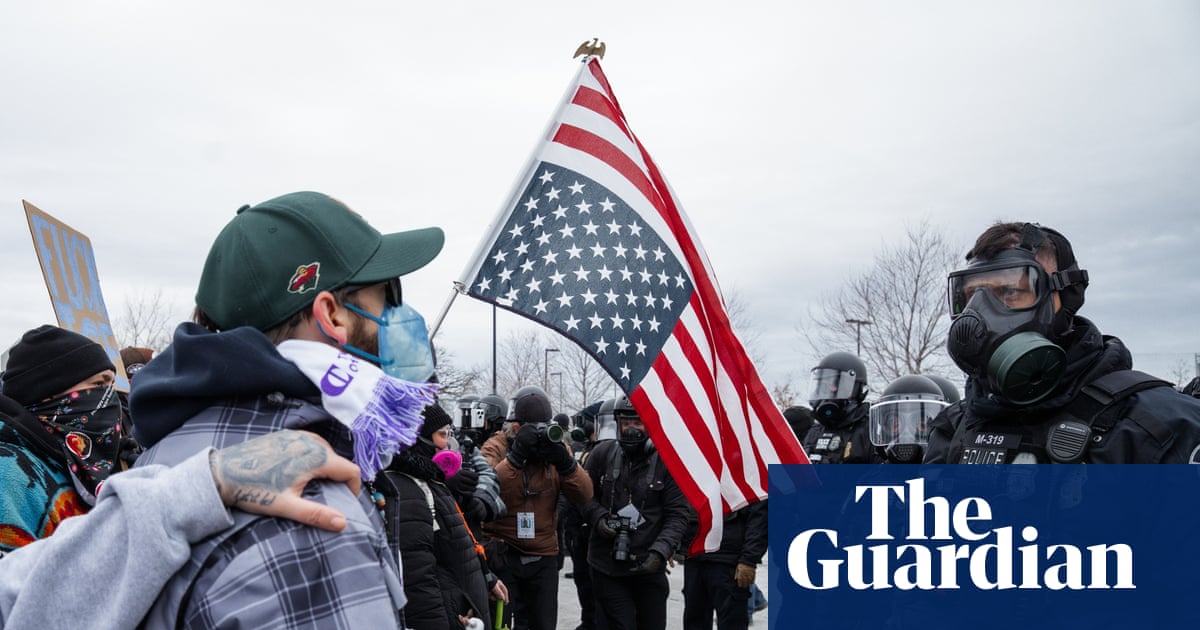
Austin had traveled to Newark, New Jersey, on Memorial Day weekend, when 300 people detained inside the Geo Group’s Delaney Hall detention facility staged a hunger strike, and was arrested twice during a violent clash between New Jersey state police and anti-ICE protesters. His endangering-another-person charge was dropped, but the disorderly conduct charge followed him to last Wednesday’s court hearing
“We now have presented material evidence that the conditions of release are no longer adequate,” US assistant attorney Neville Hedley told Micko at the hearing. “The current conditions of release don’t address public safety.”
Hedley submitted snippets of body camera footage from New Jersey authorities to the court. “One of the body cameras shows Mr Austin in the middle of a very busy intersection,” Hedley said before the gallery burst out in laughter. Hedley argued the footage showed “an inability to disengage” at ICE detention center protests. That footage wasn’t played in court
Austin’s attorney, Sarah Gad, pushed back, warning that the restrictions infringed on her client’s first amendment right to protest over what remains only a pending charge. “This is not a license for the government to throw a blanket slate of boilerplate conditions,” Gad told Micko
Austin’s plans to protest across the country are now on hold. “The government got exactly what they wanted. They’re wanting to silence us,” said Austin. “By confining me to Pennsylvania, they’re saying you’re not allowed to go and protest, you’re not allowed to go and participate, you’re not allowed to resist.”
Austin and Cities Church co-defendant William Kelly said they caught Hedley and US Attorney Robert Keenan smirking at them as they left the courtroom. “History will remember you as fascists,” Kelly said
Austin’s activism began in January when he traveled to Minnesota from Pennsylvania to protest against the Trump administration’s harsh immigration crackdown. Austin was first arrested on 16 January after protesting at the ICE detention center at the Whipple federal building near the Minneapolis-Saint Paul airport. The army veteran hadn’t locked his phone with a passcode, and federal agents seized the opportunity to unlock it
“They took my phone before they arrested me the first time and took me into the Whipple and took my phone and scanned my face,” said Austin. He was released without charges, but was arrested again as he continued to protest in the area, and then when he went to New Jersey’s Delaney Hall
Prosecutors successfully convinced Micko that Austin’s behavior in Newark was a danger to public safety. If it weren’t for travel restrictions, they say, Austin would be a danger to himself and others
Other defendants, however, raised concerns about how agents aggressively arrested them. Andrew Edwards said agents kicked down his door last winter, forcing him to appear in court half-naked. Satara Strong-Allen was tackled and slammed against a wall by federal agents who apparently mistook her for NekimaLevy Armstrong when she stepped out of her hotel room that morning
Monique Cullars-Doty, co-founder of Black Lives Matter Minnesota, questioned why standing in an intersection was treated as exceptional. “You know how many damn intersections I have stood in?” Cullars-Doty said. “They claim that there were four officers in this busy intersection. Like, why do you have four officers in an intersection?”
Some who know Austin argue the court-ordered mental health assessment stigmatizes people with behavioral health conditions. Austin has been in treatment for PTSD since serving six deployments to Afghanistan. Jules Langlois said Micko’s order amounted to using that diagnosis against him. “What we see here is the criminalization of mental health,” said Langlois
Explore more on these topicsShare
Reuse this content
