

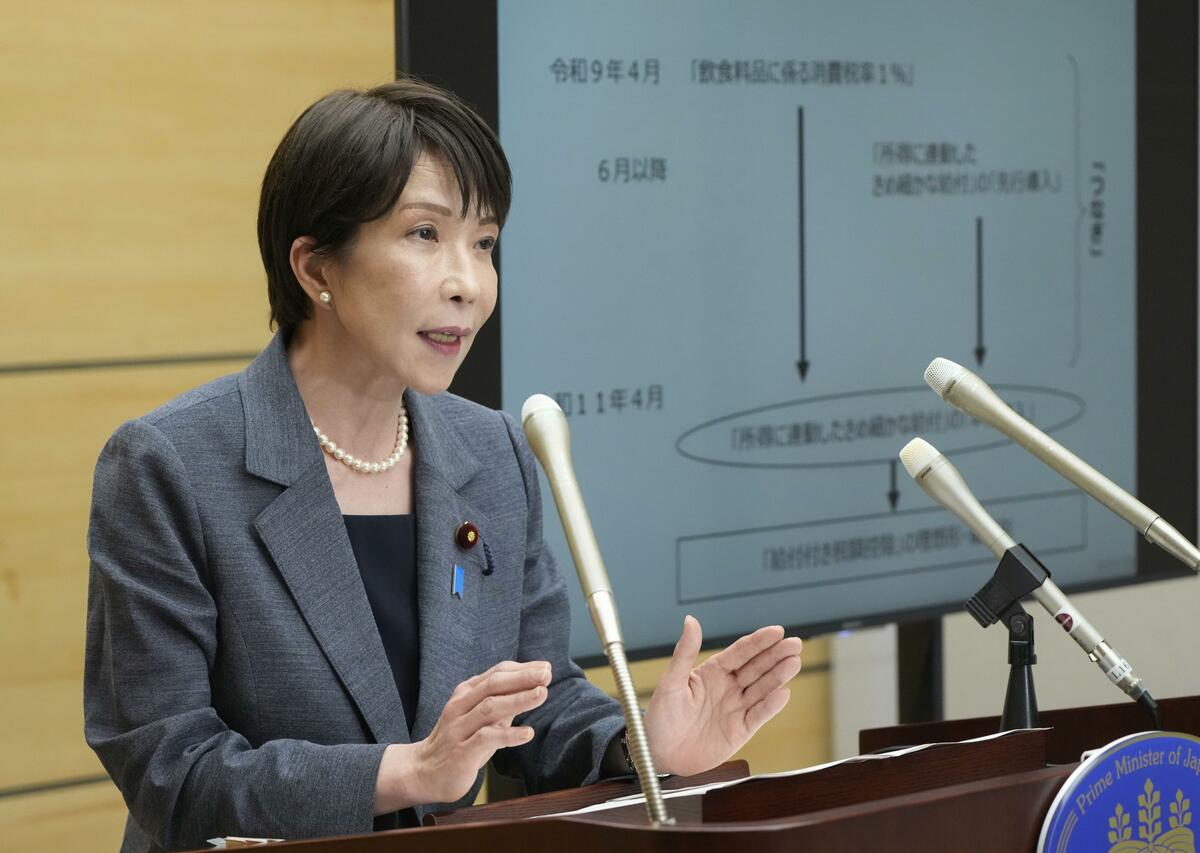
Prime Minister Sanae Takaichi said Thursday that Japan will cut the consumption tax rate on food and beverages to 1 percent from the current 8 percent for two years starting next April, marking the first reduction since the system was introduced in 1989
The tax cut will be coupled with cash handouts to low- and middle-income earners to “effectively reduce the tax burden to zero,” which is “the best option” to support households struggling with higher prices, Takaichi told a press briefing at her office
The plan was unveiled earlier in the day at a meeting of executives of the ruling Liberal Democratic Party led by Takaichi, who instructed senior LDP officials to secure the party’s endorsement and pave the way for Cabinet approval by early next month
Amid already high government bond yields and a weak yen, the tax cut could further fuel concerns over Japan’s fiscal health, as the measure would create a gaping hole in social security funding, with the loss of tax revenues reaching about 10 trillion yen ($61 billion) over two years
Takaichi, who is pursuing expansionary spending to spur economic growth, has yet to identify a specific revenuel secure the necessary funds through fiscal “reforms” and “without (issuing) deficit-covering bonds.”
Acknowledging that the consumption tax is a vitalfull responsibility for restoring the tax rate to its original level two years after (implementing the cut) to ensure fiscal sustainability and maintain market confidence.”
Takaichi’s tenure as LDP head, however, will expire in fall 2027, meaning it is uncertain whether she will remain prime minister in spring 2029
LDP Secretary General Shunichi Suzuki told reporters earlier Thursday that Takaichi explained her decision to party executives, who unanimously approved it. The party aims to have related bills approved during an extraordinary Diet session likely to be convened in the fall, he added
The LDP’s junior coalition ally, the Japan Innovation Party, also agreed to Takaichi’s tax cut plan and will cooperate on it when the two parties’ senior officials hold talks, JIP Secretary General Hiroshi Nakatsuka told reporters
Meanwhile, some LDP members openly expressed their opposition. Former Foreign Minister Taro Kono told reporters that there is “no guarantee” the planned tax reduction will lead to lower food prices and that they could “spike significantly” when the tax rate is restored to its original level two years later
Yuko Obuchi, former LDP election strategy chief, has resigned as a senior member of an informal meeting under the LDP’s research commission on the tax system in protest at the tax cut plan
She is known for emphasizing fiscal discipline. Her father, the late Prime Minister Keizo Obuchi, served as chief Cabinet secretary under Prime Minister Noboru Takeshita, whose government introduced Japan’s 3 percent consumption tax 37 years ago
The LDP, led by Takaichi, scored a landslide victory in the House of Representatives election in February on pledges that included rapid consideration of slashing the consumption tax rate on food and beverage products to zero for two years. The JIP and many opposition parties made similar promises at that time amid elevated prices
But the ruling parties decided to change course and seek a cut to 1 percent after learning at a cross-party meeting about taxation and social security that adjusting retailers’ cash register systems to a zero rate would require more time
To fulfill the campaign pledge of a zero tax, cash handouts to low- to middle-income households would total 600 billion yen annually, which is equivalent to the revenue from a 1 percent tax rate on food and beverage items
With opposition parties arguing that a de facto tax rate hike eventually awaits the public because the cut is a temporary measure, the cross-party meeting, called the national council on social security, failed to reach a consensus following monthslong discussions, leaving it up to the prime minister to decide
While Takaichi has vowed to reinstate the tax rate after two years, which may mean April 2029, it could become a politically risky move given that a House of Councillors election is slated for the summer of 2028
The ruling bloc refers to the two-year tax cut scheme as a “transitional measure” until the new income-linked relief program for lower-income workers is introduced in fiscal 2029. The program was approved during the cross-party talks
Japan’s consumption tax rate has gradually increased, mainly to finance mounting social security costs as the population rapidly ages. The rate started at 3 percent, increased to 5 percent in 1997, and rose to 8 percent in 2014
Since 2019, the rate has been set at 10 percent, but a reduced rate of 8 percent has been applied to food and beverage sales, excluding alcoholic beverages and dining out
Related coverage:
