

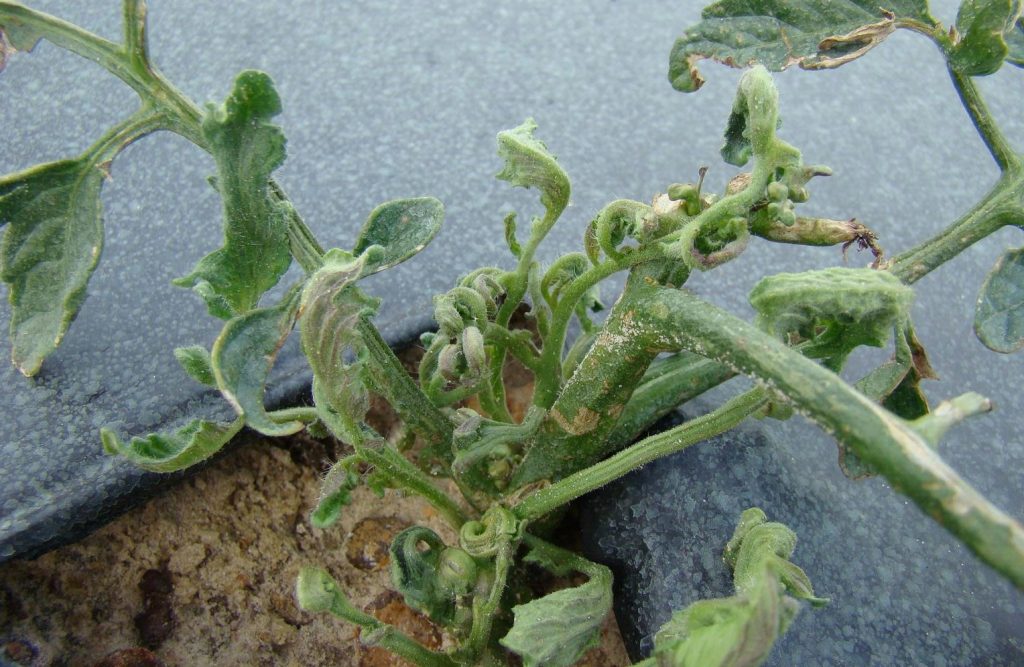
Most home gardeners know to watch for insect damage, diseases, and weather-related plant stress. But a new threat may be responsible for damaging plant leaves and contaminating your produce: herbicide residue.
“Herbicide injury occurs when a broadleaf herbicide that is normally used to control troublesome weeds accidentally damages desirable plants, such as vegetables in a garden or ornamental trees, shrubs, or flowers,” said Jeffrey Derr, director of the Hampton Roads Agricultural Research and Extension Center and a weed management Extension specialist. “This can happen when someone applies an herbicide to their lawn on a windy day and the spray droplets are blown onto other plants, or if someone applies hay, manure, or compost that contains broadleaf herbicide residue to their garden.”
Herbicide injury causes twisted stems, distorted leaves, and leaf cupping, as well as stunted growth, poor flowering, and reduced yields. Tomatoes, peppers, beans, lettuce, grapes, and roses are among the plants most susceptible to damage
To avoid herbicide injury, Derr recommends these strategies:
- When purchasing hay, manure, or compost, ask the farmer if any broadleaf herbicides were applied to the pasture.
- If broadleaf herbicides were applied, ask which product was used and when it was applied. Your local Virginia Cooperative Extension office can help determine if enough time has elapsed to make that product safe to use in your garden.
- If you have recently treated your lawn for broadleaf weeds, don’t compost those grass clippings or otherwise apply them to your garden. It is best to return these clippings to the lawn.
- Always follow label instructions when applying herbicides in your own landscape. For information on home use of herbicides and pesticides, see the Virginia Cooperative Extension publication “An Introduction to Integrated Pest Management.”
“These broadleaf herbicides are approved by the EPA to control weeds, and when applied properly, they are an important tool for growers and homeowners to manage weeds such as poison ivy in the landscape,” Derr said. “Unfortunately, there is a potential for non-target plant damage if they are not applied properly or if they are present in manure, compost, hay, or straw used in a garden.”
While some herbicides break down relatively quickly, others can remain active for months and in some cases, more than a year. Certain herbicides used to control broadleaf weeds in pastures also can pass through livestock digestive systems and remain active in manure
“Unfortunately, if your vegetable garden has been damaged by lawn or pasture herbicides, we recommend that you not consume any of that produce,” Derr said. “While these products are approved for use to treat troublesome weeds, they are not approved for use on edible crops like tomatoes, and that produce should be tossed out.”
For more information on herbicide injury, see the Extension publication “Plant Injury from Herbicide Residue.”For information on managing drift, see “Pesticide Drift Series: Using Buffers to Reduce the Impact of Spray Drift.” Because other issues — including broad mite damage — can appear similar, gardeners who are unsure of the cause should contact their local Extension office for help with identification
About Derr
Jeffrey Derr is director of the Hampton Roads Agricultural Research and Extension Center and a weed management Extension specialist
Interview
To schedule an interview, email mediarelations@vt.edu
Contacts:
Virginia Tech Media Relations
Tom Soladay
540-232-2501
