

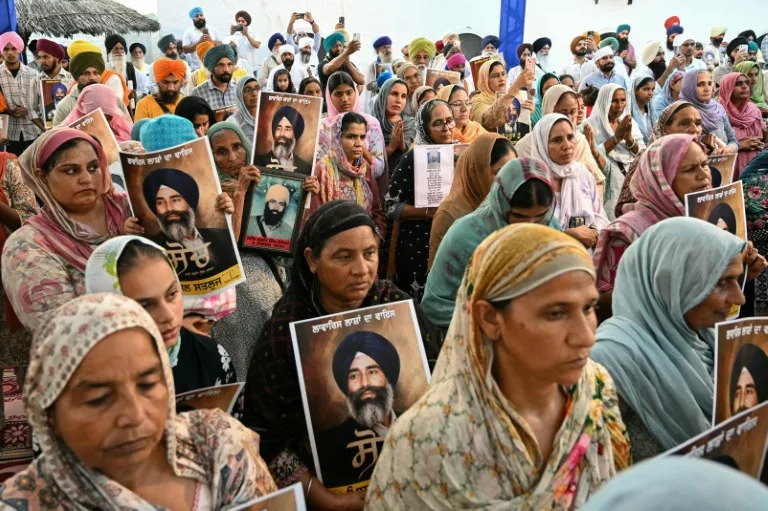
At a Sikh temple in India’s Punjab state, a crowd gathered to watch a film that has drawn authorities’ ire, recounting the horrors surrounding a separatist insurgency in the 1980s-90s
The film, “Satluj”, tells the story of Jaswant Singh Khalra, a rights activist allegedly tortured and killed by police in 1995 after having investigated thousands of cases of disappearances and presumed extrajudicial killings during a brutal government crackdown in the state
Viewers showed up for a screening in the temple courtyard in Gurdaspur district even as officials have accused director Honey Trehan of distorting history, and after the film was taken down from online platforms within 48 hours of its release
Advertisement
Advertisement
For some in the crowd, it was an act of defiance, seeking to preserve the memory of what many regard as one of the darkest chapters in Punjab’s history
“It has shown us all that we didn’t know, and which our government wants to keep hidden,” Shamsher Singh, 32, told AFP after his second time watching “Satluj”
While authorities have not officially announced any actions against the film or its distribution, a rumoured ban has sparked anger
“The government bans anything that is good,” said Singh
But the alleged restrictions have also fuelled an interest in watching the film, with Sikh groups hosting screenings in temple courtyards, community halls and village squares across Punjab
Advertisement
Advertisement
“We’ve been organising at least five such screenings each evening,” said Inderpal Singh Bains, a farmer leader who is behind the Gurdaspur temple event
“Such is the craze that we have a long waitlist, with many villages still waiting” for a screening, he said
– Disappeared without a trace –
Punjab state in the 1980s and early 1990s was a violent battleground between Indian authorities and armed backers of “Khalistan”, a conservative separatist movement that sought an independent homeland for the Sikh community
Thousands of civilians, police and militants were killed as security forces battled separatists, who enforced strict religious codes and targeted political opponents, according to rights groups
Advertisement
Advertisement
In 1984, the Indian army carried out a raid against insurgents hiding in the Golden Temple in Amritsar — the holiest site in Sikhism — sparking anger among faithful
The prime minister at the time, Indira Gandhi, was then killed by her Sikh bodyguards, leading to mass riots which killed some 3,000 people
For Harjinder Kaur, whose separatist father was killed in fighting in 1991, the film is a painful reminder of the open wounds in her family history
Kaur’s mother and two uncles are believed to have been arrested two years after her father’s death, and have not been seen again since
“My father, of course, paid for his actions, but I am pained for my uncles and mother who had no fault,” she told AFP, their fate unclear despite police saying they would be released
Advertisement
Advertisement
According to figures presented in “Satluj”, an estimated 25,000 people were abducted and killed during the unrest
The film shines a light on such incidents, following activist Khalra’s investigation before his own abduction
But critics say it offers a selective retelling of history
Ravneet Singh Bittu, from the ruling Bharatiya Janata Party of Hindu nationalist Prime Minister Narendra Modi, argued that “‘Satluj’ cannot hide behind the excuse of ‘creative freedom’ while presenting disputed claims as established history”
“Punjab’s painful past is not a script to be selectively edited to suit a narrative,” said Bittu, whose grandfather Beant Singh was Punjab’s chief minister before being assassinated in 1995
Advertisement
Advertisement
Trehan, the director, told AFP that his film “depicted the truth”, adding that he had received overwhelming “love and appreciation” for it
He cited speeches by Khalra himself “talking about 25,000 people who were abducted and killed”
Rajiv Singh Randhawa, a key witness in Khalra’s abduction case, said criticism of “Satluj” was overblown
“One movie can’t threaten the state or an individual,” he told AFP at his home in Amritsar, adding that “the ban has already taken Khalra’s story to millions” of viewers
bb/abh/ane/ami
