

- Jonathon Brooksstarts for theCarolina Panthers: Brooks’ ADP is rapidly climbing, and his usage in Week 1 of the preseason won’t stop that trend.
- TheMiami Dolphinshave their wide receivers:Caleb Douglas andMalik Washington appear to be the top wide receivers on the Dolphins‘ depth chart.
- Last Chance! The PFF Early Bird Sale Ends Aug. 17: Save 33% and get PFF+ for just $79.99, our lowest price of the year.

Nathan Jahnke’s fantasy football reactions focus on player usage and stats, breaking down all the vital information you need to achieve fantasy success in 2026. Here, we touch on only players who are relevant in fantasy football leagues
These are my 10 biggest reactions to the games from the last four days. To get a more in-depth breakdown, check out my complete preseason Week 1 recap
There are only a few days left to take advantage of the PFF Early Bird Sale. Use code earlybird by Aug. 17 to save $40 on a PFF+ annual subscription and get all the data, tools and expert insights you need for fantasy draft season and beyond
Jonathon Brooksstarts for Carolina: Brooks played in his first NFL game since December 2024
Carolina moved on fromRico Dowdle this offseason, knowing Brooks would return to joinChuba Hubbard andTrevor Etienne in the Panthers’ backfield. Hubbard entered training camp as the starter, but there has been plenty of speculation that Brooks could eventually take over the job if he plays well enough, particularly given that Hubbard has lost playing time to other backs in the past
Brooks’ ADP began to skyrocket after Hubbard was declaredweek-to-week with a hamstring injury. The initial expectation was that Brooks could take over at some point during the season, but Hubbard’s injury has created a path for Brooks to potentially start as early as Week 1. His usage with the starters in this game was nearly ideal, as he played in every situation except third-and-long, when Etienne took over. Once Carolina turned to its backups, Brooks’ day was done, and Etienne became the every-down back.
Carolina’s decision to use Brooks on early downs and in short-yardage situations offers a strong indication of how he could be deployed during the regular season. Hubbard has played in all situations throughout his career, so a two-man backfield could push more of his work toward passing downs while Brooks handles the bulk of the rushing opportunities. That type of split would likely make Brooks the more valuable fantasy back of the two
Brooks may no longer qualify as a clear value in fantasy drafts given his rapidly rising ADP, but his potential workload gives him a legitimate chance to spend much of the season as a fantasy starter
Jeremiyah Lovemakes his NFL debut: Love played 16 of 22 snaps over two drives
Arizona drafted Love third overall but also signed free agentTyler Allgeier in free agency. Allgeier was listed first on the unofficial depth chart, and head coach Mike LaFleur has made it clear hedoesn’t want to overwork one running back, preferring to keep his backs fresh. This has raised concerns about whether Love will get as much playing time as a typical early first-round running back
Love started this game, suggesting he is already ahead of Allgeier on the depth chart. He took each of the first six snaps before Allgeier replaced him and ran the ball on three straight plays. Love then returned to finish the first drive. Arizona took out most of its starters after the opening drive, but both running backs continued to play. Love dominated the snaps on the second drive, eight to three. Love continued playing for a third drive, while Allgeier’s day was done after two. Love played eight of 10 snaps on that drive, whileBam Knight played the other two.
The fact that Love started despite the unofficial depth chart was encouraging. He played 75% of the offensive snaps over the first three drives, which is on the high end of the typical snap-rate range for a starting running back. However, it would have been nice to see Love pulled from the game at the same time as Allgeier — or, better yet, at the same time as the other starters. For a coach who doesn’t want to overwork his running backs, it was surprising to see him give Love 14 touches in a preseason game.
Allgeier may cut into Love’s playing time a little more in the regular season — Arizona simply might have wanted to give its rookie an extended first look at the NFL game. If anything, this game should help Love’s ADP rather than hurt it
The Giants’ committee at running back:Cam Skattebo,Tyrone Tracy andDevin Singletary all received work with the starters
New York retained the same top three running backs from last season despite bringing in a new coaching staff. While many expected Skattebo to emerge as the clear lead back, head coach John Harbaugh and offensive coordinator Matt Nagy have long histories of utilizing committees at the position. That uncertainty was reflected on the Giants’ first unofficial depth chart, where both Skattebo and Tracywere listed as starters
Skattebo started the game and played the first two snaps before Tracy took over on third down and remained on the field for the final four plays of the drive. Singletary opened the second drive with the starters, followed by Tracy and then Skattebo, with all three rotating heavily for the remainder of the drive. The one consistent trend was Skattebo coming off the field on third downs, but he still played only five of 12 early-down snaps
Skattebo is returning from a season-ending injury, and a new coaching staff has reason to give all three backs opportunities during the preseason. There is still plenty of time for him to establish himself as the clear lead option on early downs. However, there is also a chance Skattebo won’t be fully back to form this season, and this rotation raises the possibility that none of the three backs will consistently play more than 50% of the offensive snaps. That uncertainty makes Skattebo difficult to justify at his current ADP, particularly when other players in the same range have more secure roles in their offenses.
Tyjae Spearsout-snapsTony Pollard: The running back rotation in this game suggests the Titans could be moving closer to a 50-50 split after two seasons of Pollard leading the backfield
Pollard and Spears have shared the Titans’ backfield for the past two seasons. Last season, when both were healthy, Pollard played roughly 70% of the early-down snaps, while Spears handled roughly 80% of the third-down and two-minute-drill snaps. The two split short-yardage and goal-line situations. They remain the top two running backs on the depth chart this season, but they are now playing under a new coaching staff. New offensive coordinator Brian Daboll has typically utilized a running back rotation outside of his time with a healthySaquon Barkley.
Pollard started this game and played six snaps on the first drive, while Spears played five. Spears then took all five snaps on the second drive before the two split the third drive with three snaps apiece. There was no clear early-down or third-down back as there has been in the past. Both running backs recorded four carries, with Spears breaking off a 25-yard run and Pollard scoring a touchdown
Teams don’t always rotate their running backs the same way in the preseason as they do in the regular season, so Pollard could still lean more toward early-down work and Spears toward third downs. Still, the frequency with which they rotated — combined with both leaving the game at the same time — suggests this backfield could be much closer to a 50-50 split than it has been in past seasons. Spears’ consensus ADP is 92 picks later than Pollard’s, but based on this game, the gap between the two should be considerably smaller.
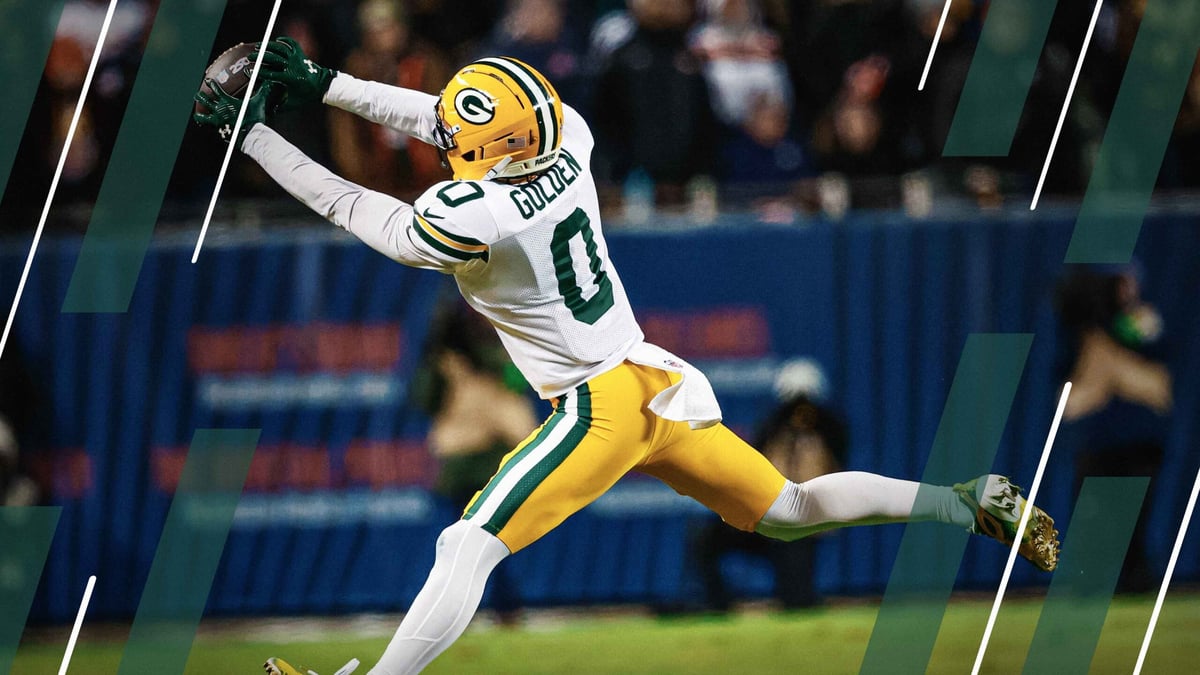
Matthew Goldenplays in 12 personnel: Golden took both snaps out of 12 personnel with the starters overJayden Reed
Green Bay had a crowded receiver room when everyone was healthy last season, withChristian Watson,Romeo Doubs,Dontayvion Wicks and Golden typically working outside. Reed has spent his entire career in the slot in 11 personnel, rarely taking snaps in other groupings. Doubs signed with theNew England Patriots, and Wicks was traded to thePhiladelphia Eagles, and thePackers made no significant additions this offseason, instead lettingSavion Williams andBo Melton move up the depth chart. That led to speculation Reed could see more work in 12 personnel, or even start over Golden.
The starters played one drive and largely stuck with 11 personnel, with Watson and Golden outside and Reed in the slot. The Packers ran only two snaps of 12 personnel, and Reed was off the field for both. Williams took one snap with the first unit, replacing Watson in 11 personnel rather than appearing in the heavier grouping. That makes Reed unlikely to be the primary receiver in 12, which caps his ceiling, though it doesn’t rule out more of those snaps than usual. Watson and Golden should both play more than they have in the past, but neither is likely to hold above 90% of the offensive snaps, which leaves Reed in position to be the first man off the bench for either.
Starting in 12 personnel helps Golden’s fantasy ceiling. He is likely fourth in the target order behind Watson, Reed and tight endTucker Kraft, but there is room to climb if he plays well
First look at the Browns’ wide receiver rotation: RookiesKC Concepcion andDenzel Boston have already worked their way into the starting lineup
The Browns had the lowest-graded wide receiver unit last season, prompting the team to spend two early draft picks at the position. Boston was alreadynamed a starter earlier in the week, while Concepcion was also listed with the first team on Cleveland’sunofficial depth chart. They joinedJerry Jeudy on the first two drives. As expected, Boston lined up at X, Jeudy at Z and Concepcion in the slot
Concepcion primarily played in 11 personnel, but he also took one snap in place of Jeudy in 12 personnel with the starters. Jeudy left after two drives, while Boston and Concepcion remained in the game.Isaiah Bond replaced Jeudy, and the three receivers rotated in 12 personnel. Cleveland’s willingness to use Concepcion in two-receiver sets is encouraging, as it gives him a path to more playing time than a typical slot receiver. If he plays well enough, he could eventually take a larger share of those snaps from Jeudy.
The later rotation also reinforced Bond’s standing as the top backup. He primarily played in the slot as a rookie but lined up outside throughout this game. If any of Cleveland’s top three wide receivers miss time this season, Bond appears most likely to see a significant increase in snaps
Boston and Concepcion are both intriguing mid-round fantasy picks. Their ADPs are unlikely to move much based on this game, however, as their usage largely confirmed expectations entering the preseason
Omar Cooper Jr.doesn’t play with the starters: New York’s rookie wide receiver appears to be fourth on the depth chart
New York’s wide receiver room was in constant flux last season, particularly afterGarrett Wilson suffered a season-ending injury. The Jets’ primary additions at the position this offseason were Cooper through the draft and veteranTim Patrick in free agency. The Jets opened this game with Wilson andAdonai Mitchell as their top two wide receivers, which has been the expectation throughout OTAs and training camp. Mitchell was already worth a late-round pick before this game, and his usage on the opening drive further solidified his role.
Isaiah Williams served as New York’s slot receiver in 11 personnel. Williams has been astandout during training camp and is expected to maintain a role in the offense during the regular season. Wilson, Mitchell and Williams all left the game after the first drive. Cooper took over in the slot on the second drive, with Patrick and undrafted rookie Malik McClain lining up outside. Notably, Cooper remained on the field in 12 personnel
Even if Cooper eventually overtakes Williams as the primary slot receiver, it will be difficult for him to earn enough playing time to become a reliable fantasy option. He remains a late-round possibility, but several wide receivers being drafted after him have clearer paths to significant playing time this season
The Dolphins have their wide receivers:Caleb Douglas andMalik Washington were the clear top two wide receivers with the starters
Miami moved on from longtime wide receiversTyreek Hill andJaylen Waddle this offseason. Washington was the primary holdover, while the Dolphins added free agentsJalen Tolbert andTutu Atwell and drafted Douglas,Chris Bell and Kevin Coleman. Two months ago, the competition appeared wide open
Since then, Douglas and Washington have received the most praise throughout training camp. Miami’s starters played one long drive and utilized a variety of personnel groupings. Douglas and Washington played 100% of the snaps in 11, 12 and 21 personnel, while Douglas also played both snaps in 22 personnel. Washington’s usage was particularly noteworthy because he played 93.4% of Miami’s 11-personnel snaps last season but only 37.6% of the snaps in two-receiver sets, often competing withNick Westbrook-Ikhine andCedrick Wilson Jr. in those groupings.
It was surprising to seeJalen Reagor serve as the third wide receiver in 11 personnel. The former first-round pick spent his first two seasons with thePhiladelphia Eagles before bouncing between three teams over the next three seasons, recording single-digit receptions each year. He spent part of last season on theLos Angeles Chargers practice squad and didn’t sign with Miami until June 2
Tolbert and Atwell took over on the second drive, withTahj Washington joining them in 11 personnel. Considering the opening drive lasted 16 plays, it would have been understandable for Miami to give Douglas or Washington a play or two off. Instead, both remained on the field throughout the drive, suggesting there is a sizable gap between them and the rest of the wide receiver room
Both Douglas and Washington are worth late-round picks, as one of the two will likely lead Miami in targets this season
The Bills consolidate their tight end rotation:Jackson Hawes played just one snap with the starters after playing 43% of Buffalo’s offensive snaps last season
Buffalo retained its top three tight ends from last season inDalton Kincaid,Dawson Knox and Hawes. Kincaid was typically on the field in clear passing situations, while Knox and Hawes were the primary tight ends in 12 personnel
That rotation changed significantly in this game. Buffalo ran five plays out of 12 personnel with the starters, and Kincaid and Knox were on the field for all five. Hawes’ only snap with the starters came in 21 personnel. Kincaid and Knox also split the snaps in 11 personnel
Kincaid still might not play as much as a typical fantasy starting tight end, but this usage suggests his playing time could increase from last season, particularly in 12 personnel. Buffalo has also been cautious with Kincaid in previous preseasons, so the fact that he played as extensively as he did is an encouraging sign for his health and role
Kincaid is an ideal target for fantasy managers who wait at tight end
Isaiah Likely’s troubling playing time: Likely played only six snaps with the starters, all in 11 personnel
Likely spent the first four seasons of his career in a tight end rotation with theBaltimore Ravens — whereMark Andrews was typically the primary receiving tight end, andCharlie Kolar handled much of the blocking work. Likely followed John Harbaugh to theNew York Giants, where he was expected to emerge as the primary tight end. However, New York retainedTheo Johnson, its top receiving tight end from last season, as well as its top blocking tight end inChris Manhertz
The Giants ran 10 plays out of 11 personnel, with Likely playing six and Johnson playing four. All six of Likely’s snaps were pass plays, while three of Johnson’s four were runs. Johnson and Manhertz handled both snaps with two tight ends on the field, while Manhertz was the primary tight end in 21 personnel. That usage suggests Likely could remain in a rotation similar to the one he experienced in Baltimore, except he would now occupy the Andrews role, with Johnson filling something closer to Likely’s old role.
It’s worth noting that the Giants ran only one play out of 12 personnel, making it difficult to draw firm conclusions about Likely’s role in that grouping. New York also rotated heavily at running back and wide receiver, so plenty could change between now and the start of the regular season. One encouraging sign was that Likely’s day ended after two drives alongside several other starters, while Johnson and Manhertz remained in for the third. Still, this is a situation worth monitoring, and it would have been more encouraging to see Likely on the field more frequently with the starters.

