

Dominican Republic Stands with Barbados, Cuba and Others as Caribbean Countries Move Towards Digital ID and Biometric Systems to Drive Seamless Travel, Tourism, Security and More – Travel And Tour World
Dominican Republic Stands with Barbados, Cuba and Others as Caribbean Countries Move Towards Digital ID and Biometric Systems to Drive Seamless Travel, Tourism, Security and More
By: Debomita Dutta
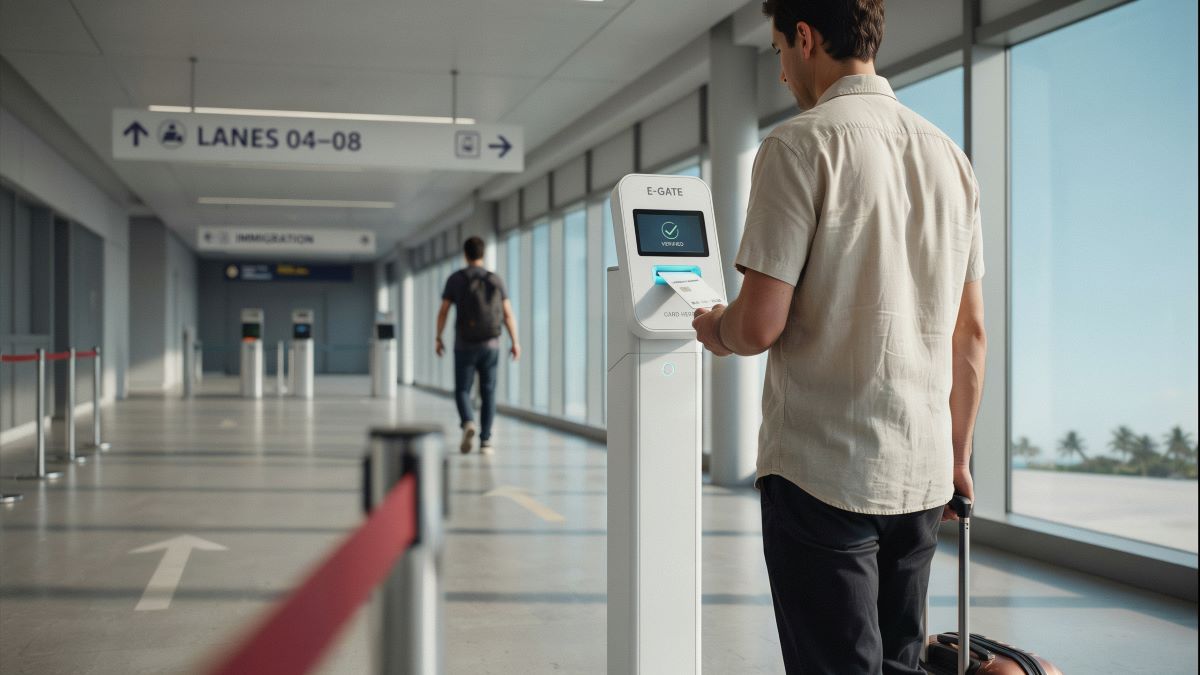
Image generated with Ai
The Caribbean is entering a historic digital transformation era as Guyana, Barbados, Cuba, Curaçao, the Cayman Islands, the Dominican Republic and CARICOM partners accelerate the adoption of digital identity, biometric securityand cross-border data systemsdesigned to reshape regional travel, tourism, governanceand security. The transition includes passport-free travel pilots using interoperable smart e-ID cards between Guyana and Barbados, Cuba’s legally backed multi-modal biometric identity framework using iris, facial and voice recognition, Curaçao’s partnership with the Netherlands’ Logius agency, and CARICOM IMPACS collaboration with the United States Department of Homeland Security (DHS) to strengthen biometric border protection.
Supported by global digital governance models such as the European Union’s eIDAS framework and India’s Aadhaar digital identity infrastructure, these Caribbean initiatives reflect a broader international movement toward secure Digital Public Infrastructure (DPI). Recognized institutions including the World Summit on the Information Society (WSIS), the Inter-American Digital Government Network (GEALC), CARICOM IMPACS and the U.S. Department of Homeland Security highlight the growing importance of trusted digital identity systems in improving connectivity, reducing fraud and enhancing regional resilience.
This article analyzes how the Caribbean’s unified digital identity transition is creating a new blueprint for borderless mobility, faster tourism flows, stronger economic integration, improved public services and advanced security cooperation across island nations while examining the opportunities and challenges behind this emerging digital revolution
The Caribbean’s Unified Digital Identity Transition
For those seeking a direct overview of how these transformations affect regional movement and security, the key components are detailed below:
Advertisement
Advertisement
- Border Integration: A historic bilateral framework between Guyana and Barbados now permits passport-free travel using interoperable smart e-ID cards.
- Modernized Governance Hubs: Curaçao and the Cayman Islands are redesigning public service accessibility, converting decentralized paper systems into high-security digital citizen profiles.
- Biometric Statutory Reform: Cuba has updated its legal identity infrastructure, incorporating physiological markers like iris scans, facial maps, and voice prints into a secure national registry.
- International Vetting Alignment: Under the guidance of CARICOM IMPACS, Caribbean governments have formalized a multi-nation biometric data-sharing alliance with the United States Department of Homeland Security (DHS) to counter transnational crime.
The Core Blueprint: How Digital Public Infrastructure Reshapes Regions
At the center of this transformation is the rapid adoption of Digital Public Infrastructure, commonly referred to as DPI. Much like physical roads, bridges, and electric grids dictate the economic output of the physical world, DPI forms the invisible network architecture necessary for an expansive digital economy
Essential Pillars of Modern DPI Architecture
- Unified Digital Identity Networks: Providing verified, unique cryptographic anchors for every resident.
- Secure Interoperable Data Exchanges: Enabling different ministries and sovereign nations to communicate instantly without data silos.
- Integrated Digital Payment Layers: Allowing automated, low-fee public transactions and cross-border remittances.
When applied to an interconnected island region like the Caribbean, DPI functions as a powerful tool for integration. Historically, the geographic fragmentation of the Caribbean Sea has complicated regional integration, creating administrative delays for citizens moving between states, whether for commerce, employment, or leisure. By digitizing identity authentication, individual states are laying the groundwork for a standardized trust framework
Advertisement
Advertisement
This model mirrors successful international systems, notably the European Union’s eIDAS (Electronic Identification, Authentication, and Trust Services) system and India’s highly scalable Aadhaar infrastructure. These systems demonstrate that validating a person’s legal identity digitally before they reach a border or apply for an international service dramatically lowers administrative costs, curtails identity fraud, and builds regional economic resilience
Guyana and Barbados: Scaling Borderless Travel Protocols
The bilateral partnership between these two nations serves as the operational pioneer for cross-border integration within the Caribbean Community. By linking their digital architecture, they have set a new standard for regional mobility
- Passport-Free Transit Corridor: Effectively launched a cross-border system on July 1 that allows citizens to travel between both nations using only their digital identity cards.
- Interoperable Infrastructure: Utilizes smart e-ID card technology designed to bypass traditional paper passport checks at border checkpoints, significantly reducing processing queues.
- Regional Expansion Model: Acts as a blueprint for the wider Caribbean, with multiple CARICOM member states actively reviewing the framework to integrate their own domestic e-ID architectures.
Dominican Republic: Establishing Transnational Governance Benchmarks
Positioned as a major diplomatic and technical anchor, the Dominican Republic focuses heavily on establishing regulatory standards, data security, and unified governance structures
- International Distinction: Formally recognized at the World Summit on the Information Society (WSIS) Forum for its leadership in cross-border digital alignment.
- Institutional Guidance: Actively steers the Inter-American Digital Government Network (GEALC) to promote safe interoperability and strict data protection laws across Latin America and the Caribbean.
- Privacy-First Strategy: Focuses on establishing highly secure, encrypted digital trust frameworks that ensure citizen data remains safe during cross-border information exchanges.
Cuba: Enacting Rigorous Multi-Modal Biometric Statutes
Cuba is executing a comprehensive transformation of its legacy identity infrastructure by anchoring its national registries within a rigorous, updated legal framework
- Statutory Overhaul: Passed new legislation through parliament, overseen by the Ministry of Interior, to replace an outdated identity decree from 2007.
- Centralized Data Repository: Establishes a singular, comprehensive national database designed to house the identity records of both native Cuban citizens and foreign residents.
- Multi-Modal Biometric Mandate: Formally encodes advanced biological identifiers into law, explicitly utilizing iris scanning, facial recognition architecture, and voice biometric print analysis.
Curaçao: Standardizing Municipal Portals with International Alliances
Curaçao is directing its digital transformation toward public service optimization, looking to international partnerships to modernize how citizens interact with the state
- European Technical Alliance: Partnering directly with Logius, the official digital government services agency of the Netherlands, to build its local identity platform.
- Portal Mirroring: Developing customized, local versions of the highly successful Dutch national digital portals, DigiD and MijnOverheid.
- Streamlined Governance: Unifying state interactions into a singular digital key, allowing citizens to securely execute transactions, manage personal data, and access public benefits online.
Cayman Islands: Expanding Citizen Enrollment and Universal Access
The strategy in the Cayman Islands centers on total domestic inclusion, ensuring that every resident within its borders is accounted for under a single foundational framework
Advertisement
Advertisement
- Expanded Eligibility Criteria: The Department of eGovernment has systematically expanded the national ID card application process to include permanent residents, legal dependents, and other qualified worker categories.
- Foundational Identity Goal: Aims to enroll the entire resident population to create a definitive identity database for easier public service deployment.
- Administrative Efficiency: Designed to eliminate redundant government paperwork, verify legal residency status instantly, and optimize the distribution of national resources.
United States and CARICOM: Securing Boundaries
As regional travel becomes more streamlined, international law enforcement and border security frameworks are adjusting in parallel to protect the shared perimeter
- Biometric Pact: The United States Department of Homeland Security (DHS) executed a formal Memorandum of Cooperation (MOC) targeting regional security.
- Unified Border Protection: Coordinated through the Caribbean Community Implementation Agency for Crime and Security (CARICOM IMPACS) to exchange biometric information between member states and the U.S.
- Transnational Threat Mitigation: Establishes a highly secure vetting network designed to counter document forgery, human trafficking, and international criminal activity at border control points.
| Nation / Entity | Primary Partner / Authority | Core Technology Used | Strategic Objective | Target Demographic |
| Guyana & Barbados | Bilateral CARICOM Alliance | Interoperable Smart e-ID Cards | Eradication of passport requirements for regional transit | All legal citizens |
| Dominican Republic | GEALC Network Support | Interoperable Government Frameworks | Setting regional standards for data protection and service delivery | Comprehensive domestic & regional networks |
| Cuba | Ministry of Interior | Multi-modal Biometrics (Iris, Face, Voice) | Transitioning to a centralized database governed by updated legislation | Citizens and international residents |
| Curaçao | Logius Agency (Netherlands) | Localized DigiD & MijnOverheid Portals | Complete digitization of public service delivery pipelines | Full domestic population |
| Cayman Islands | Department of eGovernment | Foundational National Identity Cards | Expanding state resource access and simplifying identification | Citizens, permanent residents, and dependents |
| CARICOM IMPACS | U.S. Dept. of Homeland Security | Secure Biometric Data-Exchange Systems | Strengthening border controls and identifying transnational security threats | Cross-border travelers and visa applicants |
Direct Socio-Economic Impact: Intersecting Travel, Tourism, and Security
The systemic convergence of digital identification systems does not merely change bureaucratic procedures; it directly drives progress in the Caribbean’s most vital economic and protective sectors
Maximizing Caribbean Hospitality and Visitor Velocity
- Frictionless Mobility Architecture: Eliminating passport bottlenecks triggers immediate growth in visitor confidence, leading to a projected spike in regional arrivals, quick family visits, and inter-island student exchanges.
- Diversified Destination Profiles: Simplified transit loops encourage regional travelers to select nearby islands for short holidays, spreading leisure expenditures evenly into developing micro-economies rather than confining them to isolated commercial cruise hubs.
- Operational Optimization: Integrating digital health, verification, and check-in steps decreases airport clearance times, allowing regional transport hubs to accommodate higher passenger traffic volumes without expanding physical runway footprints.
Boosting Cross-Border Trade and Investment Pipelines
- Fostering Intra-Regional Commerce: Fast-tracked immigration lanes lower cost barriers for micro-entrepreneurs, trade delegations, and small-scale farmers moving specialized goods through the CARICOM Single Market and Economy framework.
- Securing Investment Assets: Standardized corporate and personal e-IDs facilitate cross-border financial compliance, enabling initiatives like the proposed Trident Arrow Investment Fund to draw capital directly from citizens throughout the archipelago for major infrastructure projects.
- Accelerating Strategic Sectors: Fluid corporate travel enables technical specialists in agriculture, software development, and renewable energy grids to share resources and physical labor across island borders without administrative delays.
Reinforcing Border Vulnerabilities Against Transnational Crime
- Mitigating Citizenship-by-Investment Hazards: The Biometric Data Sharing Partnership provides critical identity safeguards for Eastern Caribbean nations managing economic migration, identifying instances where purchased passports are used to hide assets or bypass active global restrictions.
- Securing High-Risk Infrastructure: Real-time background queries powered by automated U.S.-CARICOM information networks help immigration officers intercept human trafficking rings and document counterfeiters before they can exploit inter-island travel corridors.
- Standardizing Regional Policing Capability: Centralized regional databases elevate local law enforcement capabilities, replacing disparate, isolated watchlists with a modern, real-time perimeter alert network that guards the entire Caribbean basin.
Feature Comparison: Multi-Modal Biometrics vs. Standard Electronic IDs
As jurisdictions choose different technological directions, understanding the differences between foundational electronic IDs and advanced multi-modal biometric structures reveals how security depth matches administrative cost:
| Technical Feature | Standard Smart e-ID Systems | Multi-Modal Biometric Arrays |
| Primary Verification Hardware | Contactless chip readers & smart card scanners | High-resolution iris cameras, facial scanners, microphone matrices |
| Primary Data Stored | Cryptographic tokens, basic demographics, single-print file | Structured facial geometry vectors, structural iris maps, vocal pattern hashes |
| Vulnerability Profile | Vulnerable to physical theft, credential sharing, card cloning vectors | Extremely high security; near-zero rates of spoofing or identity transfer |
| Primary Deployment Use Case | Cross-border travel corridors, automated toll networks, general government portals | Centralized security networks, high-security border operations, forensic registries |
Advertisement
Tags: Biometric Identity, Caribbean Digital Revolution, passport-free travel
Advertisement
Advertisement
This content is protected under the Copyright Act. Unauthorized scraping, AI extraction, reproduction, or republication is strictly prohibited. Read ourCopyright Policy.
Follow Travel And Tour World in Google News

PARTNERS









REGIONAL NEWS
Europe

Portugal Unleashes a Mighty Summer Beach Revolution as Game-Changing New Maps Op
Wednesday, July 15, 2026

Europe Travel Powerhouse Faces Blistering Heat Shock as Nine Nations Record Asto
Wednesday, July 15, 2026
America

Thailand Creates Massive Global Tourism Shake-Up With Landmark Visa Overhaul as
Wednesday, July 15, 2026

Nevada Aligns with California, Florida, Arizona, Texas, and Hawaii as Las Vegas
Wednesday, July 15, 2026
Middle East
Kuwait City Aligns with Amman, Doha and Manama Under Global Travel Spotlight as
Wednesday, July 15, 2026
Türkiye Tourism Gains Momentum as Deep Hotel Discounts Drive a Sharp Rise in La
Wednesday, July 15, 2026
Asia

Indonesia Unleashes a Powerful New Asian Travel Gateway as Macao SAR Passport Ho
Wednesday, July 15, 2026

Cebu Pacific to Introduce Starlink WiFi in 2027 Transforming Southeast Asia Low
Wednesday, July 15, 2026
© 2026 Travel And Tour World. All Rights Reserved.
Copyright Policy
We use cookies on our website to give you the most relevant experience by remembering your preferences and repeat visits. By clicking “Accept”, you consent to the use of ALL the cookies.Do not sell my personal information.
Settings
Manage consent
X
