

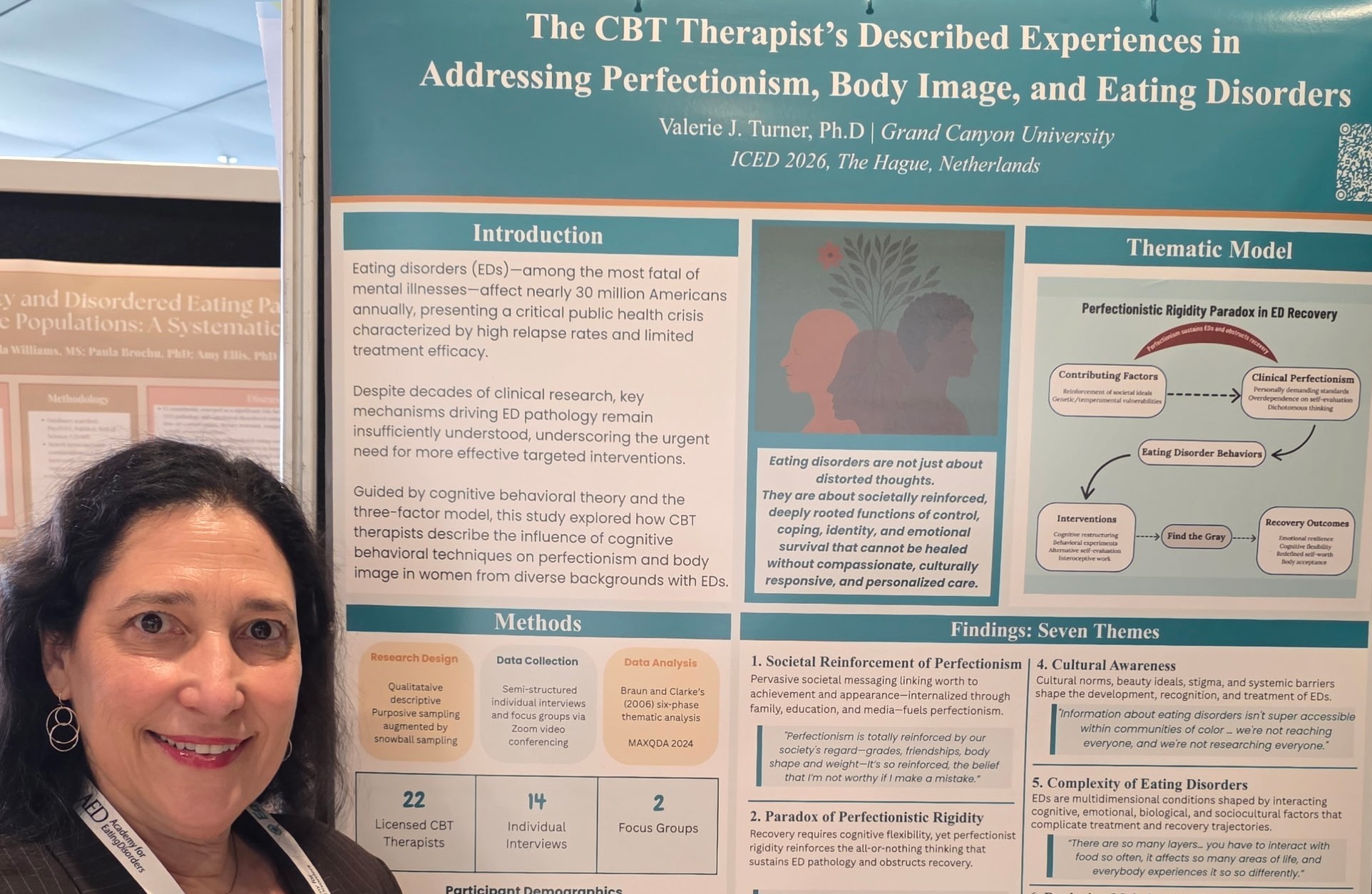
As a violinist, Dr. Valerie Turner felt comfortable performing in front of audiences that were there to be inspired by beautiful music
But speaking on eating disorders in front of about 1,000 experts, clinicians and scholars was a challenge. Turner did just that at the International Conference on Eating Disorders, held at the World Forum The Hague in the Netherlands this June, just one year after she successfully defended her dissertation as a learner in Grand Canyon University’sCollege of Doctoral Studies
“It was very nerve-wracking for me, and people would advise you, ‘You are the expert on this research. You know what you’re talking about. If you lived it for years, you wrote it,’” Turner said
So she persevered and felt more confident after meeting renowned experts and scholars and noticing the strong interest in this issue from the international community
“The thing with eating disorders, it’s a relatively young field compared to other mental illnesses, which have been studied for quite some time,” said Turner, adding that eating disorders weren’t listed in the Diagnostic and Statistical Manual of Mental Disorders until the 1980s
“So a lot of these researchers, these huge researchers, and the original seminal works done on eating disorders, are still in the game, and these are the people that I got to interact with.”
Presenting at the conference, which was hosted by the Academy for Eating Disorders, Turner expounded on her dissertation, titled “The CBT Therapist’s Described Experiences in Addressing Perfectionism, Body Image, and Eating Disorders.”
“Her invitation to present at the International Conference on Eating Disorders in The Hague is a testament to both the quality of her scholarship and her ability to communicate complex ideas to an international audience,” said Dr. Adam Hiebel, Turner’s dissertation chair. “She represented Grand Canyon University with professionalism, intellectual curiosity and confidence, and I could not be prouder to see her sharing her research alongside some of the world’s leading experts in the field
“Valerie’s accomplishments reflect not only her dedication to advancing psychological science but also the strength of the scholarly community we strive to cultivate at GCU.”
This was the third conference Turner spoke at since earning her doctorate in psychology with an emphasis on cognition and instruction. At each conference, Turner has asked researchers to sign a copy of her dissertation
“It felt like I’m closing the circle where now I’m part of them, I’m part of this, and that’s really one of the proudest moments of my academic career, to be able to be in the same arena as these great researchers, these thought leaders, and speaking about my research and having interactions with them,” Turner said
Last November, Turner spoke at the Association for Behavioral and Cognitive Therapies Conference in New Orleans. And three weeks after talking at The Hague, Turner spoke and made a poster presentation at the 11th World Confederation of Cognitive and Behavioral Therapies Congress in San Francisco, attended by international experts and researchers
Among the big thought leaders Turner has met and admired are Dr. Anna Bardone-Cone, a prominent eating disorder researcher at the University of North Carolina; Dr. Carolyn Black Becker, a licensed clinical psychologist and professor at Trinity University in San Antonio; and Dr. Tiffany Brown, an associate professor at Auburn University in Alabama and a former assistant project scientist and licensed clinical psychologist at the UCSD Eating Disorders Program
Turner said Bardone-Cone’s model for eating disorder behaviors was part of her theoretical framework
Turner’s persistence in her research has paid off. She said convention applicants must submit an abstract from their dissertation to get accepted or invited to speak
“We have to define it,” Turner said of the eating disorder crisis, adding that there are at least 30 million American afflicted and that it’s a diagnosable mental illness
One misconception, she said, is that anorexia is limited to emaciated people. “Actually, there are more people in average or large bodies with eating disorders because there’s so many. There’s binge eating disorder, bulimia, and it’s one of the deadliest of all psychiatric illnesses, which is probably another thing one doesn’t realize
“… It’s a mental disorder when it gets to that point, and it is about control. It’s their self-control. It’s their emotional numbing. It’s protection.”
Perfectionism, she said, is “out of control.”
“It’s not something they could say, ‘Oh, I won’t eat and purge my food, or I won’t starve myself,’ whichever, because it’s the same cognitive mechanisms that are behind it,” Turner said
She always had an interest in psychology and earned her master’s degree in addiction counseling from GCU and started her pursuit of her doctorate nine months later
One of her goals is to join the GCU faculty and reciprocate the support and guidance she received to produce a dissertation worthy of presenting on an international stage
“GCU prepared me for that,” Turner said
Hiebel marveled over Turner’s passion and preparation
Turner “exemplifies the very best of what we hope to see in our doctoral graduates,” Hiebel said. “As her dissertation chair, I had the privilege of watching her transform a meaningful research question into a rigorous and impactful study that has gained recognition well beyond the university
“Valerie has an extraordinary passion for understanding eating disorders and improving treatment through evidence-based research, and that passion is evident every time she speaks about her work.”
The liposuction and GLP-1 craze for weight loss wasn’t a craze at the time Turner started her research with CBT therapists who worked with eating disorder clients, and she is concerned about its impact
“If there’s something that’s going to make it easy to lose weight, one would think it would help,” Turner said. “But actually, it’s not helping because the problem, as I’ve said before, is that there’s serious mental health conditions, and so it doesn’t address the psychological drivers underneath
“That’s where it gets a little tricky because people can go to people who have issues or want to be thinner, which is the driver in a lot of eating disorders, go to a clinic for weight loss, but that is not helping their eating disorder.”
GCU News senior writer Mark Gonzales can be reached at [email protected]
Related content:
GCU News: Learner leans on experiences in public safety to make doctoral impact
GCU News: Doctoral graduate earns green light on traffic stop study
GCU News: Professor’s mission: To push fellow learners across the finish line
