

Health and medicine
Connecting with the community to create technology-based health solutions
Public Health Technology Corps gives ASU students the opportunity to work directly in the field, solving real-world, local health problems
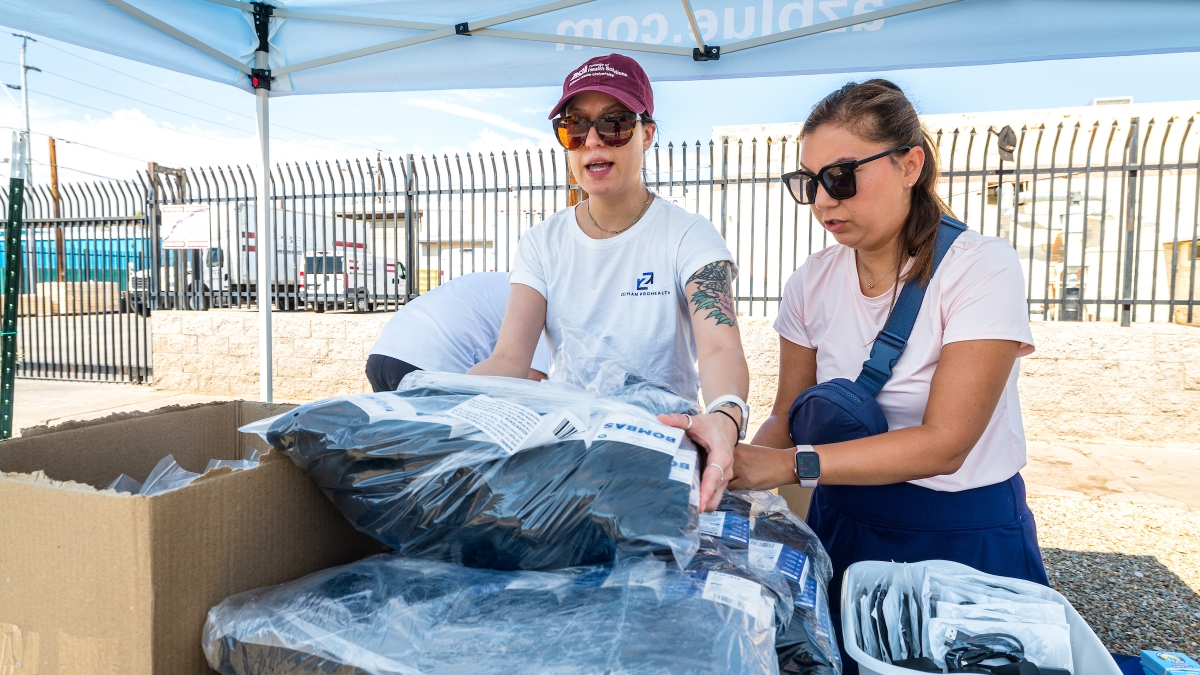
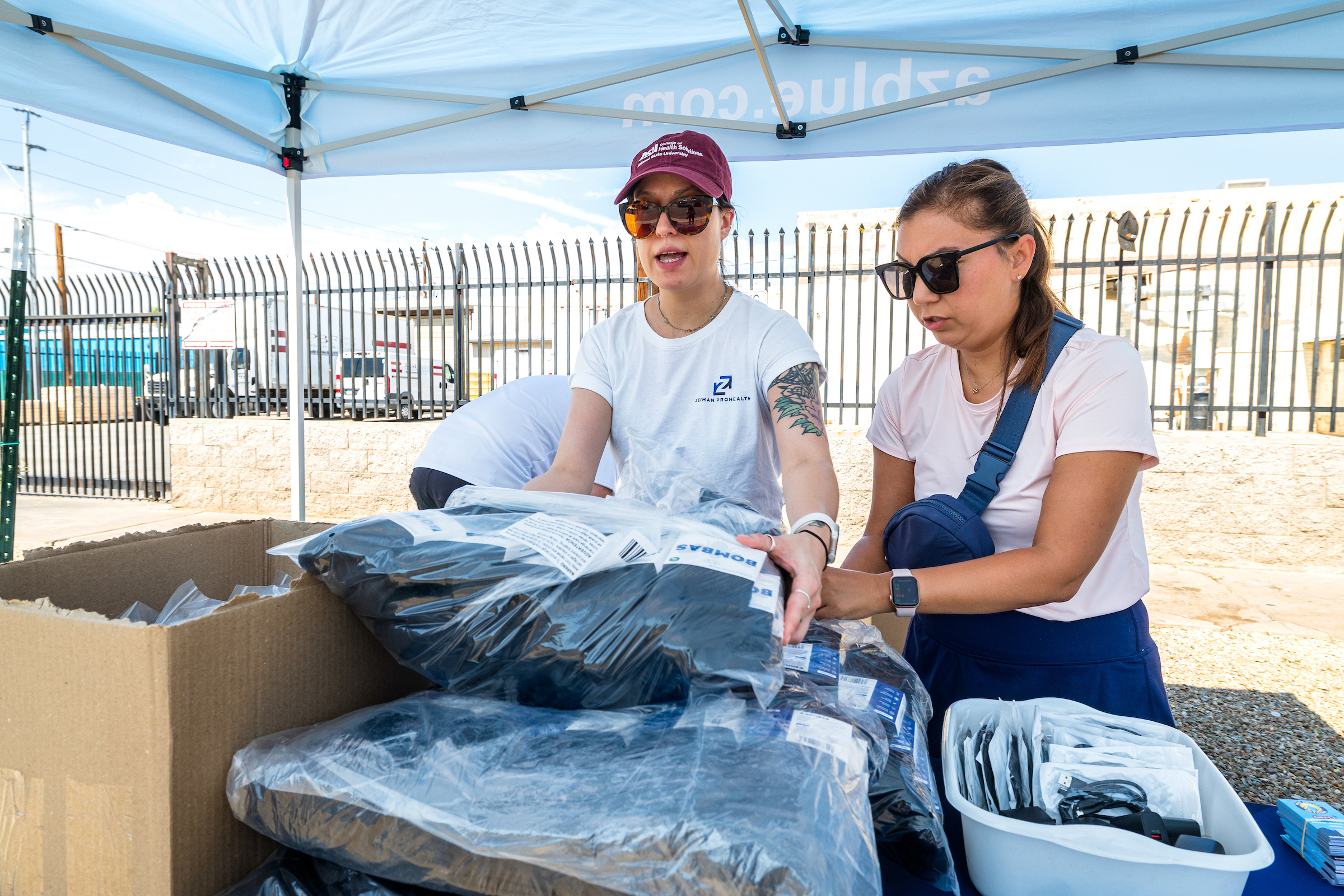
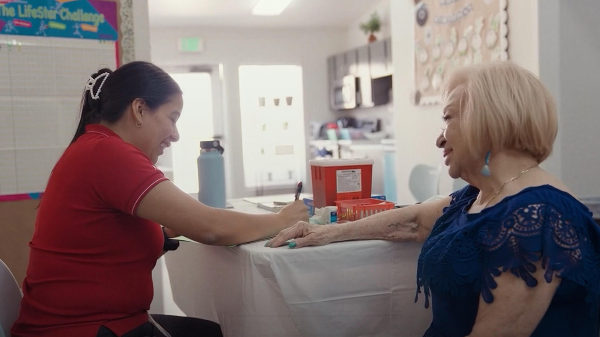
Second-year graduate student Adria Laborin (left) is doing part of her summer practicum with Zeihan ProHealth, helping hand out supplies like water, snacks, socks, hygiene items and Narcan to underserved communities in downtown Phoenix. Laborin is part of the Public Health Technology Corps, which provides students in ASU’s School of Technology for Public Health the opportunity to collaborate with a diverse set of community partners on technology-focused public health projects. Photo by Charlie Leight/ASU News
Story highlights
- The Public Health Technology Corps provides students in ASU’s School of Technology for Public Health the opportunity to collaborate with a diverse set of community partners on technology-focused public health projects.
- The corps allows students to work directly in the field, solving real-world local health problems
Adria Laborin has appreciated everything she’s learned in the classroom in her first year as a student in Arizona State University’s Master of Public Health program
But as a young woman who wants to make a difference in the world, there’s only so much a classroom can offer
“Yes, it’s fun. Yes, it’s great to learn,” Laborin said. “But I think that you can get really burnt out unless you’re out connecting with the community.”
That’s exactly what Laborin has done this summer as part of the Public Health Technology Corps, which provides students in ASU’s School of Technology for Public Health the opportunity to collaborate with a diverse set of community partners on technology-focused public health projects
The corps serves as the applied practice experience for the Master of Public Health degree and as the capstone for the Master of Science in Public Health Technology, all part of ASU Health
“Instead of a traditional internship where they are just going to a place and doing whatever duties, they are partnered with community organizations and they work with the organization to create technology-based solutions,” said Xena Baza, director of the Public Health Technology Corps. “Students are trained to meet with the organization, learn what their needs are and figure out how their skills can help solve an issue.”
Laborin has been working with Zeihan ProHealth, a Phoenix-based public health consulting firm that offers street medicine initiatives to expand health care access in underserved communities, and has held events this summer in downtown Phoenix to provide hydration supplies, heat relief kits, snacks and other items to people without housing
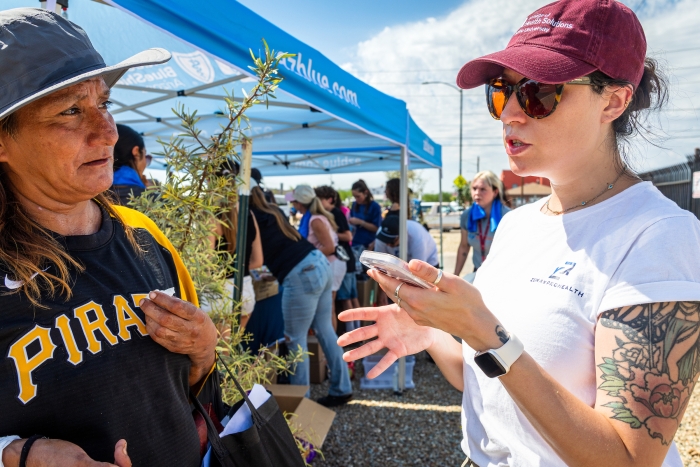
“I go out and do surveys and try to get the voice of the people who are experiencing homelessness,” Laborin said. “Asking questions like, ‘What health centers are being used most? What clinics are being used most?’
“I’ve also added components related to technology. Do people have smartphones? Do they have a phone at all? Would they use QR codes to figure out where cooling centers are?”
The goal: Using the community needs assessments to better understand health priorities and improve outreach for underserved populations. At the same time, students are making connections that could lead to job opportunities after graduation
“One of the goals of the corps in general is professional development and career readiness,” Baza said. “Connecting them with these organizations, even if they don’t end up (working with them), they get a better understanding of the field of public health, what types of jobs are out there and where they can make their impact.”
Assisting refugees with health care needs
Leela Udupa, who received her Master of Science in Public Health Technology and is applying for medical schools, completed her applied project this past spring with REACT, the Refugee Education and Clinic Team, a student-led partnership between ASU and the Mayo Clinic Alix School of Medicine working to address health care disparities in Maricopa County refugee communities
Udupa led a team that created a video aimed at helping refugees navigate the health care system in the United States
“Many newcomers, when they come to the U.S., are told to follow up with their primary care physician, a specialist, go to the pharmacy or even the emergency room. It can be very confusing,” Udupa said. “The goal of the video is to explain in very simple language the difference between primary care, specialty care, urgent care and the emergency room, and also include practical information that’s important to know, like bringing your insurance photo ID and asking for an interpreter when you need it.”
Brittany DiVito, a clinical assistant professor in the Edson College of Nursing and Health Innovation and director of the REACT Clinic, said the video is just over five minutes long so as to give refugees a concise and easy-to-digest navigation of the health care system
DiVito said the video, initially done in English, is in the process of being translated into 12 languages, including Arabic dialects, African languages and Ukrainian
“Trying to do it in their own language is helpful,” DiVito said. “We want to make sure that once it’s completed, the video is something they can refer back to if needed at some point. Because, honestly, I think even half of Americans need help with this.”
DiVito said the REACT Clinic is near completion of a second video aimed at helping refugees understand what to expect in their new home states
“For instance, when people arrive in Arizona, what do they need to know?” DiVito said. “Sun protection. Sunscreen. This is a tarantula. This is a rattlesnake. Anything that’s helpful with their adjustment.”
Like Laborin, Udupa said the opportunity to work with a community partner and roll her sleeves up, so to speak, has been invaluable in trying to come up with technology-based health care solutions
“I think that’s a great aspect of the corps,” Udupa said. “I think that this truly helped me understand the real navigation challenges refugee families face and create something that was able to turn health care into something clearer, more repeatable and more accessible for them
“So I’m really grateful for the program. And even though I’m going to be going to medical school, I still want to participate in projects that will help these underserved communities. And now I feel more confident and ready to do that.”
ASU HealthDowntown Phoenix campusFacultySchool of Technology for Public HealthSDG 03 Good Health and Well-BeingGraduate studentsCommunityProspective studentsHealth and medicineStudentsHealth careEdson College of Nursing and Health InnovationCommunity partnerships
ASU Health, Downtown Phoenix campus, Faculty, School of Technology for Public Health, SDG 03 Good Health and Well-Being, Graduate students, Community, Prospective students, Health and medicine, Students, Health care, Edson College of Nursing and Health Innovation, Community partnerships
More Health and medicine
Aflatoxin is one of the world’s most dangerous food toxins, having been linked to liver cancer, impaired immune function and chronic inflammation.As climate change creates warmer and more humid…
Read this story
Healthy LivingBioscienceLatino / ChicanoFood and DiningResearch
When people think of health care professionals, what often comes to mind are doctors and nurses. In reality, there are more than 250 distinct professions in the field. This summer, a new…
Read this story
Health careCommunity involvementCommunity partnershipsNursing
Regina Fields is a 35-year-old woman with an acute kidney injury. She’s short of breath, nauseous and having trouble urinating.The nurses taking care of Fields have questions about her condition, so…
Read this story
Artificial intelligenceInnovationHealth careTechnologyNursing
