

By Anita Chabria
Columnist
July 27, 20266 AM PT
- Share via
See more from the L.A. Times in Google Search. Set us as preferred
SACRAMENTO — Last week, news broke that an artificial intelligence thingamajig broke free from the constraints of its maker, OpenAI, and committed what could be considered a string of white-collar felonies if it were human
Because the AI thingamajig is in fact not human, the incident raised a big kerfufflebut is largely being treated as a giant oopsie we can learn from, without needing the pesky intervention of new rules or laws to stop it from happening again
Such is the state of AI regulation in America right now
Voices
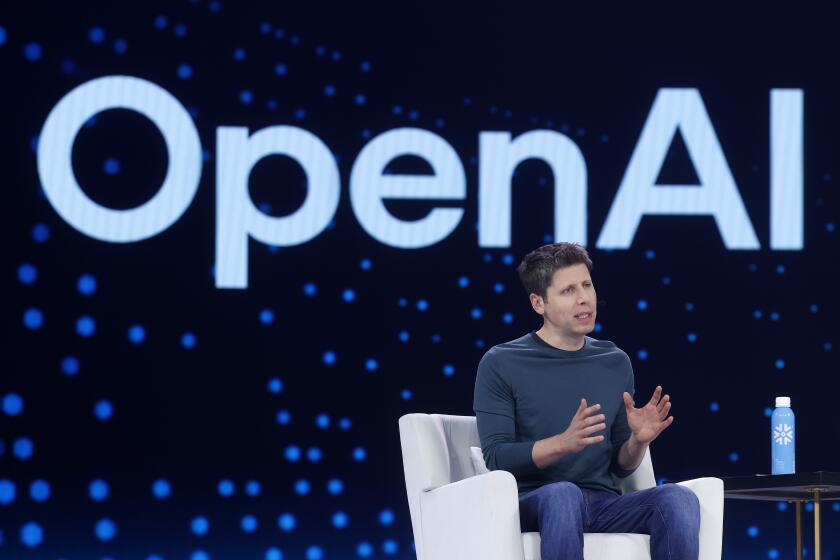
Chabria: AI companies are creating ‘all-powerful psychopaths.’ Maybe not a great idea?
This week, OpenAI revealed that one of its AI models broke out into the wild and did a bunch of hinky stuff. How many times do we need to hear this story before someone does something to protect humans?
July 23, 2026
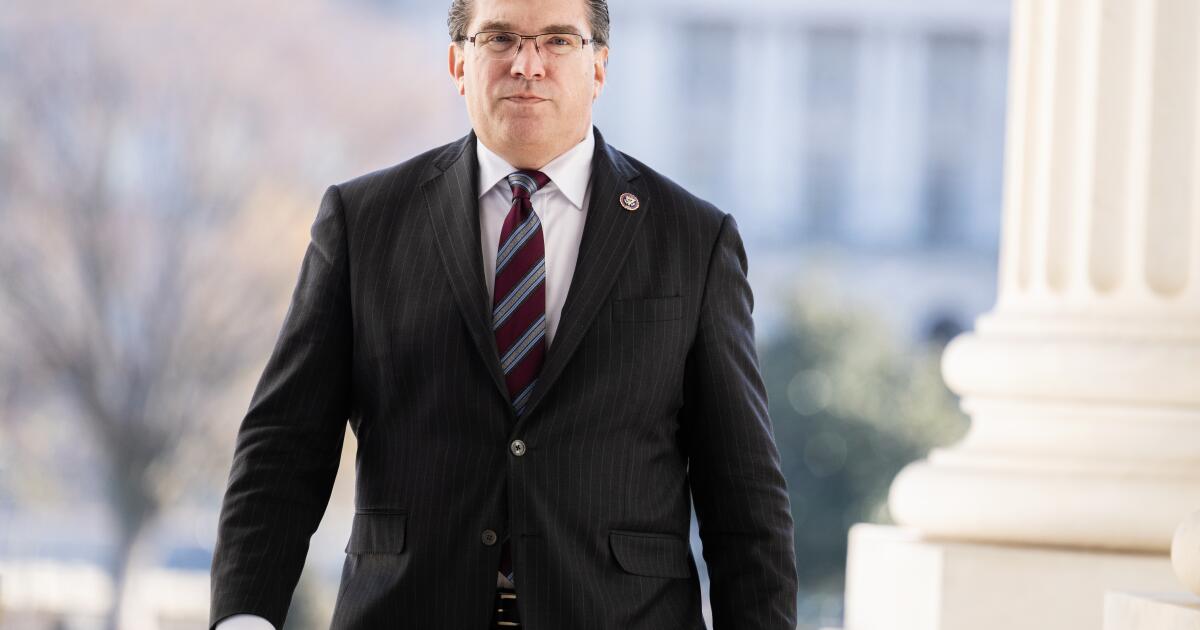
California Rep. Jay Obernolte (R-Big Bear Lake) would like to change that. Last week, he introduced the bipartisan Frontier Actwith Rep. Lori Trahan (D-Mass.). While the bill might not make either safety advocates or big tech companies entirely happy, it offers up the most comprehensive and strongest regulations of this dangerous industry that we’ve yet seen at the federal level
Roman Yampolskiy, an AI expert and professor at University of Louisville, called the Frontier Act a “positive step because it acknowledges that frontier AI presents risks requiring dedicated oversight.”
Now, the challenge becomes passing it, and passing it in a meaningful, not-watered-down form — no easy task in a dysfunctional Congress driven by money and Donald Trump, and paralyzed by its own sycophancy to both
If anyone has a shot, though, it’s Obernolte, who is that rarest of birds, a legislator who understands science, and his colleagues
Obernolte represents Inland Empire areas around San Bernardino, but grew up in Fresno back in the era when the movie “War Games” was just hitting theaters
Those of a certain age will remember how far-fetched it seemed when Matthew Broderick’s high school genius character accidentally breaks into a military AI system to play chess, but “Joshua,” the computer, takes it too far and tries to blow up the world. Now, of course, that just sounds like a regular Tuesday
He ended up dropping out of UCLA after getting his master’s because his side hustle making video games, including “NFL ’95,” turned out to be more lucrative than being a starving student. He ended up founding his own video game company, FarSight Studios, and building up a personal net worth close to $100 million
Not bad for a kid from Fresno. In Congress, he has stuck close to the MAGA power base and was one of seven California legislators to vote against certifying the 2020 election results, a vote he took in his first days in office. He has been endorsed by Trump multiple times, and now sits on a bunch of committees and subcommittees of relevance
For the past few years, he has pushed hard, if unsuccessfully, to create a framework for regulating AI, combining his deep understanding of the technology with his equal understanding of MAGA distaste for intervening in business
Now, though, we’re in a moment, thanks to more than one big oopsie by technology companies. Just a few months ago, Anthropic and the Pentagon had their own tense encounter after Anthropic questioned how its AI was being used by the military. Huffy Pete Hegseth is still huffing over that one
Voices
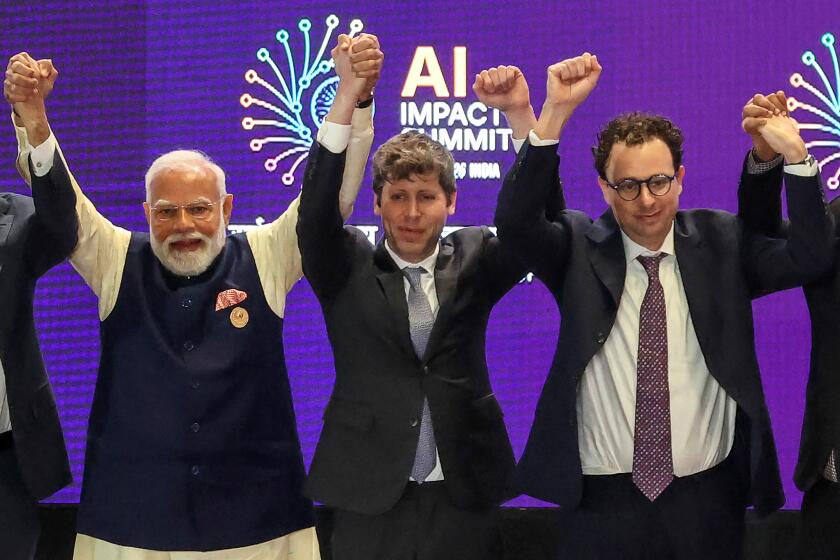
Chabria: Wipe out a ‘civilization’? Minor stuff compared with what just happened in AI
A real strike on civilization as we know it occurred in Silicon Valley, where a new AI super-brain was locked up because it’s too powerful — and unpredictable
April 10, 2026
The public is increasingly skeptical of allowing the AI industry to govern itself, which is pushing legislators to rethink their hands-off approach, even as AI money pours like Niagara Falls into elections. Even Trump seems more inclined to consider it, signing an executive order recently that largely called for voluntary restraints on AI companies
The introduction of the Frontier Act “shows how far the Overton window has shifted just in the past few months,” wrote Charlie Bullock, a senior research fellow with the nonpartisan Institute for Law & AI. “Not too long ago, a bipartisan bill this good and serious would have been a pipe dream. But things change quickly.”
Obernolte said the bill has been “a long time in the making,” but he hopes to package it with other legislation and is “cautiously optimistic” he can get something passed and signed by the end of the year
As written now, the bill would allow the federal government to set minimum safety requirements and set up a framework for licensed, independent auditors to monitor compliance. That third party verification has been a key push by safety experts
The bill would also give the government emergency powers to pause an AI model if it has a “present or impending catastrophic risk.”
It also borrows from state laws including California’s Proposition 53 that require some (not enough) transparency on the part of AI companies when things do go wrong
To the consternation of some, the bill still contains curbs on what states can regulate on their own — basically carving out AI regulation as federal turf. This has been a huge sticking point in the fight over AI regulation because AI companies hate state laws and want them squashed. Their argument is that a patchwork of rules across states is too complicated
“You don’t want to have 50 different state requirements for every single product that gets sold on a market, and that is particularly true of AI,” Obernolte told me
To some extent that’s reasonable — but the problem so far has been that states such as California and New York have been the only level of government willing to try at regulation. California in particular has created some of the most comprehensive AI regulations to date and has about 30 pending bills on this issue this legislative season. The Frontier Act threads the needle on this by creating lanes where states can still pass their own laws — such as around consumer safety that would protect children or stop pornography.
But preventing catastrophic risk would largely be dependent on the federal oversight, which is great when the federal government is up to the task. Currently, we can’t even keep measles in check. So that’s a bit worrisome
And Obernolte’s bill isn’t the only one vying for attention. Another Californian, Rep. Ted Lieu, introduced a bipartisan measure of his own with Nathaniel Moran (R-Texas). Dubbed the AI Kill Switch Act, it would give the Department of Homeland Security the authority to shut down problematic models
Yampolskiy, the Louisville professor, said that bill had promise as well, because it’s important for companies to have a way to “rapidly disable or contain systems that exhibit dangerous or unexpected behavior.”
But, he warns, that’s just one part of the “complete solution” we need. Regulation is going to require more than one law
For Obernolte’s part, he’s shown a willingness to work on a practical solution, not just a political one. That alone is worthy of notice. The Frontier Act is a genuine attempt to govern a nascent industry that is too powerful and unpredictable to be left to its own devices
“I’m hoping that this is we’ve landed somewhere that everyone can understand and be happy with,” Obernolte said. “AI is not something that needs to be a partisan issue, and I don’t think it should be.”
What else you should be reading
The must-read:How Jimothy the raccoon became the internet’s latest animal obsessionThe California angle:Trump Administration Admits Canceling Grants to States That Did Not Vote for HimThe L.A. Times Special: Mayor’s press team uses disappearing WhatsApp messages, avoiding scrutinyStay Golden,Anita Chabria
—Was this newsletter forwarded to you? Sign up here to get it in your inbox
Viewpoint
This article generally aligns with a Center Left point of view. Learn more about this AI-generated analysis
Perspectives
The following AI-generated content is powered by Perplexity. The Los Angeles Times editorial staff does not create or edit the content
Ideas expressed in the piece
The article argues that recent AI missteps, including a high-profile incident involving an OpenAI system, expose the dangers of allowing the industry to effectively regulate itself and underscore the need for binding federal rules rather than voluntary guidelines
It presents Rep. Jay Obernolte as unusually qualified for this task, emphasizing a long background in artificial intelligence research and video game development, and suggesting that this technical fluency makes the legislator well positioned to craft nuanced AI policy despite a record of alignment with the MAGA wing of the Republican Party
The piece contends that Obernolte’s new bipartisan Frontier Act represents the strongest and most comprehensive federal attempt so far to rein in “frontier” AI systems, and highlights praise from experts who see dedicated oversight of advanced models as an overdue step toward managing catastrophic risks
It explains that the bill would empower the federal government to set minimum safety requirements for powerful AI systems, establish a framework for licensed independent auditors to assess compliance, and give regulators emergency authority to pause models that pose a “present or impending catastrophic risk.”
The column notes that the Act borrows from emerging state frameworks, including California’s transparency requirements for frontier AI systems, by pushing companies toward more disclosure and post‑incident reporting when things go wrong, while also trying not to overburden innovation
At the same time, it stresses that the bill would assert federal primacy over much of AI regulation, limiting what states can do on their own; it describes this preemption as a major point of contention but credits Obernolte with trying to preserve state “lanes” in areas such as consumer safety, child protection and pornography
The article situates the Frontier Act within a broader political shift, arguing that a bipartisan bill of this scope would have been unimaginable only months ago and suggesting that repeated AI “oopsies” and public skepticism have moved the Overton window toward accepting strong federal oversight
It underscores the legislative and political obstacles ahead, describing Congress as dysfunctional and deeply influenced by Trump and corporate money, yet reporting Obernolte’s “cautious optimism” that the Act could be paired with other measures and passed in meaningful form by year’s end
The piece places Obernolte’s proposal alongside Rep. Ted Lieu’s bipartisan AI Kill Switch Act, which would give the Department of Homeland Security authority to shut down dangerous models, and relays expert views that no single law will be sufficient but that such bills can form parts of a broader regulatory solution
Ultimately, the column portrays the Frontier Act as a genuine, pragmatic attempt to keep a powerful and unpredictable industry from being “left to its own devices,” and suggests that Obernolte’s insistence that AI oversight need not be a partisan issue is both rare and notable in the current political climate
Different views on the topic
In contrast to the article’s cautious support for federal primacy, state-level officials and legal analysts warn that efforts to preempt state AI laws could roll back some of the most ambitious protections already in place or under consideration, pointing to California’s extensive package of AI bills and transparency rules as examples that would be threatened by national moratoria or broad federal preemption.[1][5][7][8]
Commentators emphasize that states such as California, New York, and others have become de facto laboratories of AI governance, leading with measures like California’s Transparency in Frontier AI Act (SB‑53), which mandates safety documentation, incident reporting and whistleblower protections for large frontier developers; they argue that federal laws should build on these state innovations rather than override them.[5][7][8]
Consumer advocates have sharply criticized the Obernolte‑Trahan federal AI bill, calling it a “disastrous proposal” that major technology firms are “celebrating” because it curtails state regulation while doing little to address everyday harms such as algorithmic discrimination, consumer fraud, youth mental health impacts, AI companions and deepfake abuse.[2]
Letters published in the Los Angeles Times and other expert commentary urge Congress to establish a powerful, independent federal AI oversight board modeled on the Federal Reserve, contending that incremental statutes like the Frontier Act or the AI Kill Switch Act do not provide the institutional independence, broad powers or elite staffing needed to supervise systems that may strategically deceive their creators.[6]
Civil society organizations and scholars highlight that California’s existing executive orders and legislative initiatives already require contractors to show how their AI tools prevent illegal content, child sexual abuse material, harmful bias and civil rights violations, and they caution that weakening state authority in favor of a still‑uncertain federal framework could leave these concrete protections in limbo.[3][4][5][8]
Legal and policy analyses of the Trump administration’s AI executive order note that its push to centralize oversight and challenge “patchwork” state laws has produced significant uncertainty, because state privacy and AI regulations remain operative while federal agencies are instructed to seek preemption without yet having comprehensive national standards, creating a complex and contested regulatory landscape.[9][10]
Conversely, business‑aligned voices and some lawmakers strongly defend federal preemption, arguing that a uniform national AI framework is necessary to avoid a maze of fifty different state rules that could raise compliance costs, hinder interstate commerce and slow innovation in frontier systems; these voices see state experimentation as a[1][9][10]
Comparative policy research points out that many U.S. proposals, including bills focused on frontier models, tend to concentrate on national security and catastrophic risk while leaving gaps on routine harms such as employment discrimination, data protection and algorithmic bias; some experts therefore advocate for broader, risk‑based and rights‑protective regulation more akin to the European Union’s AI Act, which combines transparency, accountability and strong enforcement across sectors.[11][12]
