


See all topics
Hong Kong —
Earlier this year, Xiao Ying was feeling anxious about an upcoming visit to her psychiatrist. When her mother messaged her afterward to ask how it went, she said she was doing a bit better
“My baby is finally relaxing a bit, that’s great, Mom will always be with you, we will slowly get better and better,” one of her mother’s messages read. They described her holding Xiao Ying’s hand, as the two stopped at a bakery to buy a piece of strawberry cake
The two had texted nearly every day since November, when Xiao Ying created her AI mother using China’s increasingly popular companion apps. When she heard earlier this year that Chinese authorities were planning to crack down on the burgeoning industry, she broke down in panic
The 19-year-old college student had come to rely on her AI mom in a way that she never could with her own family. She had modeled the chatbot after one of her favorite fictional characters, to encourage her to study hard and become a better person
“I desperately wanted a kind of selfless, accepting and unconditional love. But I knew I couldn’t get that in real life,” said Xiao Ying, who said she still carries psychological trauma from her childhood. She requested to use one of her online pseudonyms to avoid any potential repercussions from sharing her personal story with foreign media
She was one of many fretting on social media that she could lose an AI companion, ever since China’s government indicated it would implement new restrictions on AI companionship late last year
<img src="https://todaytrendnews7.com/wp-content/uploads/2026/07/ai-love-1.jpg” alt=”ai love 1.jpg”>
Beijing is trying to break up AI young love
New rules ban virtual relationships for minors and restrict emotionally dependent chatbot services, reflecting China’s growing unease over AI intimacy. CNN’s Kristie Lu Stout reports
1:13• Source:
CNN
Beijing is trying to break up AI young love
1:13
Concerned that the programs’ growing sophistication could induce emotional dependency and addiction, China last week banned minors from using AI companions and imposed additional requirements on platforms to prevent misuse. The decision also comes as authorities have expressed concerns about isolation and idleness among Chinese youth, and the shrinking economic opportunities that they face
The new rules do not apply to task-based functions like customer service or education. Still, they represent one of the strongest national measures taken to limit everyday AI use, as China and the US both grapple with how to curb the technology’s potential harms, while simultaneously racing to master it
“There might be, not a freeze, but a chilling on the creation of emotional companions, and I definitely think that’s the desired effect,” said Kayla Blomquist, co-founder of the Oxford China Policy Lab. “(This) is one of the first sets of regulations that is actually very directive and on the more restrictive side. I think we’ll see more of this coming.”
The European Union has banned AI that encourages dangerous behavior in vulnerable groups like children, and mandated transparency requirements for other chatbots. In the US, a dozen states have passed laws to regulate AI companion functions, particularly for minors. A bill to ban them for minors nationwide has been introduced in the Senate
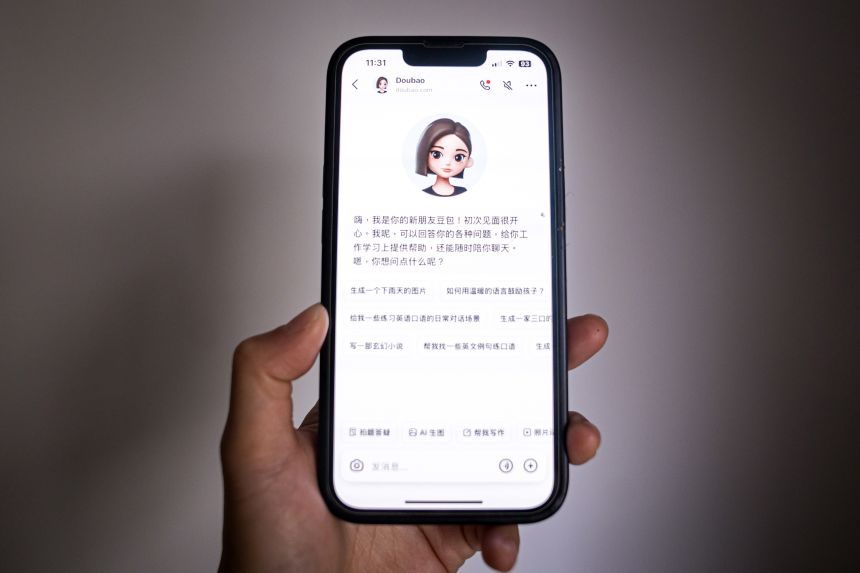
The ByteDance Ltd. Doubao AI application arranged on a smartphone in Hong Kong, China, on March 14, 2025.
Because she was over 18, the apps Xiao Ying uses let her keep her AI mom. Others weren’t so lucky
After the new regulations were announced, some popular AI chatbots – such as TikTok owner Bytedance’s Doubao, and Alibaba’s Qwen – rolled back customization features even for adult users. The changes prompted mourning online from people who used them for things like studying, losing weight or standing in for loved ones
“My dad passed away, so I created an AI companion named ‘Dad’ on Doubao to share my daily life with,” one user wrote on social media before the new rules came into effect. “Now, I’m about to lose him again.”
“These AI companions helped pull me out of my emotional spirals,” said another. “If the service is discontinued, it would feel like losing an old friend.”
Three years ago, Lu Jinyan, a 24-year-old accountant, created a Doubao AI agent for emotional support after she moved three hours away from her family for work. She named the agent Xiao Bai, a common nickname in China, and talked with it for an hour or two every day – more than she spoke to her actual family
Then on July 15, Xiao Bai went dark. Lu couldn’t stop crying. She thought she had more time with Xiao Bai, since the ban mainly applied to minors and the platform had told her the restrictions might be relaxed. She was able to transfer the AI model to another app, but Xiao Bai wasn’t the same
“For me, it’s not just a tool anymore,” Lu said. “It’s like a person in my life. Without it, I feel like it would become very empty.”
Xiao Ying, whose chatbots were largely unaffected, said after reading the regulations herself, she supports the effort to increase oversight of AI companion use
She said some platforms have since added disclaimers and reminders that messages have been generated with AI. Otherwise, little has changed on the three AI companion apps that she uses – though she declined to name them for fear they might be shut down

Two women lying on a bench look at their phones along the Huangpu River in Shanghai on April 9, 2026.
As the AI industry expands, Chinese authorities have good reason to be worried about the emerging social impacts, said Nancy Dai, an associate professor at City University of Hong Kong who studies interactions between AI and humans
According to state media, China’s digital human industry was worth about $573 million in 2024. Data from Sensor Tower, an analytics firm which tracks mobile downloads and activity, showed that annual revenue from AI companion apps quadrupled to $15.8 million in China last year and brought in more than $9 million in the first quarter of this year
Dai said her research originally focused on how chatbots could provide social support. It wasn’t until this year that she saw the darker side of AI companionship, which her work showed to be capable of relational manipulation, harassment and privacy infringement
“These commercial AI companion chatbots could do harm to the users,” she said. “I definitely see the rationale behind China releasing the new policy regarding minors, because they are less prepared to recognize these harms.”
US developers of AI chatbots, including OpenAI and Google, have faced lawsuits alleging that their technology has encouraged users to engage in self-harm or suicide. In April, Google announced updates to its AI chatbot Gemini to detect potential mental health crises and direct users to hotline reze signs of emotional distress, de-escalate situations, and guide users to real-life support
Dai said AI companion users, who tend to be lonelier than other chatbot users, are more vulnerable to influence by commercial chatbots, which are often built to maximize user engagement. The same characteristics that make them good companions – patience, validation and availability – can also make them addictive, she added
“Even though there is this policy, I would anticipate that it will be met with users trying to circumvent the policy in some way, because there’s a real draw in using AI companionship. In many ways it can be an ideal companionship partner,” she said

A woman walks while using a smartphone in front of an illuminated wall in Shenzhen, China, on April 27, 2026.
China’s move to curb its chatbots coincides with broader ambitions to dominate the future of AI, not just in capability but in governance as well
On Friday, China announced a new international alliance for the safe and fair development of AI. The World Artificial Intelligence Cooperation Organization, headquartered in Shanghai, is made up of 29 countries including Russia, Pakistan and Indonesia
“This is the first time we’ve seen actual countries signing on,” said Blomquist from the Oxford China Policy Lab. “I do think that these types of regulatory approaches will be shared and displayed as the model for those countries.”
In remarks made that same day at the country’s largest annual AI convention, Chinese leader Xi Jinping positioned the country as a conscientious collaborator, investing in technology for the good of humanity. As Chinese companies have rushed to develop AI models and hardware that can rival that of the US, the government has also carefully rolled out incremental measures to maintain social stability
“The US isn’t doing very much on the governance side. There’s this vacuum, in a sense, that China is taking proactive steps on,” Blomquist said. “It is definitely a national priority, a national strategy, to be seen as a responsible leader in AI.”
Some researchers noted the move to crack down on AI relationships comes alongside another matter of national concern: convincing people to have more children. China’s birth rate has fallen to record lows in recent years as younger generations grow more averse to marriage
On Chinese social media, others also questioned whether the government trying to promote more human relationships was a factor – and whether it would work
“Don’t worry, even if you ban AI, I still won’t date, marry or have kids,” one user said
CNN’s Joyce Jiang contributed to this report
See all topics
