

Breakneck pace in immigration courts is driving up deportation orders
The Trump administration is packing immigration courtrooms and giving less lead-time on hearings in an effort to clear a decades-long backlog
ByVALERIE GONZALEZ Associated PressandCYBELE MAYES-OSTERMAN /REPORT FOR AMERICA Associated Press
August 1, 2026, 12:04 AM
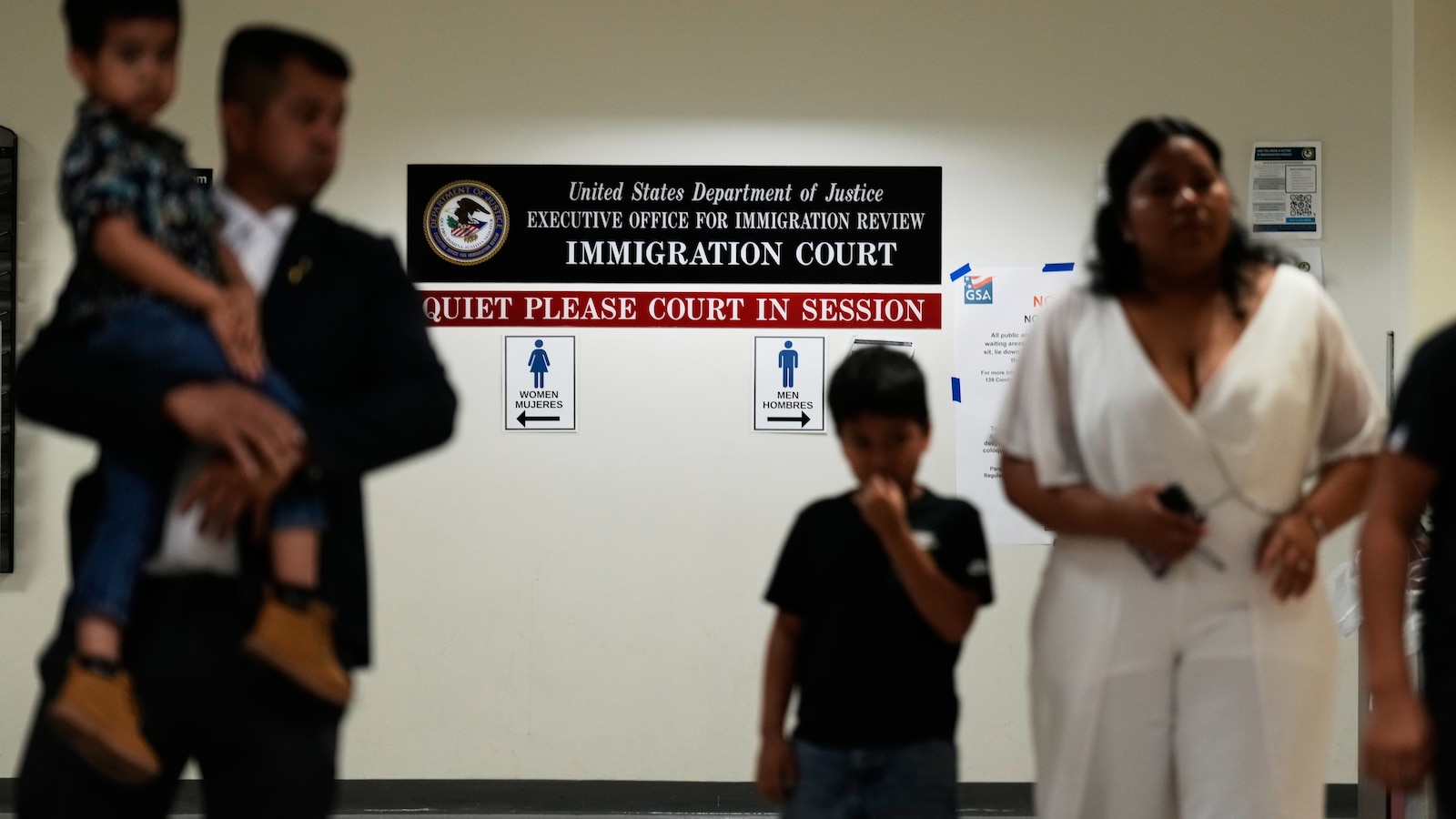
HARLINGEN, Texas –The Trump administration is packing immigration courtrooms and giving less lead-time on hearings in an effort to clear a decades-long backlog. The result is a historic rise in the number of people missing court dates and being immediately ordered deported as the system struggles to keep up, new data shows
Dozens and often hundreds of immigrants’ cases a day are being assigned to individual judges in courthouses across the country, in what are known as “mega” master hearings, which have seen a significant increase this year. More than 1,300 such hearings were held in June alone, a nearly threefold jump from the previous June, according to data analyzed by Mobile Pathways, a nonprofit that tracks immigration court data to help immigrants, their lawyers and other organizations
At the same time, the data shows, courts have severely cut the length of time many people are getting to prepare for complex immigration proceedings, from about six months to often just a little more than a month
They’re subsequently missing hearings, receiving deportation orders and being told they’ve abandoned any asylum claims at unprecedented rates
“The combination of collapsed lead times and packed hearing blocks is a schedule designed for people not to have their case heard,” said Bartlomiej Skorupa, chief operating officer of Mobile Pathways. “The data shows valid claims are closed before being adjudicated.”
Those who favor stricter immigration laws see the swift hearings as a course-correction for a longstanding problem
“There’s no credibility in the system that never reaches an end,” Andrew Arthur, a fellow at the conservative Center for Immigration Studies, said
Still, he worries that these rapid-fire hearings could affect judges’ performance
“You don’t want to put so many cases on that the judges get burned out or that there’s a danger of denying due process to anybody,” Arthur said
The Justice Department office that handles immigration courts said in a statement that judges were adjusting their schedules to resolve cases more quickly, while making sure all cases get handled fairly and lawfully. It said court delays harm immigrants who have valid claims, and that the public interest is served when the government deports people without legal grounds to stay
Attending immigration court in Harlingen, Texas, on days where there are mega master hearings can mean waiting outside in the hot, crowded entrance for over an hour until the lobby can accommodate the next wave of people. Adults with cases often are accompanied by relatives and attorneys, and detained children are brought in with shelter case managers and legal advocates
The courts call it a “mega” day when a judge has more than 50 cases scheduled. Although the practice is not new, it became much more frequent starting in mid-May
On a recent day, about 90 cases were scheduled with Immigration Judge Delia Gonzalez. More than 20 people did not show up, but even so she ran out of time to hear each case and rescheduled a handful of people who had waited more than eight hours
“There’s a real limit to how many cases a judge can hear with any care in one morning,” said former immigration judge Elizabeth Young. “When you cram that many hearings into a single docket, you’re working through a list, not holding court.”
Some immigrants requested more time before their next hearings, presenting evidence of having been defrauded by unscrupulous attorneys profiled in local news reports. Others without any attorney asked for more time to figure out the proper evidence filing procedures
A Colombian man who submitted more than 1,500 pages as evidence in his asylum claim said he still wanted to obtain more documentation from members of the military, businesses and politicians back home
Gonzalez declined the requests. Most cases lasted less than five minutes

Iran live updates: Trump weighs strikes on Iranian energy sites, US officials say
- Jul 31, 7:36 PM

Dad sentenced to 15 years in prison in school shooting carried out by teenage son
- Jul 30, 1:51 PM

Trump met with advisers on Iran options
- Jul 26, 3:49 PM
That same day in West Valley City, Utah, Immigration Judge Brock Taylor was assigned 159 cases. By noon, Taylor recited a dozen names of people from Mexico, Colombia, Peru and Venezuela who failed to show up. Without elaborating, he said each was properly notified of their hearing date and failed to appear. He ordered them removed from the United States and they would have no right to appeal
In Chicago, attorney Peter Meinecke, a lawyer for the Resurrection Project, which runs a legal clinic for immigrants, said one of his clients was issued a removal order when he couldn’t attend a mega master hearing across the country in Seattle after a vehicle accident fractured both of his legs and confined him to a wheelchair
At the start of the second Trump administration in January 2025, about 20% of people missed scheduled immigration court hearings nationwide As hearing notice times shrunk, that no-show rate doubled to 40% by this June, the organization said. A nonprofit group that tracks and analyzes immigration court data and gives that information to immigrants and other organizations
Deportation orders have risen alongside the no-show rates. Almost 33,000 deportation orders were issued in January 2025. This June, there were about 79,000 And once a deportation order is issued, an immigrant’s asylum claim is almost always considered “abandoned.”
The national rate of cases considered abandoned is now nearly five times the historical average dating back to 2009; in New York and Chicago specifically, it’s roughly six times higher
“That’s a recipe for disaster, because more people are going to be ordered removed in absentia who truly have a valid case,” said Katie Fleming, a director at Acacia Center for Justice, a network of legal service providers
Some people have even been issued deportation orders while they were inside the building that houses the Chicago immigration court, but confused about where to go and how to get help an attorney for the National Immigrant Justice Center, which runs a legal help desk there
“The court ordered them removed despite the fact that they were not absent,” McGriff said
Advocates for stricter immigration policies call the strategy a time-saver
“It really is economizing the judge’s time,” said Arthur, the Center for Immigration Studies fellow. “It is increasing the number of final orders that are going out, so that’s decreasing the backlog entirely.”
The backlog, which grew significantly under the Biden administration, has decreased for the first time in at least 10 years. The number of pending cases with the Executive Office of Immigration Review, which oversees immigration courts, decreased from 3.7 to 3.5 million in fiscal year 2025 and continued to drop this year
“It can be a tough job when you’re doing it at scale,” Arthur said
Attorneys representing immigrants have similar challenges keeping up as their own caseloads intensify
Jaime Diez, a veteran immigration attorney based in Brownsville, Texas, recently had almost 20 cases called in one day, nearly 10 times his previously normal pace
“Due process is being thrown out of the window,” Diez said standing outside the courtroom with a six-inch thick file for one client. “It’s very worrisome, I don’t know how long it’s going to last.”
Mayes-Osterman reported from Chicago and is a corps member for The Associated Press/Report for America Statehouse News Initiative. Report for America is a nonprofit national service program that places journalists in local newsrooms to report on undercovered issues. Associated Press writer Elliot Spagat contributed from West Valley City, Utah
