

Cyclosporiasis Outbreaks Hits More Than Half of the US
03:00
In recent weeks, headlines about an “explosive diarrhea” parasite have been seemingly everywhere, causing widespread concern. Cyclosporiasis typically spreads through contaminated food, and it’s been sickening thousands across the United States
The intestinal infection, caused by the cyclospora parasite, isn’t new and usually ramps up in the summer. However, multiple states are seeing large clusters of cases at numbers higher than expected for this time of year, especially Michigan, where over half of U.S. cases have been reported, per NBC News’ latest tally
“The very quick uptick and high numbers of cases, I would say, is unusual,” Kali Kniel, Ph.D., professor of microbial food safety at the University of Delaware, tells TODAY.com
The parasite spreads to people through contaminated food or water, and past outbreaks have been linked to raw produce. So, what’s driving the latest spike — and is it safe to enjoy fresh fruits and vegetables this summer?
Health officials are still investigating a potential
In a statement released on Monday, the Michigan Department of Health and Human Services said early results point to lettuce or salad greens as a potential culprit in the state’s outbreak, but that it still couldn’t rule out other foods completely
It’s currently unclear if the outbreaks in different states are connected, the U.S. Centers for Disease Control and Prevention previously told NBC News
What Is the ‘Diarrhea Parasite’ Going Around?
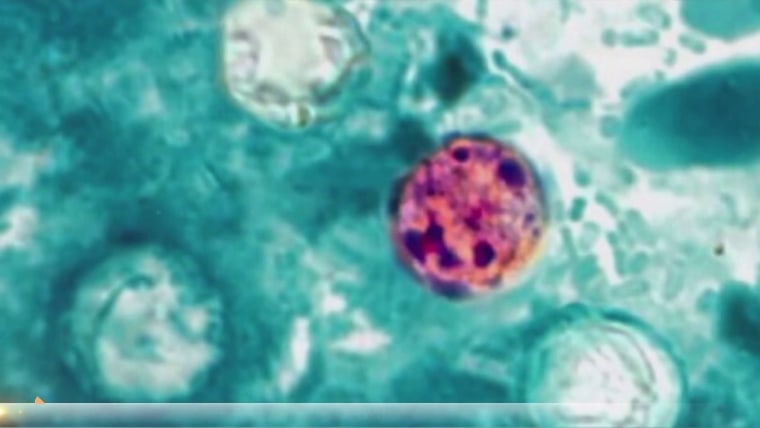
Cyclosporiasis is caused by Cyclospora cayetanensis, a microscopic parasite carried in human feces. People become infected by consuming food or water contaminated with particles of feces from an infected person, Kniel explains
When ingested, cyclospora infects the small intestine and causes severe gastrointestinal upset. The most common symptom of cyclosporiasis is sudden, watery, “explosive” diarrhea, which may persist for weeks, per the CDC
“If you’ve ever had a stomach flu or food poisoning, this is exactly what we’re talking about, but people describe it as being even worse,” NBC medical contributor Dr. John Torres said on TODAY in a July 14 segment
Cyclosporiasis is usually not life-threatening, and healthy people usually recover on their own, Kniel says. However, treatment with a combination antibiotic is highly effective
After the parasite is shed in stool, it takes one to two weeks living outside the body to mature and become infectious, says Kniel, which makes person-to-person spread highly unlikely
The parasite can get into produce if it’s grown in soil or washed with water contaminated with feces, for example. Fresh fruits and vegetables are common culprits, says Kniel
Where Are Cyclosporiasis Cases Surging?
As of July 14, about 5,000 cases of cyclosporiasis have been reported in more than 30 states, according to reports from state health departments confirmed to TODAY.com and NBC News
Additionally, the CDC has confirmed reports of 843 cyclosporiasis cases and 86 hospitalizations since May 1, which is considered the start of cyclosporiasis season in the U.S
Michigan is being hit the hardest. As of July 14, the state has reported 3,309 cyclosporiasis cases and 44 hospitalizations, per the MDHHS
Ohio, New York, North Carolina and Illinois are also seeing cases surge into the hundreds
There’s no evidence that there is a single, multi-state outbreak and it’s unclear if these clusters are connected, the CDC has said
“There may be multiple unrelated outbreaks going on at the same time,” Donald Schaffner, Ph.D., professor of food microbiology in the Department of Food Science at Rutgers University, tells TODAY.com
The true number of cyclospora infections in the U.S. is likely higher than the numbers currently being reported. That’s because many people who get sick with diarrhea do not go to a doctor or get tested for cyclospora, per the CDC
What Food Is Driving the Rise in Cyclospora Cases?
The cause of the recent cyclosporiasis outbreaks is still unknown. The CDC is working with the U.S. Food and Drug Administration to investigate a potential source
On July 13, Michigan health officials released a statement that identified “lettuce or salad greens” as a potentialannot be completely ruled out. No specific type of produce, grower or supplier has been identified as the
These early findings that point to lettuce only apply to Michigan. The MDHSS has shared instructions for “lettuce-specific safety measures” for people living in affected counties
It’s not clear if the Michigan outbreak is connected to the recent increase in cases in other states
“Much more likely, there are multiple parallel pathways for people to become infected,” Dr. Trevor Suslow, an expert on food safety and professor at University of California, Davis, tells TODAY.com
Past cyclosporiasis outbreaks in the U.S. have been linked to contaminated salad greens, cilantro, basil and raspberries
However, the experts emphasize that food isn’t the only culprit, and that water could potentially be to blame. Water contaminated with feces can be used to irrigate produce crops, for example
In Michigan and Ohio, the surges are happening in counties that border Lake Erie. “These cases seem to me to be more of a waterborne outbreak rather than a foodborne outbreak because of the geographical clustering,” says Schaffner, adding that it’s still to early to conclude how people were exposed
Michigan health officials stressed in a statement that “there is currently no evidence linking recreational water activities to this outbreak” and that “exposure to contaminated produce” is the main potential
Tracking Cyclospora Outbreaks
Cyclospora is a challenging parasite to track, food safety experts tell TODAY.com
“It has a much longer incubation period than most (types) of food poisoning,” explained Torres
Symptoms may not appear for up to 10 days, and confirming a diagnosis through testing and then arranging an interview with an epidemiologist to investigate can take up to a month or longer, says Schaffner. By that point, the person isn’t likely to remember what they consumed that could’ve caused the symptoms
As a result, only a small portion of cases every year get traced back to a particular food item, Dianna Blau, acting chief of the CDC’s Parasitic Disease Branch, told NBC News
It’s also worth noting that, in July 2025, the CDC’s foodborne surveillance network made testing for cyclospora optional, which could be impacting the response, Schaffner says
Should You Avoid Certain Produce?
The only way to prevent cyclosporiasis to avoid food and water that may be contaminated with feces. And because no definitivekeep off your grocery list — but the experts caution people not to panic
“Almost all servings of fresh fruits and vegetables that you can buy on the market today are not linked to this outbreak, and are not any more likely to cause illness because of the outbreak,” says Schaffner
So, currently there’s no reason to cut out raw produce, especially during peak season for so many delicious fruits and vegetables
“We know that fresh (produce is) part of a healthy diet, and I certainly don’t want to discourage that,” adds Schaffner, who still plans to enjoy his favorite fresh produce this summer
If you live in one of the affected counties in Michigan, the state health department is recommending the following precautions:
- Purchase whole heads of lettuce instead of pre-washed and packaged salad greens.
- Throw away the outer two to three layers of the leaves.
- Wash the inner leaves with clean, running water.
- If you cook your greens, do so to a temperature of at least 158 degrees Fahrenheit, which is ideal as washing doesn’t guarantee you will kill the parasite.
How to Prevent Cyclospora
“There are ways to be proactive,” says Kniel
Cooking food to least 158 degrees Fahrenheit is the best way to protect yourself. Freezing can also eliminate cyclospora, but it’s not guaranteed
Washing produce thoroughly can reduce the risk of foodborne illness, but it won’t eliminate cyclospora entirely, Suslow notes
State health departments have offered a few more tips to prevent cyclospora infection:
- Wash your hands well with soap and hot water before and after handling raw produce.
- Scrub all fresh fruits and vegetables with a produce brush under clean, running water. Do not use soap.
- Remove the outer layer of leaves or the peel, if possible.
- Cut or peel off damaged areas of produce before eating.
People with weakened immune systems may need to take extra precautions and should consult their doctor about how to avoid foodborne illness, says Kniel
“We are seeing hospitalizations, so if you do get sick, good hydration is critical, and so is getting clinical care because this can be treated,” Kniel adds
If you develop symptoms of cyclosporiasis, contact your doctor
