


The artificial intelligence arms race has entered a new phase. For the past two years, investors focused on which hyperscaler would spend the most on AI infrastructure. Now the more important question is how those investments will be financed.
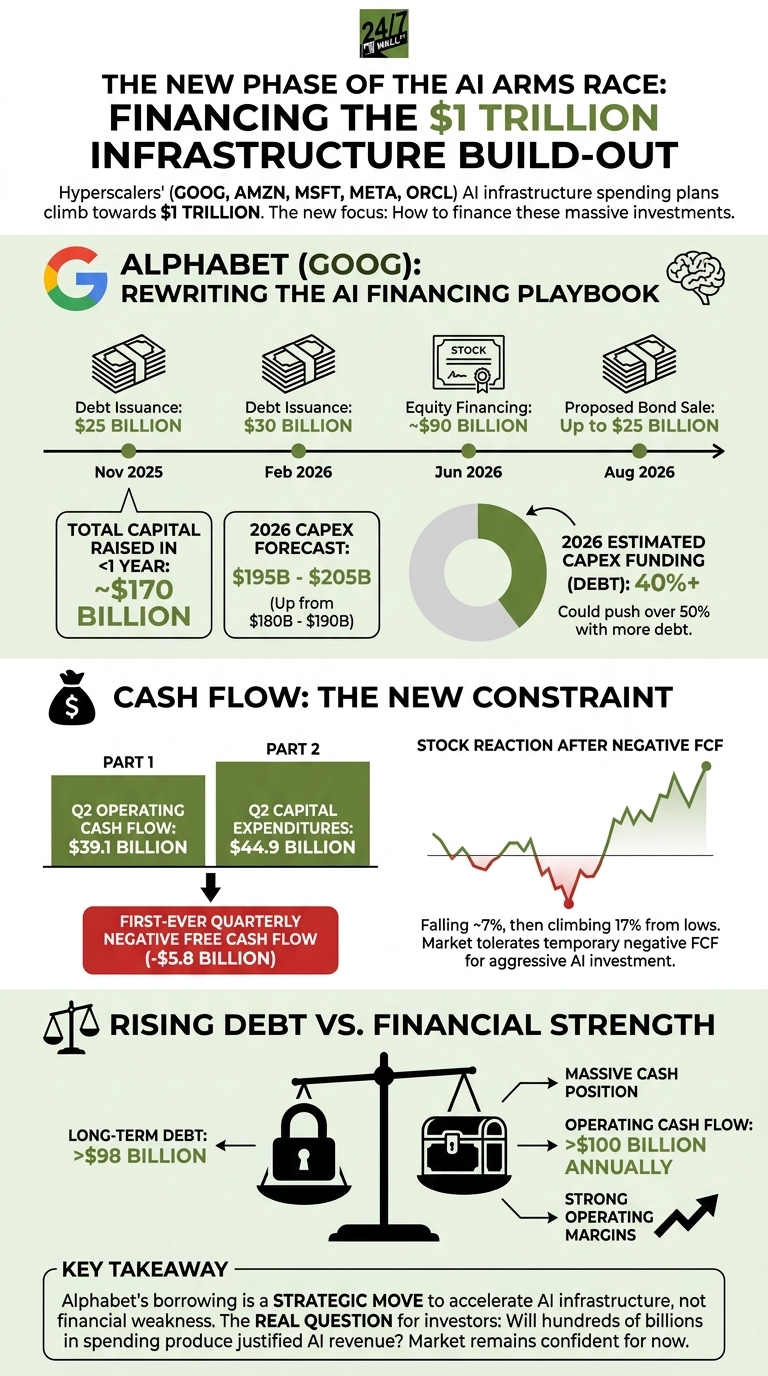
Capital spending plans fromAlphabet(NASDAQ:GOOG | GOOG Price Prediction),Amazon(NASDAQ:AMZN),Microsoft(NASDAQ:MSFT),Meta Platforms(NASDAQ:META), andOracle(NASDAQ:ORCL) have climbed towards $1 trillion, stretching even the enormous cash flows these companies generate. Instead of slowing their ambitions, they areincreasingly tapping debt marketsand equity investors to bridge the gap.
For long-term investors, that’s an important shift because it changes how these companies fund growth without necessarily changing the growth story itself
Alphabet Is Rewriting the AI Financing Playbook
Alphabet has become the clearest example of this new reality. The company is returning to the bond market for the third time in just nine months, seeking to raise as much as $25 billion through a new debt offering
| Financing Event | Amount Raised |
| November 2025 debt issuance | $25 billion |
| February 2026 debt issuance | $30 billion |
| June 2026 equity financing | Roughly $90 billion |
| August 2026 proposed bond sale | Up to $25 billion |
If the latest bond sale prices in full, Alphabet will have raised roughly $170 billion in fresh capital in less than a year. The timing isn’t surprising. Alphabet recently lifted its 2026 capital expenditure forecast to $195 billion to $205 billion, up from an earlier outlook of $180 billion to $190 billion
Assuming the company ultimately raises around $80 billion in debt this year, borrowings alone would finance about 40% of its projected capital spending. With four months remaining in the year, another debt offering could push that figure over 50%, although another equity raise remains a possibility
This isn’t because Alphabet can’t access capital. It’s because AI infrastructure is becoming too expensive to fund entirely from internally generated cash
© 24/7 Wall St.
Cash Flow Has Become the New Constraint
The biggest surprise from Alphabet’s second-quarter earnings last month wasn’t revenue growth or Google Cloud’s continued momentum. It was cash flow. Alphabet generated $39.1 billion in operating cash flow but spent $44.9 billion on capital expenditures, producing itsfirst-ever quarterly negative free cash flowas a public company
Normally, investors punish that kind of development, and initially they did. Alphabet shares fell roughly 7% immediately after earnings before reversing course. Within about 10 days, the stock had climbed 17% from those post-earnings lows as investors concluded that the cash burn reflected aggressive investment rather than weakening demand
Ironically, Wall Street appears more willing to tolerate temporary negative free cash flow than slower AI investment. That’s a remarkable change from just a few years ago, when free cash flow was one of the market’s favorite valuation metrics
Rising Debt Isn’t the Same Thing as Financial Stress
The obvious concern is leverage. Before the latest proposed bond offering, Alphabet reported more than $98 billion in long-term debt after its earlier financing rounds. Viewed in isolation, that sounds like a dramatic increase, but against Alphabet’s balance sheet, it looks much less concerning
The company still holds one of the largest cash positions in corporate America, generates well over $100 billion annually in operating cash flow on a trailing basis, and continues to post operating margins that most companies can only dream about
Granted, higher debt means higher interest expense, and investors should expect financing costs to keep climbing if Alphabet continues borrowing. It also raises the stakes for AI investments to generate attractive returns over time
But unlike highly leveraged companies borrowing simply to stay afloat, Alphabet is borrowing from a position of financial strength to accelerate infrastructure spending
Key Takeaway
In short, Alphabet isn’t signaling financial weakness by issuing more debt — it is acknowledging that a $205 billion annual AI investment program has outgrown what even its formidable free cash flow can comfortably support
For investors, the more important question isn’t whether Alphabet can afford another $25 billion in bonds — the evidence suggests it can — the real question is whether those hundreds of billions of dollars ultimately produce enough AI revenue to justify the spending.
Thus far, the market appears willing to give management the benefit of the doubt. Until that confidence changes, financing AI with more debt may prove to be a feature of Alphabet’s strategy rather than a flaw
Contact [email protected] for any questions or corrections
