

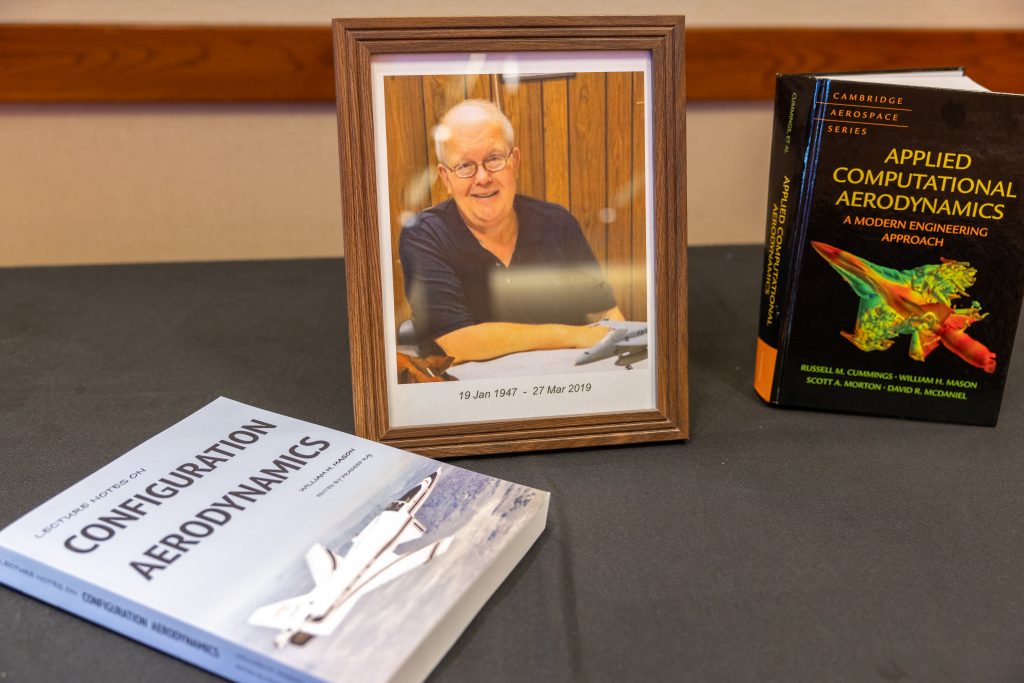
When “Lecture Notes on Configuration Aerodynamics” was released on Jan. 19, which would have been William Mason’s 79th birthday, it marked more than the publication of a new engineering re, and a shared commitment to honoring a colleague’s legacy while expanding access to knowledge
Sharing scholarship with the world
What followed was a complex, highly collaborative process to publish the manuscript. With the support of Mason’s family, including his sister, Carol Bland of Fairlawn, Virginia, the team secured permission to update and publish the work under an open license.
“Our family is delighted to see Bill’s work and legacy honored in this way,” Bland said
Pradeep Raj, collegiate professor emeritus of aerospace and ocean engineering, helped lead the effort
“Dr. Mason painstakingly prepared a comprehensive set of lecture notes that he shared with the students enrolled in his Configuration Aerodynamics class, a course he created from scratch and taught for more than two decades,” Raj said. “The manuscript he left behind had a few gaps that he intended to fill over time, but it was more like a ‘diamond in the rough.’”
In the years following Mason’s passing, the department recognized the value of the material and began exploring its future.
“In the 2020-21 timeframe, the department decided to explore converting the manuscript to an open textbook,” said Raj. “Anita Walz of University Libraries enthusiastically embraced the idea, and the publication of the book in January 2026 is largely the result of her leadership and dedication.”
“This is a story about honoring people and the importance of relationships,” said Walz, assistant director of open education and scholarly communication librarian. “It’s a story about the value of teaching materials as scholarship, about how open educational re can advance instruction and learning in technical fields, and how collaboration across time can make a difference to students and industry.”
“My experience working with University Libraries was excellent,” said Raj. “Everyone I worked with was a consummate professional, very knowledgeable about their roles and responsibilities, and always willing to go the extra mile to help me out. Since I had no prior experience in publishing a book, I knew little about the scope of the effort. Anita Walz and Kindred Grey patiently educated me and guided me through the many challenges we faced along the journey.”
A collaborative effort
The work was spearheaded by Raj, who served as the manuscript’s editor, refining and preparing it for publication. He researched concepts and applications beyond his primary area of expertise to provide accurate and up-to-date content. The project’s development was funded and supported by the Libraries’ Open Education Initiative Faculty Grant, led by Walz, and published by Virginia Tech Publishing & Press, with production led by Kindred Grey
Additionally, several dedicated Virginia Tech students, now alumni, Pranay Patel ’23, M.S.’24; Sullivan Madden ’23; and Joseph Brooks, B.A.’17, B.S.’17, Ph.D. ’22; helped bring Mason’s unfinished manuscript to fruition, providing production and technical assistance for the publication, including creating alternative text for over 300 figures and converting handwritten mathematical equations to machine-readable formats
“Working on this book was an absolute honor,” said Pranay Patel, a former Virginia Tech student. “It was really interesting getting to know Dr. Mason’s story and collaborating with Dr. Raj and the University Libraries team to bring this work to life. It also reinforced concepts I learned in my junior year. I only wish I’d had the opportunity to take Dr. Mason’s course.”
A full list of project team members can be found in the digital version of the book
Continuing a teaching legacy
The resulting book fills a gap between theory and practice in aerospace education, offering practical design perspectives that are often underrepresented in traditional curricula yet essential to both students and industry professionals.
“The goal was to make Bill Mason’s lecture notes readily available to the global aerospace engineering community at large and to the students and practitioners of aerodynamics in particular,” said Raj. “The book offers them the requisite information for applying the fundamentals of aerodynamics they have learned in standard textbooks to tackle the challenges of the aerodynamic design of aircraft.”
Today, the textbook is used in AOE 4124: Configuration Aerodynamics, a course originally designed by Mason and considered foundational within the department. Beyond campus, the open-access format ensures that students, educators, and professionals worldwide can freely benefit from the work
Early indicators point to strong global interest, with more than 1,400 downloads of the PDF version and 167 downloads of the epub version in less than eight months since its publication.
The release also contributes to a broader milestone. “Lecture Notes on Configuration Aerodynamics” is the 35th open textbook supported by the Open Education Initiative, which has saved Virginia Techstudents more than $5 million since 2016
“The publication of Mason’s lecture notes as an online, open access book ensures that countless future students, at Virginia Tech and at other universities worldwide, as well as professionals involved in aircraft design, will have the opportunity to benefit from his insights,” said Raj. “We believe this is the best way to preserve Bill Mason’s legacy.”
Raj hopes the book will inspire future engineers. “I want people aspiring to be aerodynamicists engaged in airplane design to know that ‘Lecture Notes in Configuration Aerodynamics’ is an incredible refectively applying basic aerodynamics theories in creating aircraft configurations that best meet customer needs,” said Raj
The book’s relevance is already extending into the workplace. “I worked on this book during the final semester of my master’s program at Virginia Tech,” said Patel. “Since graduating, I’ve started working at The Boeing Company and recently accepted a role as an aerodynamics engineer. I’m excited to use this book in my work, and I’ve already seen colleagues with copies on their desks.”
Faculty with course materials or unpublished manuscripts relevant to Virginia Tech courses are encouraged to explore opportunities with University Libraries’ Open Education Initiative by emailing openeducation@vt.edu, continuing the cycle of sharing knowledge in ways that benefit both Virginia Techand the global community
Honoring the past, supporting the future
In April, faculty, family members, friends, and colleagues gathered for a celebratory lunch and open house organized by AOE Administrative Support Specialist Anna Baker. The event offered an opportunity to reflect on Mason’s contributions, share memories, and see the finished work, a tangible continuation of his impact
The project also stands as a testament to the generosity of Mason’s family, whose support made the work possible. With their permission to adapt and publish the manuscript, the team was able to bring his unfinished notes to life for a new generation of learners. For many involved, most of whom never had the opportunity to meet Mason, the process underscored both the weight of his absence and the enduring reach of his influence. Their gratitude to his family runs deep, not only for entrusting them with his work, but for helping preserve and share a legacy that continues to shape students, educators, and practitioners around the world.
For Raj, the project was deeply personal. “I had known Bill Mason for several decades, including the seven years he was my esteemed colleague at Virginia Tech after I joined VT in 2012,” said Raj. “We had learned very similar lessons from our experiences in industry and academia. One of the lessons being the crucial need for students to develop competency in practical applications of aerodynamic theory for aerodynamic design of aircraft configurations using modern computational tools. And Bill Mason acted on it! It would be a crying shame if we couldn’t do everything possible to share his insights for the benefit of a large number of students and practitioners of aerodynamics.”
Contact:
Ann Brown
540-231-1886
