

Courtesy of EuropaCorp
Caleb Landry Jones plays young, newly ordained pastor torn between the congregation he inherits in a small Texas town and an unhoused community desperately in need of help in Down the Arm of God, a powerful indie drama that’s clearly on the side of the angels
With assistance from producer Luc Besson among others, Austrian-born director Peter Brunner, making his second feature with Jones after To the Night, elicits sincere, persuasive performances from his varied cast, including a fair few non-professionals with direct knowledge of homelessness. Peter Flinckenberg’s lively lensing and engagement with the distinctive light conditions of the location add an entrancing glow to the proceedings
Down the Arm of God
The Bottom LinePreaches to the converted.
Venue: Locarno Film Festival Cast:Caleb Landry Jones, India Marie Cross, Nick Stahl, Mena Suvari, John Jones, Whoopie Campfield, Dene Valentine, Amanda Davis, Atlas Fulton, Fable Fulton, Glenamzye Norment, Mike Johnson, Bobbie Lo Fruge, Crystal Salazar, Cassandra Fuentes, Kip Billups, Rhonda BennettDirector: Peter BrunnerScreenwriter: Peter Brunner, Caleb Landry Jones1 hour 46 minutes
While all that weighs in the film’s favor, on the debit side Brunner and Jones make it pretty clear where their sympathies lie, which makes the film feel a bit manipulative and ploddingly polemical. Admittedly, viewers on the festival circuit, like those in Locarno where this debuted, and folks who might catch it on streamers or in niche distribution are unlikely to be very bothered about the film’s lack of impartiality. But arguably the script by Jones and director Brunner might have been a skoosh more impactful if the small-minded townsfolk, clearly coded as bigoted MAGA types, weren’t quite so hateful with only a few exceptions.
As the story starts, Landry Jones, himself a native Texan, is Nick, a fresh-faced minister from Dallas originally just settling into the small community near the Panhandle that he’s been assigned to shepherd. His flock consists mainly of white families whom we see mostly in their Sunday best, so it’s not easy to judge the economic realities that underpin this community, nor is the film very specific about what denomination exactly this is supposed to be. Suffice to say, that there’s no obvious dancing with snakes or speaking in tongues that suggest Pentecostalism, or choice of readings that would mark the congregation as, say, Episcopalian — although the choice of songs (like Sunday school banger “I Got the Joy Joy Joy”) Nick likes to play on the guitar lean low church.
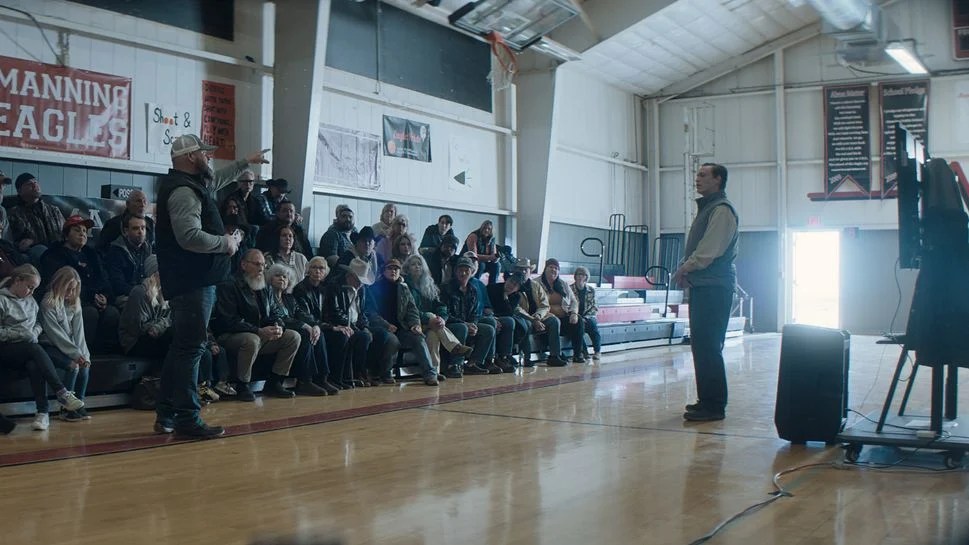
This lack of specificity is also a bit of a flaw, because it suggests the filmmakers aren’t very interested in the theological forces and powers that be that shape what turns out to be a self-centered, possibly racist worldview. That narrow-mindedness is immediately apparent when Nick asks his congregation to help the group of unhoused people, a little over a dozen souls or so, who live in a makeshift camp on the edge of town. Most of them react fearfully and clearly want nothing to do with them, especially a classically WASP-ish blond-haired, clean-cut nuclear family led by Chris (Nick Stahl) and Anna (Mena Suvari), parents to pre-adolescent youngsters Elijah (Atlas Fulton) and Faye (Fable Fulton). Anna practically clutches her pearls when asked to help the homeless.
That said, some folks, like the local nurse (Amanda Davis), agree to come out to the encampment and treat the residents, many of whom are physically disabled, suffer from mental disorders or are war veterans probably still in the throes of PTSD. Young Raven (India Marie Cross, a real find making her feature debut here) emerges as a de facto leader of the unhoused, passionate about protecting her friends but able to see reason when Nick argues, for example, that they should come stay inside somewhere when a harsh winter storm damages their encampment.
Naturally, the townsfolk fly into a rage at the mere suggestion that the unhoused should be put up in their community hall or school gymnasium, afeard as they are that their children will be in danger. Especially fierce in his objections is John (John Jones), a veteran himself of the Afghan war who lost his legs to a landmine. When confronted with fellow soldiers among the homeless community, John simply refuses to believe them when they say they too served in the military, or berates them for not taking up the benefits they might deserve. Angry words soon turn into protests and outright violence, with the gun violence that seems as inevitable as a winter storm on the horizon.
As Childish Gambino says, this is America, and at its best moments the script captures the way this nation’s irreconcilable differences play out in arguments with people interrupting and talking over one another, all sides refusing to listen. The climax is as needlessly tragic as one might expect, although Brunner rather rushes through the aftermath in a way that risks seeming implausible
But at least there is a tiny sliver of hope in the very last scene, which features Jones’ real father in a silent but moving cameo role. Further balm is provided by the lovely, country-folk songs by Rhonda Bennett that she both plays onscreen here as one of the unhoused people and that are heard over the end credits
Full credits
Venue: Locarno Film Festival Production companies: EuropaCorp, Roosevelt Film LabCast: Caleb Landry Jones, India Marie Cross, Nick Stahl, Mena Suvari, John Jones, Whoopie Campfield, Dene Valentine, Amanda Davis, Atlas Fulton, Fable Fulton, Glenamzye Norment, Mike Johnson, Bobbie Lo Fruge, Crystal Salazar, Cassandra Fuentes, Kip Billups, Rhonda Bennett, Lacey Epperson, Ellis ‘Rusty’ Donelson, Monica Samora, Anfonnichio Jones, Kylea Broom, Casey Poque, James Piedra, Bart Guthrie, Penny Loudder, Patrick JonesDirector: Peter BrunnerScreenwriter: Peter Brunner, Caleb Landry JonesProducers: Luc Besson, Caleb Landry Jones, Christian Sosa, Jon WroblewskiExecutive producers: Paul Merryman, Jennifer KuczajDirector of photography: Peter FlinckenbergProduction designer: Ashlie AdamsCostume designer: Olivia MoriEditor: Peter BrunnerSound editing: Clément MaurinSound mixing: Sean McCormickMusic: Tim HeckerMusic supervisor: Christian ChevalierCasting: Peter BrunnerSales: Kinology1 hour 46 minutes
