

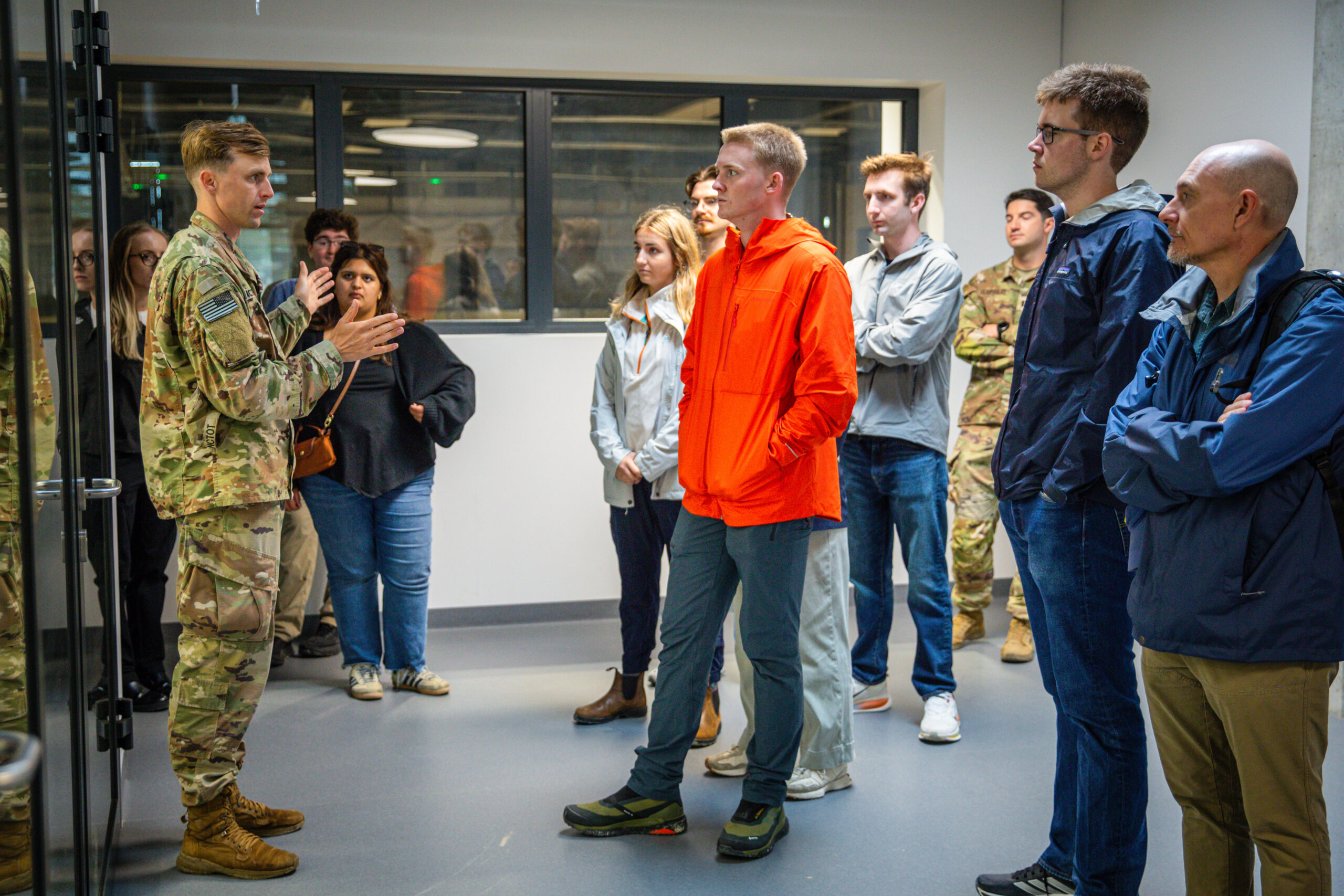
This fall, the Clements Center for National Security welcomes the inaugural class of its Defense Technology Fellows Program, a yearlong undergraduate fellowship built for students in science, technology, engineering and mathematics (STEM) who want to understand the defense world their work may one day shape. A group of 15 undergraduate students make up the first cohort
The fellowship answers a problem the national security community has discussed for years: a widening talent gap between the people who build advanced technology and the institutions that use it. The most consequential defense questions increasingly center on artificial intelligence, autonomy, nuclear power and robotics, yet the students mastering those subjects rarely encounter national security as a field of study. That gap is what the Clements Center hopes to address with its new Defense Technology Fellows Program.
“The Clements Center has historically attracted history, political science and government students to its programs. STEM students have parallel but different interests, and we weren’t always reaching them,” said Dirk Ringgenberg, professor of practice at the Clements Center and the faculty lead for the new program. “They’re building things that may or may not touch defense, and they often don’t know which. They’re fascinated by what they don’t know, and for a lot of them, that’s the entire defense industry.”
For Paul Edgar, executive director of the Clements Center, the program extends a long-standing mission to a new audience.
“New technology and national security are a perennially challenging combination, even before the invention of bronze, the domestication of the horse, and their employment in war,” Edgar said. “Today, the challenge is staggering and consequential. It is a challenge that cannot be met by engineers or strategists working in isolation. This program brings those worlds together for our young, bright minds; it familiarizes them with the defense tech ecosystem before they enter it. There is no better place to do that than The University of Texas at Austin. We are giving talented students a grounding in technology, current events, policy, business, history and strategy that will serve them, and the country, for the rest of their lives.”
The right place
A strength of this program is in its location and the access it provides. “Austin holds one of the densest concentrations of defense innovation in the country and gives us something very unique,” Ringgenberg said. “Austin brings together the state government, the state’s flagship public research university, a dense cluster of defense and dual-use companies, and a four-star Army command — the U.S. Army Transformation and Training Command (T2COM) — all within roughly a 5-mile radius.”
That concentration is growing on campus as well: UT Austin is hiring more than 20 new scholars in national security-related fields beginning this fall, a signal of how central these questions have become to the institution. Beyond campus, venture funding for Austin-area startups reached a record $7.19 billion in 2025 Among the year’s largest rounds was a $600 million infusion for Saronic Technologies, an Austin company that builds autonomous naval vessels.
The program is designed to use that access. In addition to guest lectures from practitioners, including military officers, policymakers, industry leaders and government researchers, fellows will visit sites directly. Plans for the fall semester include visits to the nuclear research reactor at the J.J. Pickle Research Campus, the Texas Robotics facility in UT’s Anna Hiss Gymnasium, and Camp Mabry. A spring trip will take students to two of the three laboratories in the Department of Energy’s National Nuclear Security Administration: Sandia National Laboratories and Los Alamos National Laboratory.
Although the fellowship is built primarily for STEM students, it is open to undergraduates in other majors who can demonstrate an interest in the program and relevant professional experience through an internship or prior job experience
Read the full story on the Clements Center website. Applications for the 2027-28 cohort will open during Spring 2027. More program information is available on the Defense Technology Fellows Program page
