
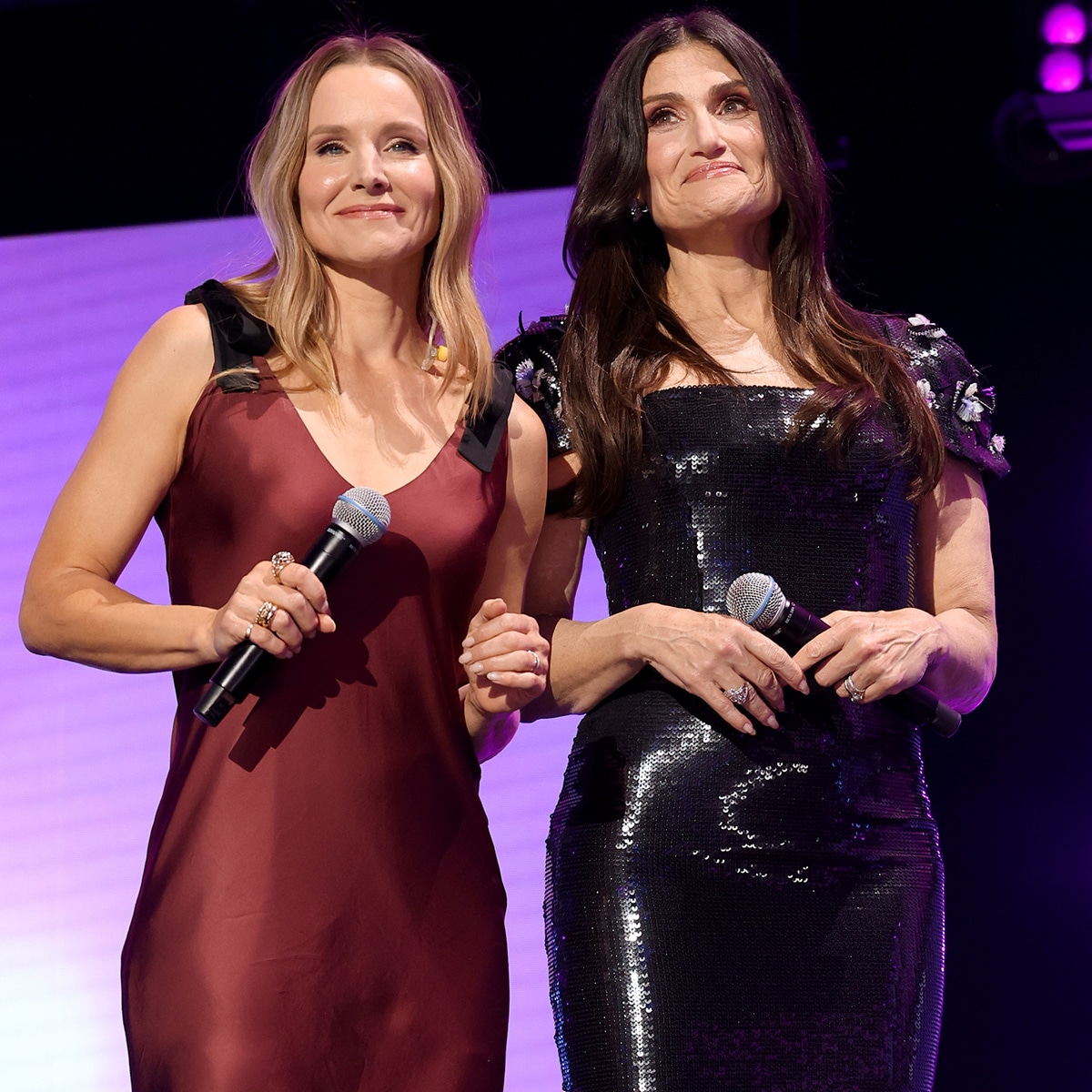
Watch:Kristen Bell, Idina Menzel Reveal How Frozen 3 Got Off the Ground
Kristen Bell and Idina Menzel weren’t letting it go when it came to making Frozen 3.
Indeed, the pair—who voice Anna and Elsa, respectively, in the franchise—shared insight into how they advocated to reprise their roles in the iconic Disney films
“The second [Frozen 2] was over I was waiting by the phone and/or texting everyone, ‘When are we gonna do it?’” Bell exclusively told E! News at the D23: The Ultimate Disney Fan Event Aug. 14 of Frozen 3. “And so I was in an anticipatory place.”
While she doesn’t remember getting the phone call for Frozen 3, which hits theaters in November 2027, Bell certainly recalls ringing Disney’s line for an update on the film.
She added, “I just remember when I called, they were like, ‘We’re talking about it. We’re discussing it.’”
And team Disney doesn’t make a move without knowing it’s a step in the right direction.
“They wait for the right time,” Menzel explained. “They don’t rush to get back to it. They only do it if they feel like they have the right story to tell.”
photos
We Can’t Let Go of These 15 Secrets About Frozen
“So, they’re super patient with it, and I guess we were a little impatient because we really like to get back to the process,” she added. “We love being together. We love revisiting these characters.”
Indeed, Bell couldn’t get enough of her Frozen family after the second film in the franchise came out in 2019, six years after the original film. As she put it, “the second the second Frozen came out, I was like, ‘Well, I’ll be outside Walt Disney Animation Studios if you need me.’”
Photo by Kevin Mazur/Getty Images for Disney
Recently, Bell opened up about her rumored $60 million salary from the Frozen sequels
“I think there’s been a lot misreported about that Frozen deal,” she told Entertainment Tonight at the 2026 Actor Awards—previously referred to as the SAG Awards—Mar. 1. “No, no, no, no, no that’s somebody making a lot of things up.”
Regardless, she hopes being a part of the franchise remains an open door for years to come.
“But that said, am I happy to have that job and does it pay very well because it’s a successful franchise? Yes,” Bell added. “And I’m so grateful for it and I will continue to do it for the rest of my life if they’ll have me.”
Keep reading for more Frozen secrets…
Photo by Alberto E. Rodriguez/Getty Images for Disney
The first modern attempt happened in 2002, and when 2003 also proved unsuccessful, more stalled attempts followed over the years. Frozen really didn’t start coming together until Christopher Buck, who directed Tarzan, came aboard in 2008, but the film wasn’t commissioned until 2011 following Tangled’s box office success.
And in 2012, Jennifer Lee, who initially came on as a screenwriter, was named co-director, making her the first woman to direct an animated film by Walt Disney Animation Studios.
2. The movie was going to be titled The Snow Queen after the original fairy tale, but the filmmakers decided to change it to Frozen “because, to us, it represents the movie. Frozen plays on the level of ice and snow but also the frozen relationship, the frozen heart that has to be thawed,” producer Peter Del Vecho explained to Bleeding Cool, denying it was inspired by Tangled. (The Snow Queen title was still used overseas.)
Bell, whose dream since she was a little girl was to voice a Disney character, was the “very first actress” to audition for Anna, with Lee saying, “We did audition a lot of people for that but she was the first and the best. We just fell in love with her.”
“They read the whole script and at the end—we didn’t have any songs written yet—and what they did was sing a duet and they sung ‘Wind Beneath My Wings,’ but they sung it like sisters and what you mean to me,” she explained. “And there wasn’t a dry eye in the house after they sang…that is when they knew, that was the whole potential and understanding the power of music and of what this emotional story can be.”
“Originally, she was much more villainous,” Buck allowed to Nerdist. “It’s very easy to go in that direction for that type of character, but as the time went and we evolved the story, she became much more three-dimensional. Before, I thought she was one-dimensional but a very fully fleshed out character.”
The moment the character really changed, though, was after they watched earlier cuts and realized it wasn’t exactly working: “Someone came up with the brilliant idea…’what if the protagonist, Anna, and Elsa were related?'” art director Michael Giaimo revealed. “Because they weren’t always siblings, they weren’t always related, and that was the beginning of finding these characters.”
“She created these snowman guards and Marshmallow was kind of a holdover from that because he was this scary snowman guard. Olaf was the very first guard she created,” Buck explained, adding he was still funny at that time.
After changing the character of Elsa completely, it wasn’t until the directors first sat down with Josh Gad that they found the character. “Josh adlibbed the line ‘it’s like a baby unicorn’ and there was something about that innocence,” Del Vecho told Kidz World.
7. One main character who wasn’t originally in the movie was Hans, Anna’s suitor-turned-villain, with Giaimo explaining, “Hans was never originally in the story in older versions…Kristoff always was in the story or a version of the Kristoff character and Anna. And then Hans was brought in at one point but he wasn’t always a villain who turned initially, and then someone came up with the idea of him turning. He was always potentially a villain, but we gave it away much sooner.”
Listening to songs by Adele and Avril Lavigne and being surrounded by nature, Anderson-Lopez told Playbill, “We were in this kind of emo place of imagining what it would be like to be this perfect person who messed up once, and was chased away from everything she has known and all the people she has been sacrificing for.”
Within a day, they would write the film’s most iconic song that would go on to sell over 10 million copies in 2014 and win the Oscar for Best Original Song. All together now, “Let it go, let it goooooooo.”
“Half of us were crying. And then I just went, ‘I have to rewrite the whole movie,'” she said on the Scriptnotes podcast. “I really, it was—I was just like I’m going to go lie down for a couple minutes. But it was the best thing. We knew we had the movie.”
13. On the same podcast, Lee admitted there was “a lot of push and pull” when it came to Elsa’s look after her transformation via “Let It Go” and how sexy to make her after this awakening.
“Everyone was seduced by her. And so there was this tug of war I think, a bit, of letting people have a little—people who wanted to have that a little and not be afraid of it, but not make it a sexual statement,” the co-director explained. “It’s more a moment of, for me, it was like you strut and you say nobody is looking, this is what I’m going to—I’m not going to be afraid of my sexuality. I’m not going to be afraid of who I am. I’m not going to be afraid of anything about myself.”
He said they washed up on the shore of a jungle and built “a tree house” before being “eaten by a leopard.” That baby boy? Tarzan, of course.
“That’s my fun little world,” he later told MTV. While the theory isn’t official (and definitely takes a hit when you factor in the events of Frozen II), Buck said, “Whatever people want to believe, go for it. If you want to tie them all together, then do it.”
Beginning with a prophecy about “a ruler with a frozen heart will bring destruction to the kingdom of Arendelle,” viewers would learn Elsa became the Snow Queen after she was left at the altar and decided to freeze her own heart, according to EW.
By the end of the film, Anna convinces Elsa to use her powers to save Arendelle from an avalanche started by Hans, with the ultimate reveal being the prophecy was actually about the two-faced prince. (Elsa’s heart would then unfreeze, making her capable of love again.)
“The problem was that we felt like we had seen it before,” Del Vecho told EW of the original ending. “It wasn’t satisfying. We had no emotional connection to Elsa—we didn’t care about her because she had spent the whole movie being the villain. We weren’t drawn in. The characters weren’t relatable.”
