

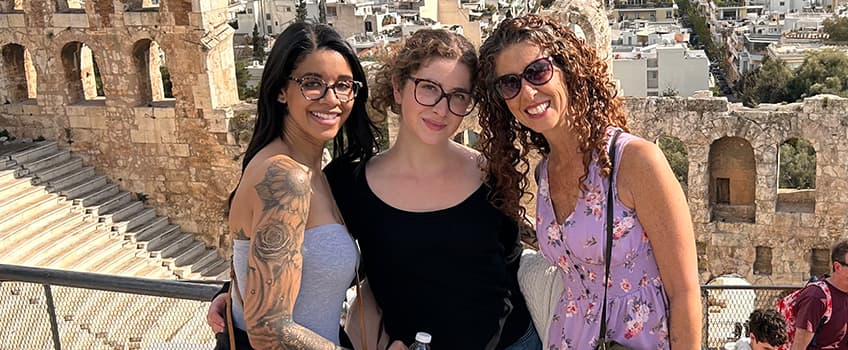
Stockton Opens New Doors to Global Learning
August 13, 2026
Study abroad is just one way for Stockton University’s campus to become more internationalized.
The Office of Global Engagement is also developing programs to push global learning
on campus
Galloway, N.J. — A Stockton University education is designed to help students see beyond the boundaries
of a classroom, a campus and, increasingly, a country
Through new partnerships with universities around the world and programs that bring
international perspectives directly into Stockton classrooms, students are gaining
opportunities to work across cultures, encounter different ways of thinking and better
understand their place in an interconnected world. And they don’t necessarily have
to study abroad to do it
“I want to integrate policies, programs, initiatives and individuals to make Stockton
more globally oriented and internationally connected,” said Patty Sagasti Suppes,
the university’s director of Global Engagement, directly citing the definition of
“internationalization” from the American Council on Education. “I want to see us embed
much more internationalization in our curriculum and in the campus life.”
I want to integrate policies, programs, initiatives and individuals to make Stockton
more globally oriented and internationally connected. I want to see us embed much
more internationalization in our curriculum and in the campus life.”
Patty Sagasti Suppes, Stockton’s director of Global Engagement
That effort is expanding what a Stockton education can offer students, whether they
spend a semester in another country, participate in a shorter faculty-led program
or collaborate from Galloway with students thousands of miles away
During the 2025-26 school year, Stockton signed new memoranda of understanding with
Sefako Makgatho Health Sciences University in South Africa; Universidad Panamericana
in Mexico; and the National Academy of Art in Bulgaria. Those join long-standing partnerships
with Nürtingen-Geislingen University and the Neu-Ulm University of Applied Sciences
in Germany
Sagasti Suppes also understands some will never want to leave Stockton’s Galloway
campus, but the university’s push for global learning does not leave them behind.
Last year, she instituted a collaborative online international learning (COIL) pilot
program with select professors
COIL is a virtual exchange program where professors from two different countries at
two different universities bring their students together virtually. The students,
with help from the professors, must learn how to figure out a problem together, despite
communication and cultural differences, over a five-week period
“Research shows that COIL can help students learn these intercultural competencies
in a very similar way that study abroad does,” Sagasti Suppes said. “So, my hope is
that students will decide well this wasn’t bad. I’ve been working with somebody in
a different country. Maybe actually going abroad isn’t so horrible or scary. Maybe
it’s attainable.”
Sagasti Suppes believes faculty study-abroad experiences are among the most effective
ways to bring international perspectives into the curriculum
“Nobody has more influence over the students than their professors,” she said. “They
trust them. They look up to them. If a professor says studying abroad is going to
be beneficial to your career and it’s a wonderful life-changing experience, that’s
a much stronger message.”
Agreements with universities abroad are one traditional way of exposing faculty to
international perspectives. As part of the agreement with Aristotle University of
Thessaloniki, Stockton was accepted into the Erasmus+ program funded by the European
Union to send students and faculty members to Greece. Stockton can also host the Greek
university’s faculty and researchers.
“My time in Greece was deeply meaningful, both personally and professionally. As an
Erasmus+ scholar, I had the opportunity to share my work on teaching the Holocaust
through children’s literature with my Greek colleague and her students, further developing
an existing collaboration,” said Judy Vogel, a professor of Mathematics and Holocaust
Studies, who traveled to Greece in January. “Visiting cultural sites connected to
the history of the Holocaust provided an important lens that continues to impact my
research and pedagogy.”
Also, Sagasti Suppes is strategizing to get more university faculty involved with
the U.S. Fulbright program, a cultural exchange organization administered through
the Institute for International Education that selects students and scholars to study,
teach and conduct research abroad
She recently was one of only 17 people nationwide to receive a Fulbright International
Education Administrator Award. She will spend two intensive weeks in November in Berlin
taking a seminar on the higher education system in Germany and developing new partnerships
to bring back to Stockton
Other recent Fulbright awardees at Stockton include Associate Professor of Business
Studies Behnam Tavakkol and Professor of Mathematics Chia-Lin Wu who were selected
as Fulbright Specialists. Their selections will allow them to be matched with an international
university for projects that last two to six weeks at a time over three years
Earlier this year, Eline Xia ’25 was selected as a Student Fulbright recipient. The
Political Science and Sustainability graduate will participate in the Erasmus Mundus
Joint Master in Global Environment and Development through the University of Copenhagen
in Denmark this fall
Finally, Sagasti Suppes said the OGE has been providing more training to faculty interested
in leading travel programs abroad
“In the past, Stockton faculty did not have a lot of preparation for teaching travel
courses abroad. This training will better prepare them to develop and run successful
programs,” she said. “The ultimate result should be faculty-led programs that will
be stronger, and we might even have more of them.”
Together, the programs are intended to make encountering different cultures and perspectives
a more integral part of a Stockton education, Sagasti Suppes said
“Internationalization doesn’t mean everybody has to go abroad. It means being willing
to see the world in a different way,” she said. “It’s about learning to see yourself
and your place in the world. It’s about self-reflection because our own cultures are
invisible to us.”
— Story by Mark Melhorn
Tagged:
Office of Global Engagement2026International educationStudy AbroadNews
