

Taylor Farms can’t catch a break this summer—and neither can we. Hot on the heels of the ongoing Cyclospora outbreak that’s impacted leafy greens, another recall is affecting numerous products containing jalapeños, also sold by Taylor Fresh Foods (which operates under the name Taylor Farms)
Earlier this month, it was reported that 110 people became sick after consuming jalapeños sold at Chipotle locations in Minnesota. As a result, Qdoba restaurants pulled the product from their stores out of an abundance of caution. As of now, the FDA does not consider there to be an ongoing risk from these establishments due to their actions to remove the affected product from their stores
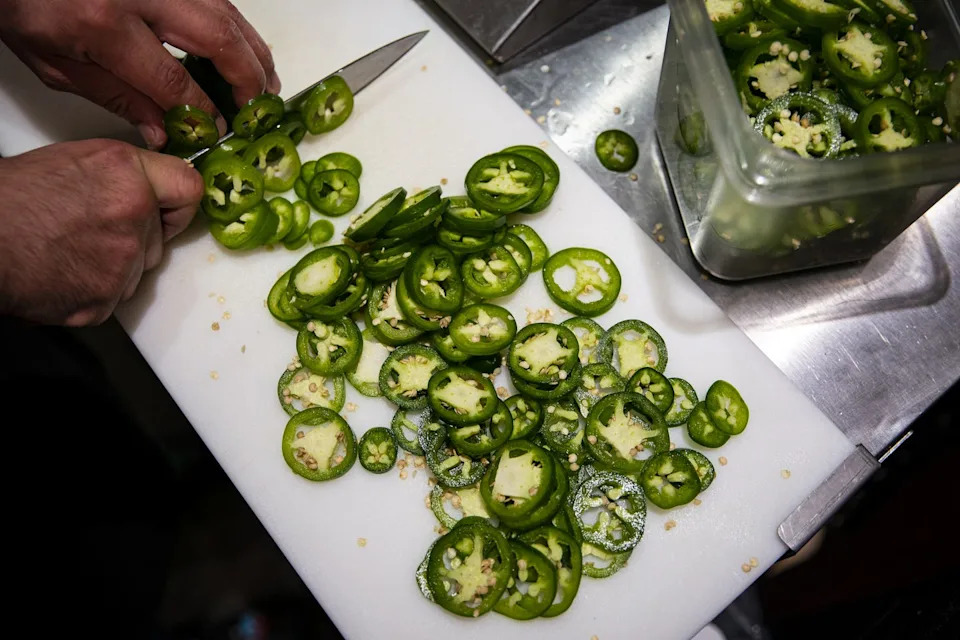
According to government agencies, the affected jalapeños, which were grown in Sinaloa, Mexico, were contaminated withSalmonella and distributed by Coast Citrus Distributors to retailers in 27 states. Coast Citrus Distributors is a supplier of Taylor Farms
What Products Are Being Recalled?
Now, the recall has expanded after 345 confirmed illnesses and 36 hospitalizations. Numerous products containing the contaminated jalapeños have been recalled and were distributed to retailers including Hannaford, Kroger, Stop and Shop, Target, Trader Joe’s, Walmart, and Whole Foods. The affected product list is vast and includes the following:
Advertisement
Diced Jalapeños sold at Hannaford locations in Maine and New York with the UPC code 030223082712 and best if used by dates of 8/7/2026-8/14/2026
Rice and Bean Burrito sold at Hannaford locations in Massachusetts, Maine, New Hampshire, New York, and Vermont with the UPC code 030223082736 and best if used by dates between 8/7/2026-8/11/2026
Private Selection Spicy Roast Beef Sandwich PS sold at Kroger locations in Alabama, Arkansas, Georgia, Louisiana, Mississippi, South Carolina, Tennessee, and Texas with the UPC code 011110678171 and best if used by dates between 8/7/2026-8/12/2026
Spicy Jarlsberg Dip sold at Kroger locations in Illinois, Indiana, Kansas, Kentucky, Louisiana, Mississippi, Missouri, Nebraska, Ohio, Texas, and West Virginia with the UPC code 030223114826 with best if used by dates between 8/7/2026–8/15/2026
Spicy Pimento Cheese Dip sold at Kroger locations in Illinois, Indiana, Kansas, Kentucky, Louisiana, Mississippi, Missouri, Nebraska, Ohio, Texas, and West Virginia with the UPC code 030223116448 and best if used by dates between 8/7/2026-8/15/2026
Pico de Gallo Salsa sold at Stop and Shop and Hannaford locations in Massachusetts, Maine, and New York with the UPC code 688267575778 and best if used by dates between 8/7/2026-8/14/2026
Taylor Farms and Unbranded Taco Dip sold at Target locations in Florida, Ohio, and Texas with the UPC code 030223073581 and best if used by dates between 8/12/2026–8/13/2026
Taylor Farms and Unbranded Mango Pico de Gallo sold at Target locations in Ohio and Texas with the UPC code 030223073543 and best if used by dates between 8/8/2026–8/13/2026
Taylor Farms and Unbranded Spicy Guacamole sold at Target locations in Ohio and Texas with the UPC code 030223073574 and best if used by dates between 8/7/2026–8/13/2026
Taylor Farms Pico de Gallo sold at Target locations in Texas with the UPC code 030223073536 and best if used by dates between 8/7/2026-8/14/2026
Taylor Farms Authentic Guacamole sold at Target locations in Texas with the UPC code 030223073567 and best if used by dates between 8/7/2026-8/12/2026
Trader Joe’s Fiesta Style Salad Shrimp sold at Trader Joe’s locations in Texas with the UPC code 000000818377 and best if used by dates between 8/7/2026-8/12/2026
Freshness Guaranteed Hot (or Spicy) Pico de Gallo Spicy sold at Walmart locations in Florida, Illinois, Louisiana, Minnesota, Nebraska, Oklahoma, and Wisconsin with the UPC code 681131276351 and best if used by dates between 8/8/2026–8/16/2026
Freshness Guaranteed Mild Pico De Gallo sold at Walmart locations in Florida, Illinois, Louisiana, Minnesota, Nebraska, Oklahoma, Texas, and Wisconsin with the UPC code 681131276344 and best if used by dates between 8/8/2026-8/16/2026
Salsa Fresca Medium sold at Whole Foods locations in Illinois and Texas with the UPC code 030223075080 and best if used by dates between 8/7/2026–8/16/2026
Pico de Gallo Mild sold at Whole Foods locations in Illinois and Texas with the UPC code 030223075097 and best if used by dates between 8/7/2026-8/16/2026
Pico de Gallo Spicy sold at Whole Foods locations in Illinois and Texas with the UPC code 030223075608 and best if used by dates between 8/7/2026-8/16/2026
Salsa Roja Medium sold at Whole Foods locations in Illinois and Texas with the UPC code 030223075639 and best if used by dates between 8/7/2026-8/16/2026
Pineapple Mango Salsa Mild sold at Whole Foods locations in Illinois and Texas with the UPC code 030223075653 and best if used by dates between 8/7/2026-8/14/2026
The U.S. Department of Agriculture’s Food Safety and Inspection Service (FSIS) also issued a public health alert for meat and poultry products containing FDA-regulated jalapeños that may also be contaminated with Salmonella
Why Are They Being Recalled?
The recall was initiated following an outbreak investigation into a multistate outbreak of food contaminated with Salmonella, which can cause salmonellosis. The foodborne illness can cause diarrhea, abdominal cramps, and fever anywhere from six hours to six days after eating contaminated food
Illnesses began as early as June 19, 2026, and have continued through July 20, 2026. Taylor Fresh Foods is no longer sourcing products from this farmer and will be filling orders from alternative suppliers
What Should I Do If I Have The Affected Products?
The FDA advises consumers, restaurants, and retailers not to eat, sell, or serve the recalled products. You should contact your health care provider immediately if you think you may have developed symptoms consistent with a Salmonellainfection after eating a dish with jalapeños. If you froze recalled jalapeños or are unsure of the company you received them from, you should discard them. Additionally, you should carefully clean and sanitize any surfaces or containers that the product touched to reduce the risk of cross-contamination.
