

Poll: Marylanders sour on state economy as household financial pressures mount
Tue, August 11, 2026 at 11:24 AM
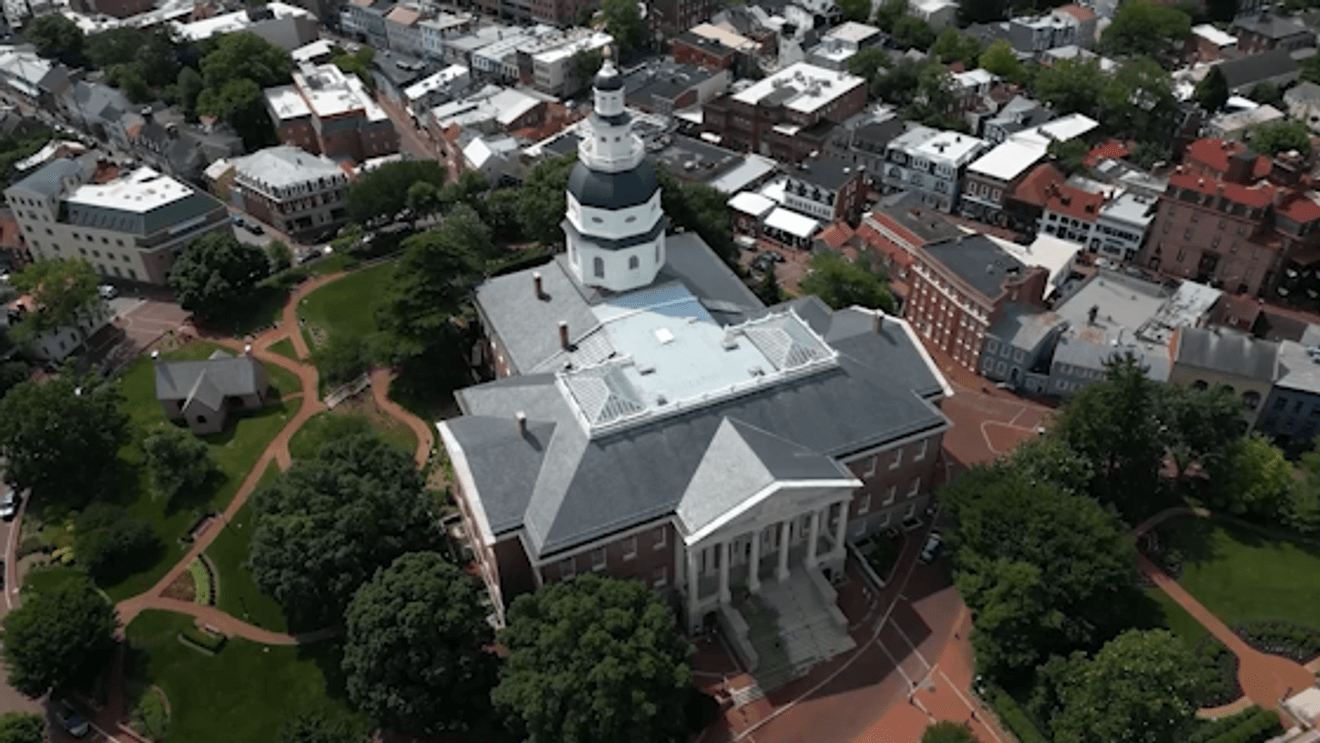
Aerial view of Maryland’s State House in Annapolis.png
BALTIMORE (WBFF) —Half of Maryland’s likely voters say they are struggling financially or just getting by, according to a new statewide poll that points to utility costs and broader economic anxiety as major concerns heading into the coming year
The Maryland Now survey, conducted by Zenith Research for Blended Public Affairs in partnership with Perry Jacobson, found 51% of voters described themselves as either “really struggling financially” or “just getting by.” Another 53% said they are worried that they or someone in their household will be unable to pay household bills over the next year
Those financial pressures are reflected in voters’ priorities for state leaders. Asked to select up to two issues they most want Gov. Wes Moore and the Maryland General Assembly to focus on over the next 12 months, 40% chose lowering electricity and utility bills — the highest share of any issue. Creating jobs and growing the economy followed at 32%, with fighting crime and improving public safety at 26%
“Marylanders are sending a clear message: They’re under significant financial strain,” said Adam Carlson, founding partner of Zenith Research. “When a majority of voters worry they won’t be able to pay their household bills over the next year, and more than two in five have struggled to pay their electricity bill over the last year, it’s a five-alarm fire. Marylanders are looking to state government for immediate relief, starting with lowering electricity and utility bills.”
The survey found 42% of voters said they had struggled to pay their electricity bill during the previous 12 months
Economic uncertainty extends to other household expenses and employment. Fifty-three percent said they were very or somewhat worried that someone in their household would be unable to pay household bills during the next year. Forty-two percent were worried that they or someone in their household would lose their job, while 41% were worried about losing health insurance. Another 37% expressed concern that housing costs could force them to lose their home, downgrade or move
Voters also offered a downbeat assessment of Maryland’s economy. Fifty-seven percent rated it “not so good” or “poor,” compared with 40% who described it as “excellent” or “good.”
The poll’s subgroup findings indicate that financial strain is particularly pronounced among Marylanders without four-year college degrees, households earning less than $50,000 annually, Black women and voters who identify as democratic socialists
With Maryland facing questions about how to address the projected budget shortfalls, voters showed substantially more support for some options than others
Fifty-four percent supported raising state income taxes on households earning more than $500,000 a year, making it the most popular revenue option tested. Legalizing and taxing internet gaming, or iGaming, was chosen by 36% of participants, while 27% chose higher taxes on businesses with 50 or more employees
Other proposals attracted less support. Fifteen percent selected extending the state sales tax to currently untaxed services, 11% said increasing the sales tax on goods from 6% to 7%, and 6% selected raising income taxes at all income levels. Property tax increases were selected by just 3%. Because respondents could select up to three choices, the percentages do not total 100%
The poll also looked an issue that has received increasing attention in Maryland: data centers
Three-quarters of respondents said they were very or somewhat concerned about the impact of data centers in the state, including 47% who were “very concerned.” Nineteen percent said they were not too concerned or not concerned at all
Among those who expressed concern, electricity use and higher utility bills were the leading issue, cited by 39%. Environmental impacts ranked second at 21%, followed by the impact of artificial intelligence on jobs and society at 12% and water use at 9%. Noise and effects on nearby property values, land use and loss of open space, and data centers’ appearance in communities ranked lower
According to the poll’s subgroup analysis, concern about data centers crosses partisan lines, with majorities of Republicans, independents and Democrats expressing concern
Zenith Research surveyed 800 likely Maryland general election voters from July 27 through Aug. 3, 2026. The poll has a margin of error of plus or minus 3.5 percentage points
Follow Political Reporter Mikenzie Frost on X and Facebook. Send tips to mbfrost@sbgtv.com
