


Consumer confidence in Anchorage plunged to its second-lowest point on record last year after a long spell of outmigration, while employment growth in the city is lagging after severe federal job losses, according to a report on city’s economic health
On the brighter side, a planned, near-term $2 billion investment in Joint Base Elmendorf-Richardson with about 2,700 new military personnel and families, will help support the economy, according to the report, released Wednesday by the Anchorage Economic Development Corp. at an annual luncheon
And the health care, logistics and construction sectors are growing, even as employment in the oil industry, long a mainstay of the Anchorage economy, has dropped in the city
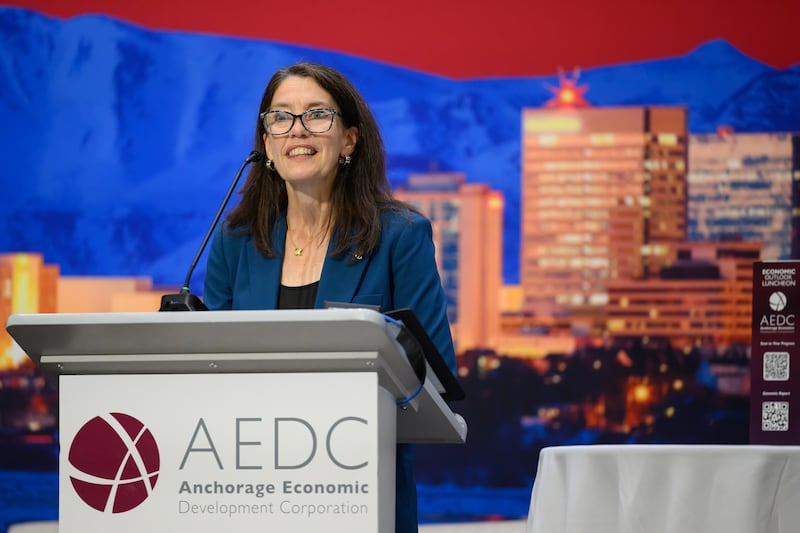
“The makeup of Anchorage economy is changing,” said Jon Bittner, president of the Anchorage Economic Development Corp., speaking to about 1,300 members of Anchorage’s business community
“We’re losing ground in industries that have traditionally been strong as a result of Anchorage being the financial and retail sector of the state, and we’re moving more into a logistics and healthcare-focused economy with added construction growth thrown in on top of that,” he said
The report was compiled in part with data from the Alaska Department of Labor and Workforce Development and the corporation’s survey of businesses. An economic forecast was completed by Economic Development Consultants, located in Anchorage
Employment in Anchorage over the next few years is expected to recover to 2015 levels following a decade of economic disruption, but steep losses in federal jobs over the last year — as the Trump administration slashed jobs and bought out employees — is sapping the growth, according to the report
“Anchorage federal employment is down 8.4% year over year, comparing the first half of 2026 to the first half of 2025, and statewide the decline is even sharper at 11.7%,” the report said
The city’s economy has been marked by significant events that began in 2015 when oil prices crashed, leading to a recession, then the pandemic in 2020, followed by a partial recovery, the report says
But “chronic” outmigration from the city has reduced the city’s population and thinned the job pool, the report says. Also a concern are future energy costs as Cook Inlet gas production wanes
Over 15 of the last 16 years, more people moved out of the city than moved in, reflecting a statewide trend as people relocated to other states or the Matanuska-Susitna region
The consumer confidence index in Anchorage, measured at 40.5 out of 100 as of July 2026, is nearly tied with the all-time low recorded of 40.1 recorded during the initial COVID shock in March 2020, the report said
The luncheon featured an unusual guest: Federal Reserve governor Lisa Cook, who spoke about her potentially needing to take action as a member of the central bank’s board of governors to reduce U.S. inflation that has been high for years. She blamed the long run of inflation in part for the disconnect represented by people who feel pessimistic about the U.S. economy even though it’s generally stable
[Federal Reserve’s Lisa Cook tells Anchorage business crowd she’s ‘firmly committed’ to bringing down inflation]
The city’s cost of living is 28% higher than the national average, a burden that contributes to outmigration
Housing represents the fastest-rising expense in the city, the report said
The average Anchorage home cost $481,000 this year, approximately a 10% increase over three years and 42% over the decade, the report said
“By comparison, the neighboring Matanuska-Susitna Borough averaged approximately $474,200 despite generally offering newer homes on larger lots, a pronounced factor in the outmigration from Anchorage to the nearby borough,” the report says
Lower housing costs represent a key opportunity for improving the economy, the report said
While Anchorage municipal leaders have taken steps to spark more home construction, it will take time to address the constrained housing market, the report said
“Expanding the supply of affordable and diverse housing represents one of Anchorage’s greatest economic development opportunities,” the report said. “Increasing housing availability would improve workforce recruitment and retention, support business expansion, and enable growth across multiple sectors of the economy.”
Anchorage Mayor Suzanne LaFrance, speaking at the luncheon, said the city so far this year has almost surpassed the total number of new housing units permitted for all of last year. LaFrance has pushed a 10,000 Homes in 10 Years initiative to encourage construction and redevelopment of abandoned and vacant properties. Her administration has also crafted tax incentive driven ordinances geared toward multi-family housing and owner-occupied residences
The municipality is doing everything it can to “open the throttle” on housing construction, she said
The jobs picture
While high-paying oil jobs have grown statewide over the last year by 5.7%, with projects on the North Slope, they’ve shrunk slightly in Anchorage, the report found
But employment has grown in logistics, health care and construction
Health care employment is expected to continue growing at an average annual rate of approximately 2% through 2029, the report says
“Healthcare remains Anchorage’s largest industry by employment and has expanded in eight of the past ten years,” the report says. “Continued population aging, increasing demand for specialized care, and Anchorage’s role as the state’s regional medical center have supported steady employment growth despite persistent workforce shortages.”
Logistics jobs are expected to grow rapidly
“Logistics remains one of Anchorage’s fastest-growing industries and is well positioned for continued expansion,” the report says. “The industry is forecasted to maintain its growth trajectory, adding an additional 300-400 jobs annually, up to 1,000 by 2029. Ongoing investments at the Port of Alaska and Ted Stevens Anchorage International Airport are expected to strengthen the city’s role as a global transportation hub while supporting employment growth and economic diversification.”

Construction jobs will also be supported by the expansion at the military base
“Overall construction employment, including residential, commercial, and horizontal infrastructure projects, is projected to increase by approximately 100-200 jobs annually, representing an average annual growth rate of roughly 1.9%,” the report says. “This annual rate of growth would be higher, given the volume of anticipated construction needed in Anchorage, if the city had not been experiencing consistent net outmigration of the workforce.”
“Much of this growth is expected to be driven by proposed increases in military investments in new construction at Joint Base Elmendorf-Richardson and the arrival of an estimated 2,600 to 2,800 additional active-duty personnel and their families,” the report says. “Forecasts still indicate a private-sector housing shortage approaching 3,500 homes, highlighting the substantial unmet demand that will remain.”
