

As New Mexico voters headed to the polls this spring, mailers promoting Democratic State Land Commissioner candidate Juan de Jesus Sanchez began appearing in mailboxes
The mailers came from American Energy Action Fund, a federal super PAC that promotes renewable energy. Weeks <a href="https://todaytrendnews7.com/two-dead-after-helicopters-collide-in-greece/” title=”Two dead after helicopters collide in Greece”>after Sanchez won the June primary, state campaign finance records still couldn’t answer two basic questions: How much did the group spend in New Mexico? And who ultimately paid?
When groups spend money to influence voters, New Mexico’s campaign finance laws are supposed to show who’s behind those efforts, so voters understand whose interests are behind the messages mailed to them, texted to their phones, promoted on social media or aired on television. Knowing how much they spent helps put that effort in perspective. The stakes of a $5,000 mail campaign differ vastly from a $5 million media blitz
The answers to these basic questions in the case of American Energy are surprisingly difficult to find
When the mailers appeared in May, the group had no filing in the Secretary of State’s searchable campaign finance database
News reports noted the absence of state filings, and former state Sen. Dede Feldman, a longtime advocate for campaign finance transparency, later filed a complaint with the State Ethics Commission
But American Energy wasn’t necessarily required to disclose its spending in the weeks before the primary election because, unlike other political action committees, out-of-state groups registered with the Federal Election Commission don’t always have to register with New Mexico or follow its reporting deadlines
Instead, they were required to provide copies of their federal reports to the Secretary of State’s Office after those reports are due to the FEC, which can be well after the primary or general election
American Energy has filed quarterly federal reports this year. It sent the secretary of state its report due July 15, which was six weeks after the June 2 primary election.
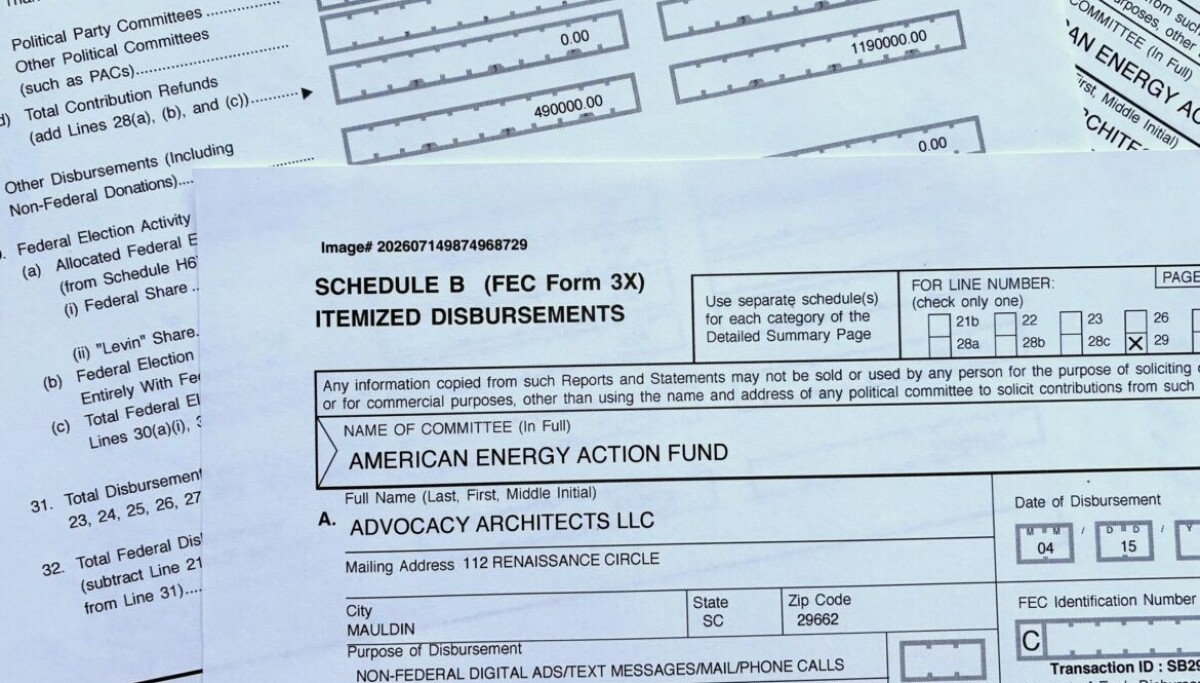
New Mexico In Depth obtained the report through a public records request, because these FEC reports are not included in the secretary of state’s online database. American Energy listed a single total for spending on nonfederal races rather than breaking it down by state, making it impossible to tell how much was spent in New Mexico
“This is woefully inadequate,” Feldman said. “The timetable of the FEC is really different from New Mexico’s and doesn’t account for New Mexico elections. And the reporting format is too broad to be useful to any member of the New Mexico public.”
The group also wasn’t required to provide the secretary of state with information about who paid for its political work, which political committees registered in New Mexico must disclose under state law
A search of the committee’s filings on the FEC website showed it received all of its funding from its affiliated nonprofit, American Energy Action, a national 501(c)(4) organization that does not disclose its own donors
Transparency challenge
In 2016, New Mexico lawmakers overhauled the state’s campaign finance reporting system, requiring the secretary of state to create an online portal where candidates and political committees file electronically and the public can search, download and inspect campaign finance data
When supporting the legislation, the office of the secretary of state wrote that the existing system relied too heavily on PDF reports that were “too difficult to search” and made “sifting through the data” “unnecessarily complicated.” The office said a searchable database would provide the transparency that candidates, the media and the public needed to “follow the money in politics.”
That system exists today for campaign finance reports filed under state law. But copies of Federal Election Commission reports submitted under the exemption aren’t part of that searchable system
They aren’t available through the secretary of state’s online, searchable database. Instead, someone looking for them must first know they exist, request them under New Mexico’s public records law and identify which political committees filed them before searching the Federal Election Commission’s online database for more complete information
To see how often the exemption was used during the 2026 primary, New Mexico In Depth requested every FEC report submitted to the Secretary of State. The response totaled more than 10,000 pages from fewer than 40 committees
The Secretary of State’s Office provided PDF files, some containing reports from multiple committees. New Mexico In Depth identified the committees and created its own sortable list before analyzing the records
American Energy Action Fund was the only committee New Mexico In Depth identified as spending money on political advertising. The others reported contributions to New Mexico candidates or political committees that should also have appeared in recipients’ campaign finance reports
Some committees submitted complete federal reports hundreds of pages long covering multiple states. Others submitted only a few pages related to New Mexico. Some included contributor information; others did not
“Under state law, it does not appear that they must reveal their contributors,” former state Sen. Dede Feldman said. “And that’s the information that is most helpful in this era. You want to know who the original contributors are.”
Some reports list only total spending, not how much was spent in New Mexico. Because the law requires only federal reports — not New Mexico-specific accounting — the information is only as detailed as the federal filing
American Energy’s filing illustrates the problem. The committee filed a summary of its FEC report covering April 1 through June 30. One line labeled “Other Disbursements (Including Non-Federal Donations)” reported $490,000 in payments to the South Carolina company Advocacy Architects, LLC.
New Mexico In Depth then searched American Energy’s complete filing in the FEC database
Payments to Advocacy Architects were for “Non-federal digital ads/text messages/mail/phone calls.” New Mexico In Depth could not determine from the report how much of the spending occurred in New Mexico, or how many other states saw similar political activity by the group.
The report showed the group received $520,000 from its sister nonprofit, American Energy Fund. That nonprofit does not disclose its own donors.
A phone call from New Mexico In Depth seeking that information was not returned
Marjorie Childress is managing editor at New Mexico In Depth, a nonpartisan, nonprofit digital news organization
