

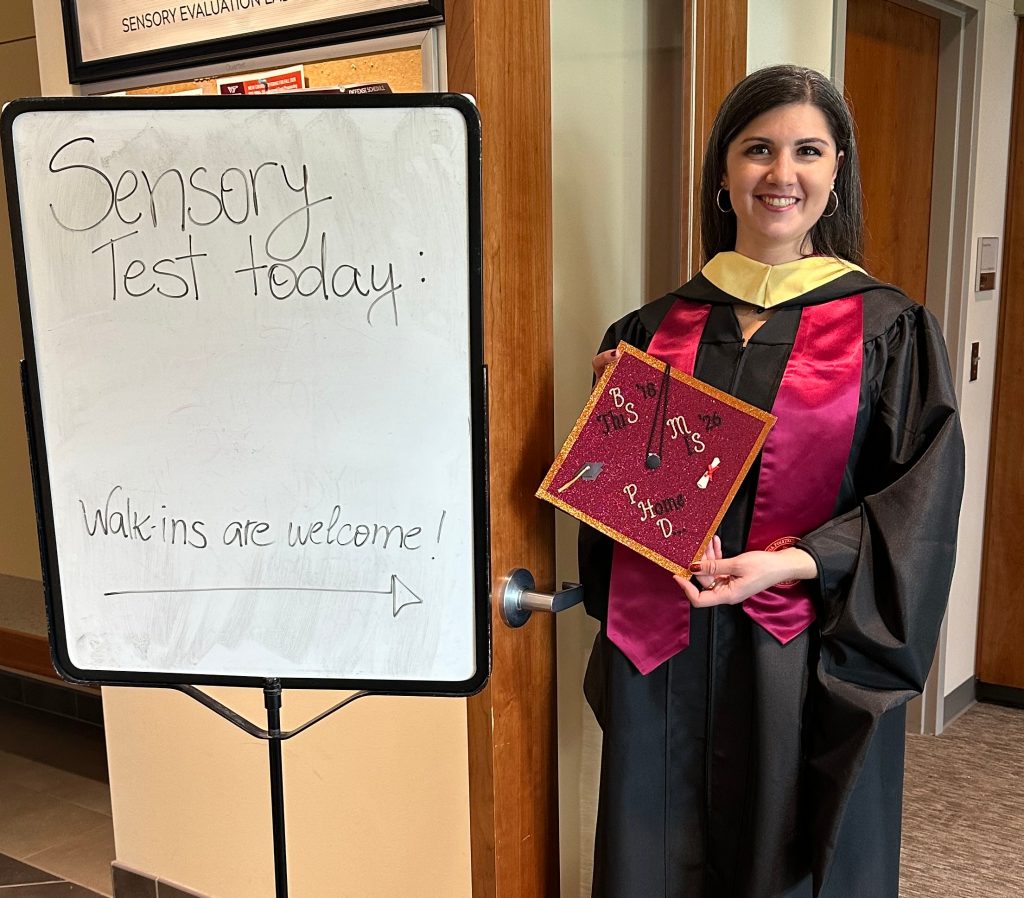
It was a visit to Virginia Tech’s snow-covered Blacksburg campus in early 2013 that convinced Julia Adornetto that the school was where she needed to be.
“Somebody threw open a window near the Drillfield and yelled, ‘Welcome to Blacksburg! Go Hokies!'” she said. “I just thought it was magical.”
But finding the right school was only one piece of the puzzle for Adornetto. Originally, she came to Virginia Tech to study chemical engineering. Today, Adornetto is a Ph.D. student in the College of Agriculture and Life Sciences’ (CALS) Department of Food Science and Technology, where she studies sensory evaluation, working to gain a scientific understanding of how and why people perceive foods the way they do
Her transition from undergraduate chemical engineering student to Ph.D.-bound sensory scientist was sometimes bumpy, but scholarships, the support of her professors, and her own passion helped her find her true calling in food science
Originally, Adornetto came to Virginia Tech to study chemical engineering, believing it would combine her love of chemistry and food. It was an unexpected injury that caused her to rethink things
“I got a nasty concussion, and I was having to do medical withdrawals from a lot of classes and figure out how to attempt to graduate on time,” she said. “I found that all my technical electives that I was interested in had FST as their prefix, and so I looked into it. I discovered it wasn’t just the prefix but a major!”
A visit with then food science advisor Linda Granata was all it took to convince her. Adornetto credits Granata and former Department Head Joe Marcy with welcoming her into the department and giving her the confidence to pursue a new path. Their encouragement confirmed that she had found her academic home
The concussion was only one of several obstacles Adornetto faced during her undergraduate years. Recovering from her injury, navigating anxiety, and later understanding how ADHD affected her academic work made for a challenging undergrad experience. Today, she speaks openly about those experiences to encourage others to do the same
“I have ADHD,” she said. “I’m fairly open with all of my professors and other students about it because I think it’s important to talk about. I really struggled in undergrad, so I relate 100 percent to what a lot of students are going through right now.”
After multiple withdrawals from engineering courses, Adornetto graduated with a lower than ideal GPA, but several professors recognized her potential and accumulated industry experience and advocated for her admission into the department’s graduate program. Adornetto credits them with seeing her potential beyond her transcript and encouraging her to continue her education
“Dr. Renee Boyer and several others went to bat for me, and eventually I got provisionally accepted,” she said. “I had to prove that I could make it in grad school before I was allowed to be eligible for any type of assistantship, but once I did that, they had an assistantship waiting for me.”
Under the mentorship of Research Assistant Professor Renata Carneiro during her master’s program and Graduate Director Jacob Lahne, who’s advising her during her doctoral studies, Adornetto studies sensory science, exploring how consumers use their five senses to perceive different foods. Her research has connected her with scientists and industry professionals across the country, and scholarship support has played an important role in making those opportunities possible
In 2025, her research that characterized dark chocolate made from wild cacao was accepted for presentation at the Institute of Food Technologists (IFT) annual conference, the largest food science conference in the world. However, attending wouldn’t be cheap. Fortunately, she applied for and received a CALS Global Travel Support Fund scholarship
“I used it to offset the cost of the flight to Chicago and my hotel room,” Adornetto said. “It also eased the burden on my advisor, who didn’t have to use as much of her grant funding.”
With the project funding they were able to save, Adornetto was able to pay for further testing and offer more hours to the undergraduate research assistant the team hired, affording them invaluable hands-on experience and highlighting the ripple effect that scholarships often have throughout the lives of multiple students
At IFT, she presented her research to accomplished sensory scientists, making connections with academic peers and leaders in the food industry
“I met someone from Hershey and someone from Pepsi,” she said. “There was another woman who was an international chocolatier who specifically sought out my poster at IFT and was very interested in it.”
Just before the end of her master’s program, fate had a final test for Adornetto. A mishap during the transition from one software platform to another resulted in her entire in-progress thesis manuscript being irreversibly deleted. It was September 2025, and she needed to defend her completed thesis by the following April. She was forced to start over from scratch. Now accustomed to these sorts of challenges, she got to work and completed her thesis in time to successfully defend it
In May, Adornetto completed her master’s degree. Months before she set foot on the commencement stage, she’d already been accepted into the CALS Graduate Teaching Scholar program for the fall 2026 cohort. Now, as she sets out on the road to a Ph.D. with an already promising research career, she looks back and sees that the path to success is rarely a straight line
“I know what it means to get knocked down and stand back up again multiple times,” she said. “This is where I belong, and I’ve never looked back.”
Contact:
540-232-2501
