

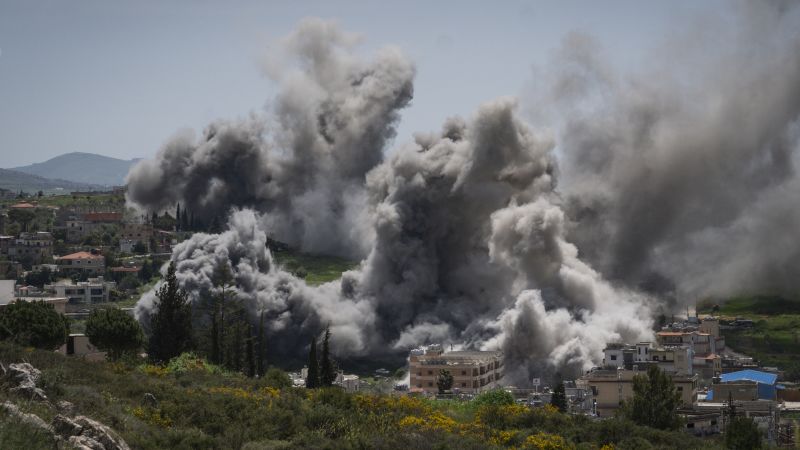
• Desalination plants targeted: A US attack damaged a desalination plant in southern Iran during its latest wave of strikes, according to a provincial official. Authorities in Kuwaitalso reported an Iranian attack on a water desalination plant, as the US-Iran conflict intensifies. Such facilities are vital in the region
• Iran’s threat:A top Iranian military adviser warned the US could face a “full-scale offensive” in the coming days if its barrage continues through the weekend, after the US militarymarked what it says was the seventh consecutive night of its renewed bombing campaign
• Conflict widens: Iran has also threatened key ports in Gulf states, in response to the US destroying a surveillance tower near the Strait of Hormuz, according to semi-official Iranian media. US regional allies have this morning fended off fresh Iranian attacks and raised alarms
17 Posts
Armed Yemeni supporters of the Iran-backed Houthi movement brandish their weapons during a protest against what the group says are restrictions imposed by the Saudi-led coalition on Houthi-controlled areas of Yemen, in Sanaa on July 17.
Gulf states are looking on with growing apprehension as the conflict between Iran and the United States escalates again
A pattern of strikes and counterstrikes is firmly bedded in, with the additional complication of growing tension between Saudi Arabia and the Iran-allied Houthis in Yemen, who are determined to break a blockade against them
The diplomatic track seems moribund for now. The flurry of Pakistani and Qatari delegations visiting Iran in an effort to sustain the ceasefire has given way to pessimism among regional diplomats. Qatar itself has been hit twice in the recent flare-up
Iranian drones have also targeted Oman, days after negotiations between the two states on a management scheme for the Strait. And Iran’s Islamic Revolutionary Guards (IRGC) has struck ships sailing close to the Omani coastline. Traffic in the Strait of Hormuz is down to a trickle
Iran has repeatedly warned it is ready to step up strikes on neighbors that host US military facilities and a semi-official outlet – Fars – published a list of five ports in Bahrain, Saudi Arabia, Kuwait, Qatar and the United Arab Emirates that it said could become targets if Iranian infrastructure were attacked
US targeting in recent days has included tunnels, roads, bridges and railways, according to Iranian state media – heightening anxiety that the conflict could spiral
“Every US escalation is met by an Iranian escalation, as each side seeks to establish new deterrence thresholds with every exchange,”
Rather than force Iran back to the negotiating table, “an equally plausible outcome is a conflict that spirals beyond either side’s intentions, expanding into a much broader regional war with diminishing opportunities to restore diplomacy,” Citrinowicz posted on X Saturday
The US has bolstered its fleet of refuelling aircraft in Israel as part of adjustments to its force posture in the Middle East region, an Israeli military official said today, amid consecutive waves of US strikes on Iran
Israel has not been involved in the latest waves of strikes on Iran since the breakdown of a fragile ceasefire between Washington and Tehran, despite its previous involvement in “Operation Epic Fury.” Nor has Iran attempted to launch attacks on Israel
Additionally, the US chose to station some of the tanker aircraft at Israeli Air Force bases, in coordination with the Israel Defense Forces (IDF), in order to reduce disruption to civilian air traffic and due to operational considerations, the official said
The IDF is making every effort to facilitate the deployment of US forces in Israel while safeguarding its own a
Kuwaiti authorities have reported “significant” damage to a “vital” site in the oil sector and some injuries following repeated Iranian attacks
The injured individuals were treated, and the site was evacuated, a statement from the Kuwait Petroleum Cooperation said. It did not specify how many people were injured nor detail the damage sustained by the site
Kuwait’s fire service added today that its forces were battling two fires in two different locations following Iranian attacks. A power generation and water desalination plant have also been struck by Iran, Kuwait’s Ministry of Electricity, Water and Renewable Energy said earlier on Saturday
Five fire service teams and three oil sector fire teams battled flames at one location, Kuwait’s fire service said, adding that several firefighters and one worker sustained injuries in the process. Three fire teams were working to control the other incident
Elsewhere in the country, debris from intercepted projectiles fell in several residential areas, causing damage but no casualities, a statement issued by the Kuwaiti army said
Kuwait’s Foreign Ministry condemned Iran’s attacks and accused Tehran of being “in flagrant violation of international law” for targeting power and desalination plants
The ministry said Kuwait maintained the right to “take all necessary measures” to defend itself
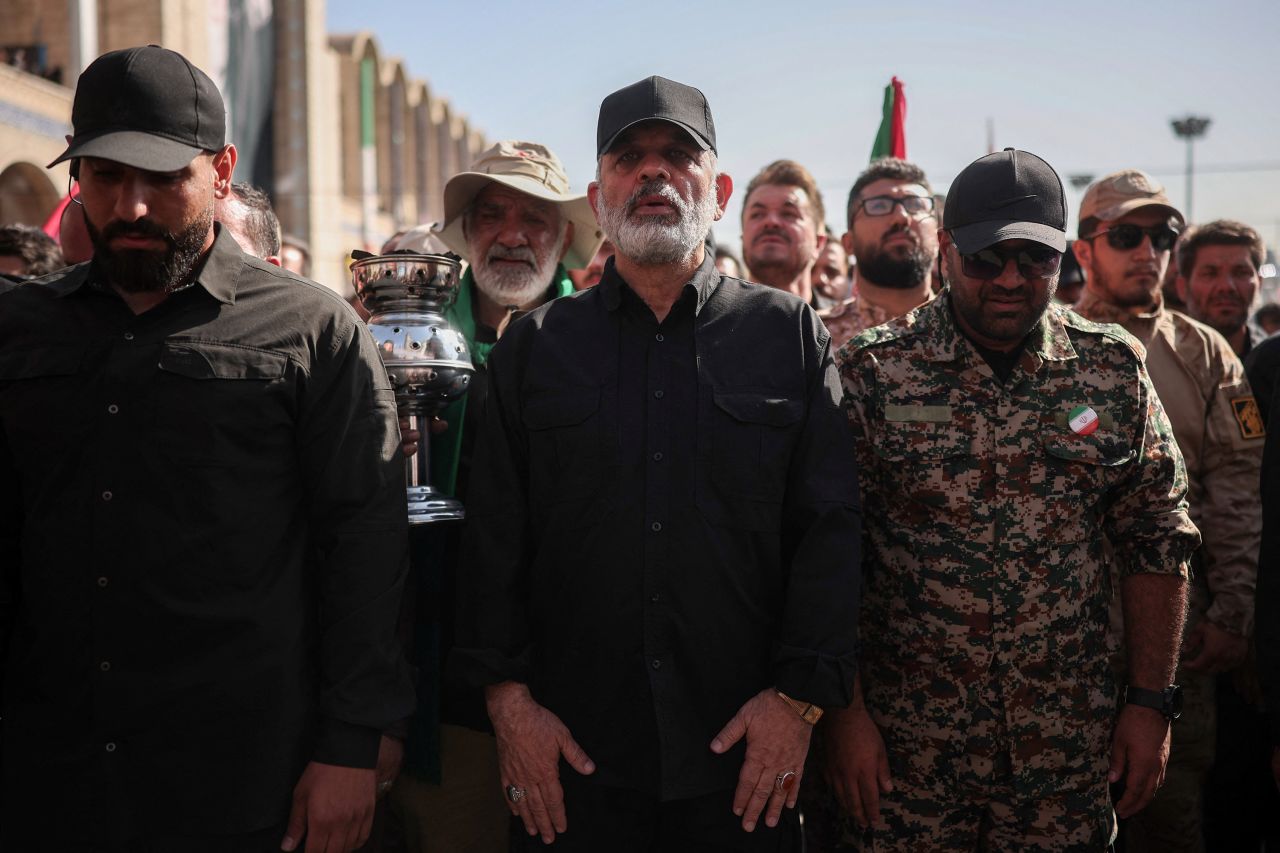
Islamic Revolutionary Guard Corps Commander-in-Chief Ahmad Vahidi, center, attends a public farewell ceremony to pay his respects to late Supreme Leader Ayatollah Ali Khamenei, in Tehran, July 5.
Iran’s Revolutionary Guards quoted the Quran in warning that those who attack Iran will be met with the same force, as it launched strikes on US allies in the Middle East region following a fresh wave of US attacks
There have been days of back-and-forth strikes between the US and Iran focused on control over the strategic Strait of Hormuz with no sign of de-escalation
The IRGC went on to issue a warning to neighbouring Gulf states, saying that, therefore, “countries hosting U.S. occupying forces, which have provided their territory to these invading criminals to launch attacks against Iran, should be prepared to receive a corresponding response.”
Overnight, both Iran and Kuwait reported strikes on desalination plants –- which are crucial for ensuring access to drinking water across much of the Middle East
They are among the most critical civilian infrastructure in the region. So, what do experts say about the legality of hitting them?
When desalination plants were targeted in March, the World Water Council – a UN-affiliated organization which advocates for global water security – condemned the attacks and called on all parties “to fully respect their obligations under international law.”
In a statement, it pointed towards an article of the Geneva Convention which prohibits combatants from attacking essential reons and supplies.”
Likewise, Kenneth Roth, a former executive director of Human Rights Watch told CNN in March that “desalination plants are purely civilian infrastructure. There is no legal argument whatsoever for attacking them.”
Similarly, amid previous threats from Trump to hit Iranian power plants, legal expert Craig Jones, a senior lecturer at the UK’s Newcastle University, laid out a framework to CNN for considering the legality of such strikes on civilian infrastructure
There are two key questions to consider, he said: Does such action have a “concrete and direct” military advantage? And if so, is this advantage proportionate to the harm inflicted on civilians and the environment?
Even if there is a legitimate military advantage to be gained, Jones said this doesn’t mean the action necessarily meets the “threshold for proportionality,” which requires impact on civilians to be considered
A US attack on Iran has damaged a desalination plant in the south of the country, leaving 20 villages without water, according to the deputy governor of Hormozgan province
Iran’s attacks on countries in the region have also continued, with the strikes targeting US facilities
Here’s the latest in the conflict:
- The US military said its strikes on Iran have taken place for a seventh consecutive night, with the US targeting coastal areas near the Persian Gulf and Strait of Hormuz, as well as transport infrastructure further inland, according to Iranian state media.
- A top Islamic Revolutionary Guard Corps (IRGC) official and military adviser to Iran’s supreme leader warned the US yesterday of a “full-scale offensive” if the strikes persisted.
- US allies in the Gulf, including Kuwait, Bahrain, Jordan and Saudi Arabia, reported raising alarms or fending off Iranian attacks early today. Iran state media claimed its forces had targeted US forces and facilities across Bahrain and Kuwait. CNN could not independently verify the claims.
- Kuwait’s Ministry of Electricity, Water and Renewable Energy said that Iranian attacks hit a power generation and water desalination plant, causing a fire.
CNN’s Adam Pourahmadi, Tim Lister, Jessie Yeung, Dalia Abdelwahab and Ibrahim Dahman contributed to this reporting
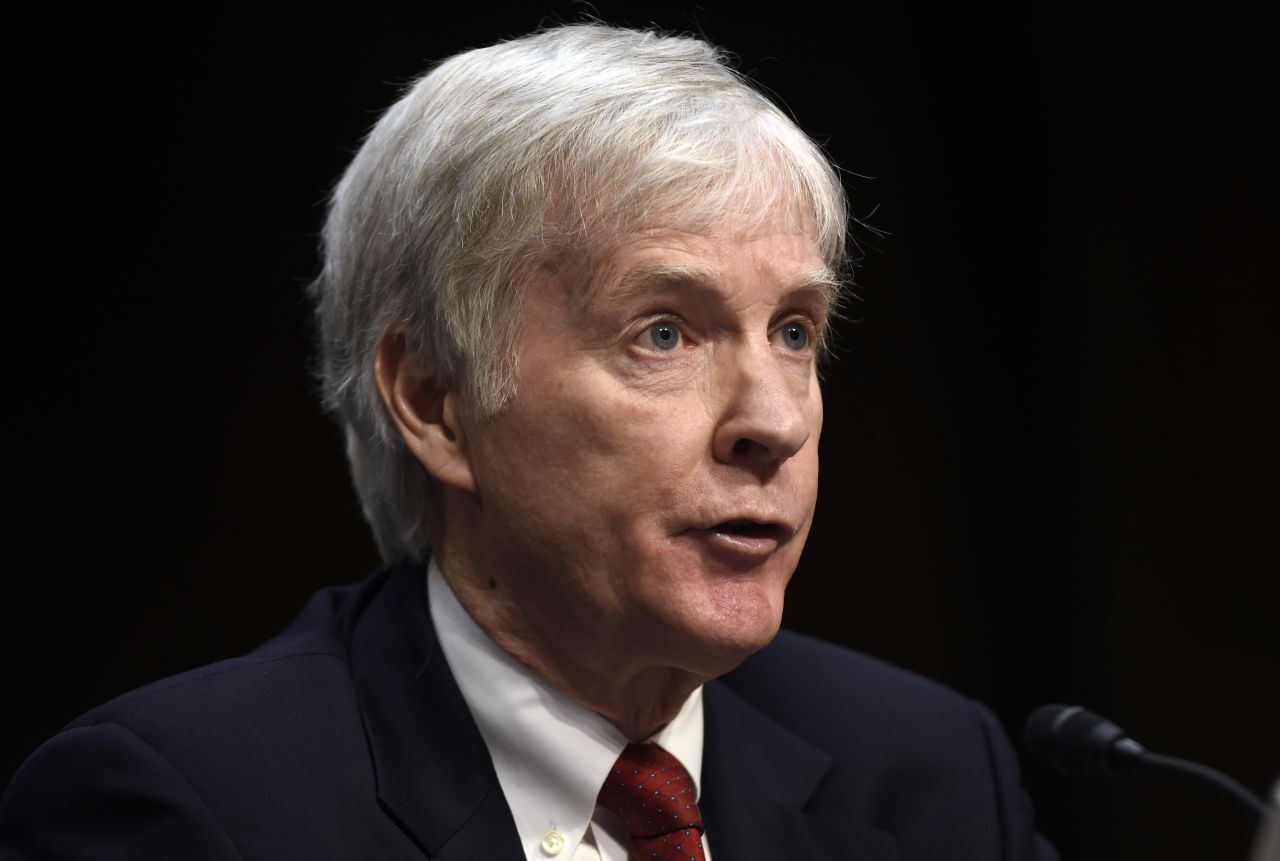
Former US Ambassador to Afghanistan Ryan Crocker testifies on Capitol Hill in Washington, on February 11, 2015.
The US is not going to achieve regime change in Iran as things stand, warns Ambassador Ryan Crocker
There’s little chance for significant change in Iran and the war has not helped the home front, he added
Crocker, a former longtime US ambassador to Middle East countries including Iraq, Syria and Lebanon, told CNN’s Elex Michaelson earlier that the US is in a “worse place” than it was before the start of the war with Iran. “There’s no question about it,” he said
Crocker, who survived the 1983 bombing of the US embassy in Beirut, Lebanon, said that at this point an unconditional opening of the Strait of Hormuz to all maritime traffic should be the objective
To accomplish that requires “a combination of diplomatic efforts, economic pressure and kinetic action,” he said
Regime change would be ambitious at this point, and returning the US to where it was at the onset of the war is key, Crocker added
“The Iranians know how to do war,” he said, adding that the extended fighting has hardened the regime even more, and bombing them “into submission” will not work
The Ras al-Khair water desalination plant in Saudi Arabia, on March 30, 2023.
As we’ve been reporting, Kuwait has said Iran attacked one of its desalination plants, while Iranian media later reported the US had struck one of its plants in Jask, a strategically important port city in the Hormozgan province, citing a provincial official. CNN has reached out to the US military for a response
Desalination plants are significant in the Middle East region, providing a key lifeline of drinking water and sustaining certain remote regions through droughts
Regional Arab countries, including Kuwait, are almost entirely dependent on desalination for drinking water. Desalination is the process of converting seawater into drinking water
In Kuwait and Oman, desalination accounts for around 90% of freshwater needs, Bahrain 85%, and Saudi Arabia around 70%. Major Gulf cities, including Abu Dhabi, Dubai, Doha, Kuwait City and Jeddah, are almost wholly dependent on desalinated water
Iran is less dependent on desalination than its Gulf neighbours for drinking water. Still, the process is key for providing water to coastal and island communities and to help to offset droughts
The targeting of key civilian infrastructure including desalination plants could be considered a war crime
CNN’s Mostafa Salem contributed reporting
A US missile attack damaged a desalination plant in southern Iran in the latest wave of attacks, according to a provincial official
Desalination plants are a critical
“Several missiles” struck electrical facilities and desalination water pumps at Bonji on the coast, leaving 20 villages without water, according to the deputy governor of Hormozgan province
An assessment of the extent of the damage was underway, he said
Iranian media outlets published images of the purported damage to the site
CNN is reaching out to the US military for a response
The US has carried out it seventh straight night of strikes against Iran, saying it hit military and maritime targets as part of efforts to wrest control of the Strait of Hormuz from Iran
A vital reion plants, the second consecutive day that one of its facilities was struck. The small Gulf state relies on desalination for about 90% of its water
Sirens sounded in Bahrain this morning, as the country’s Interior Ministry warned citizens to remain calm and head to the nearest safe place
It marks the fifth time that sirens have sounded in Bahrain over the past 12 hours, the ministry wrote on X, and comes after Iran launched another wave of attacks on US allies in the region
Overnight, Bahrain’s military said it intercepted multiple Iranian attacks
Iran attacked a power generation and water desalination plant in Kuwait, the Gulf nation said on Saturday
“Another power and water desalination plant was subjected to a hostile attack that resulted in a fire breaking out in one of the plant’s components,” said Kuwait’s Ministry of Electricity, Water and Renewable Energy
In response to the fire, authorities took “precautionary” measures including disconnecting a number of generating units, the statement said
A similar attack took place just a day ago, with a fire breaking out at another Kuwaiti power generation and water desalination plant – prompting the government to urge residents to conserve electricity during the sweltering summer heat
Kuwait has been one of the countries most frequently targeted by Iran since hostilities resumed between Tehran and Washington
Bahrain’s military intercepted multiple Iranian attacks overnight into Saturday, it said on X
“The Bahrain Defence Force’s air defense systems intercepted and destroyed several” Iranian aerial attacks on Saturday, the BDF posted on X
Bahrain is home to the headquarters of the US 5th Fleet. Its interior ministry previously reported that air alert sirens had been activated multiple times into Saturday morning local time
Several US allies reported raising alarms or fending off Iranian attacks early Saturday local time, according to state media and local authorities, as Iran claims to have launched strikes across the region
US allies reporting strikes or alerts:
- Kuwait issued seven warnings over 12 hours, extending into early Saturday, saying its air defenses were responding to missile and drone threats. Kuwait Airlines announced it would reschedule most of its Saturday flights due to the airspace closing, temporarily suspending all takeoffs and landings at the Kuwait International Airport.
- Bahrainannounced that its sirens had been activated, and urged members of the public to seek safety.
- Jordan’s air defenses intercepted 10 Iranian missiles early Saturday, Reuters reported, citing Jordanian state media.
- Saudi Arabiabriefly issued warnings in two locations before lifting them several minutes later, saying the danger had passed.
Iran’s claims:Iran state media claims Iran’s forces had targeted US forces and facilities across Bahrain and Kuwait. CNN could not independently verify the claims
Ibrahim Dahman contributed reporting
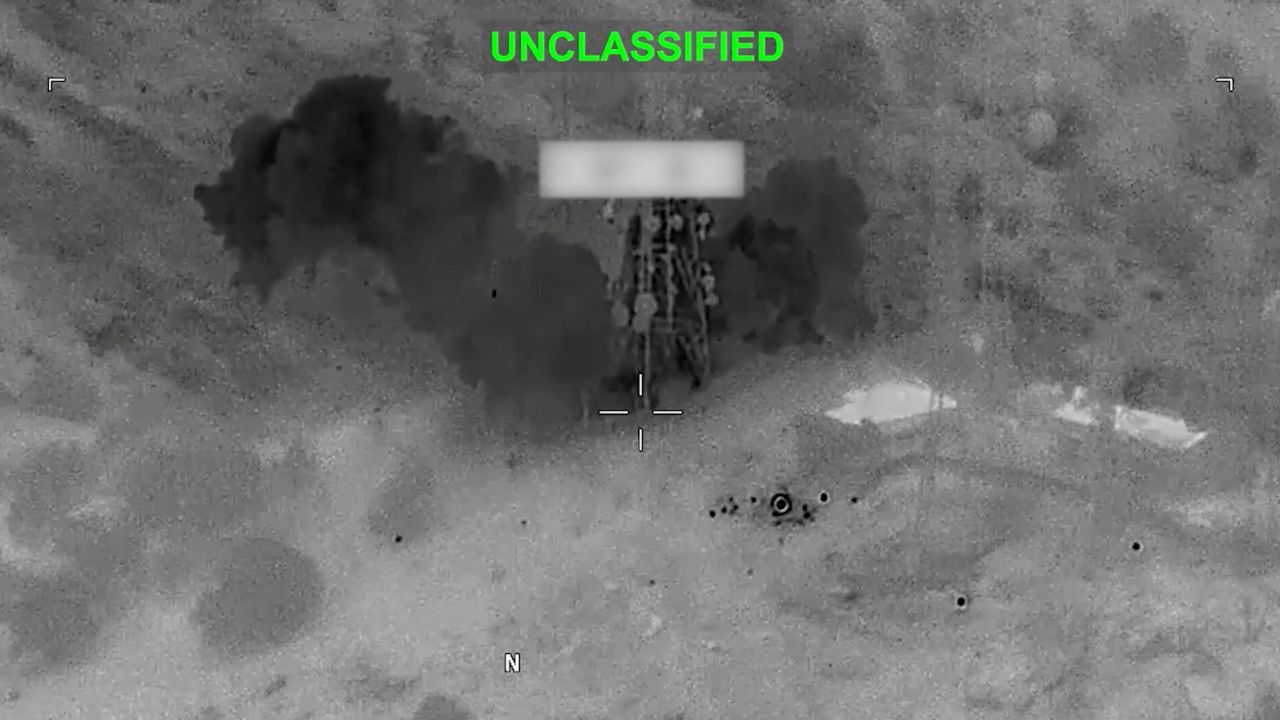
Smoke rises from an explosion at an unknown location, during what U.S. Central Command says are strikes on Iran, in this screen grab taken from a handout video released on Friday.
The US struck Iran for a seventh consecutive night, again targeting coastal areas near the Persian Gulf and Strait of Hormuz – as well as transport infrastructure further inland
Strikes late Friday into early Saturday were reported in the port city of Bandar Abbas, and the nearby islands of Qeshm and Larak which sits in the Strait of Hormuz
Bridges and a tunnel on a highway linking Bandar Abbas to Hajiabad further inland were also targeted, IRIB reported
Other areas targeted include Ahvaz, Darab, Yazd, Omidiyeh and Bushehr county – with some lying much further inland. CNN could not independently verify Iran’s claims
CENTCOM said its strikes had targeted “hit surveillance sites, military logistics infrastructure, underground weapons storage, and maritime capabilities.”
US President Donald Trump has repeatedly threatened to strike Iran’s bridges and power plants if Tehran does not return to the negotiating table
Several Arab nations have fiercely criticized Tehran’s sweeping strikes on US allies in the Middle East after the Trump administration escalated deadly attacks on Iran this week for seven consecutive days
The Iranian military hit several countries late Thursday through early Friday, including Oman, Jordan, Kuwait and Qatar, where a child was wounded by falling shrapnel from an intercepted strike
In Iraq, an Iranian missile and drone attack killed nine fighters of an Iranian-Kurdish group, according to an official from the group
Leaders in the region have issued stark condemnations and renewed demands for diplomacy – though US and Iranian officials show no signs of letting up
Here are some of the statements calling for diplomacy:
- Qatar: The Foreign Ministry in Qatar – whose officials acted as key mediators for discussions between Tehran and Washington earlier this year – urged “a serious return to dialogue and negotiations” and “understandings reached through diplomatic efforts.”
- UAE: The United Arab Emirates’ foreign minister vehemently criticized the Iranian strike in Iraq, warning the attack presents a “flagrant violation of the Republic of Iraq’s and Iraqi Kurdistan’s sovereignty.”
- Jordan:The country’s foreign minister denounced “brutal Iranian attacks” as a “blatant breach of international law” and cautioned against a “dangerous escalation” in the wider region.
- Kuwait: The Kuwaiti foreign minister expressed “strong denunciation of recent reprehensible Iranian aggressions” against Bahrain, Qatar and Jordan, describing the attacks as a “direct threat to the security of their people.”
Video released by CENTCOM shows US forces conducting the latest round of strikes against targets in Iran.
The United States military completed its latest wave of strikes against Iran on Friday, according to Central Command, marking the seventh consecutive night of its renewed bombing campaign
This comes after the US launched more airstrikes against Iran, intending to “continue degrading Iranian military capabilities,” according to the US military. Tehran also launched another wave in its widening series of attacks on US allies in the region
Here’s what to know about the US strikes and the impact:
• A pattern:US strikes on Iranian bridges, railway junctures and power lines connecting key coastal cities could suggest a wider pattern by Washington to advance options for seizing control of the Strait of Hormuz, an analyst told CNN
• Iran’s response:Mohsen Rezaei, a top IRGC official and military adviser to Supreme Leader Mojtaba Khamenei, warned of a “full-scale offensive” if the US persisted with military strikes against Iran. Tehran, so far, has been striking US allies in the region, which several Arab nations have fiercely criticized
• Impact on people:The cities currently under attack are among Iran’s poorest and most ethnically diverse, home to large populations of minority communities distinct from Persian-majority centers like Tehran. Despite being home to much of Iran’s energy industry and commercial ports, these provinces have historically suffered from underinvestment, high unemployment and weaker infrastructure
• Caught in the crosshairs:An Indian seafarer who went missing after an Iranian attack on his ship Sunday has been confirmed dead, the Forward Seamen Union of India said in a statement. This week, India ordered ship owners and operators not to deploy Indian seafarers on vessels traveling through the Strait of Hormuz, amid renewed hostilities
India is the world’s third-largest supplier of seafarers, with more than 300,000 sailors working across global shipping fleets, according to the government
CNN’s Mostafa Salem, Tim Lister, Leila Gharagozlou, Aida Karimi, Magdalena Sofia Vitores Moreno, Eyad Kourdi, Fadel Allassan, Davis Winkie, Dalia Abdelwahab and Sana Noor Haq contributed to the report
Mohsen Rezaei, a top Islamic Revolutionary Guard Corps (IRGC) official and military adviser to Supreme Leader Mojtaba Khamenei, warned the United States on Friday of a “full-scale offensive” if it persisted with military strikes against Iran
The comments come as the US completes its seventh consecutive day of strikes on Iran and Iranian retaliation at Arab US allies
“No political border will be secure against Iran’s offensive forces,” Rezaei said and added that the US should be required to pay financial reparations for what Iranian officials have characterized as attacks on civilian infrastructure, which the US denied
Rezaei’s threats largely mirror those recently made by US President Donald Trump, who had declared the already-fragile US-Iran ceasefire and memorandum of understanding “over” as the US launched new strikes on the country. Iran has retaliated by way of striking US bases within the territory of some of its Arab allies, including Qatar, Kuwait and Bahrain
