

US and Iran vie for Strait of Hormuz, waterway key to global energy supplies, in latest attacks
Published: July 12, 2026 at 9:45 PM
Updated: July 12, 2026 at 11:04 PM
1 / 2
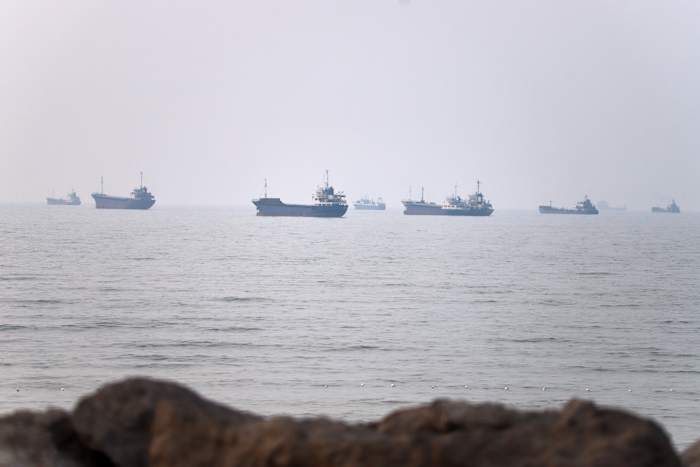
Commercial vessels are seen in the Strait of Hormuz off Bandar Abbas, Iran, Tuesday, June 30, 2026. (Amirhosein Khorgooi/ISNA
DUBAI – The United States and Iran each asserted Monday they controlled the Strait of Hormuz after a weekend of attacks stretching across the wider Middle East, further threatening any diplomacy to end the war
The attacks, sparked by Iran striking a container ship Sunday in the strait off the coast of Oman, again underlined that the waterway that once saw a fifth of the world’s traded crude oil and natural gas pass through it remained the key issue in negotiations. The narrow mouth of the Persian Gulf has seen shipping disrupted since the start of the war as Iran maintained a chokehold on it by attacking commercial vessels around it, intimidating shippers
Recommended Videos
Iran and the U.S. are nearly at the midway point of the 60-day period of an interim deal that was supposed to set up talks for a permanent end to the war. Instead, it has devolved into a series of attacks over the strait and its future, worrying world leaders the Iran war fully could resume
“A return to full-scale hostilities would have catastrophic consequences,” United Nations Secretary-General António Guterres said in a statement
US says it strikes dozens of targets in Iran
The U.S. military’s Central Command described its forces as hitting dozens of sites in the strikes Monday, including air defense systems, radar sites, missile and drone equipment and small boats
“The Strait of Hormuz is a vital maritime corridor for global trade,” Central Command said. “Iran does not control it.”
Iran’s paramilitary Revolutionary Guard, a key power center in the country’s theocracy that controls its ballistic missile arsenal, sharply rejected America’s statement
“The Strait of Hormuz is our territory, and we will not allow a rogue and child-killing army from the other side of the world to continue its illegal interference in it,” the Guard said
Missile alert sirens sounded twice Monday in Bahrain, home to the U.S. Navy’s 5th Fleet, and Kuwait said it was intercepting hostile fire. There was no immediate word on damage in either country
Iranian state media acknowledged the latest attacks on its soil early Monday, describing explosions in several locations with at least one person being killed
Iranian attacks on Sunday stretched Bahrain, Kuwait, Qatar, Jordan and even Oman — whose territorial waters with Iran make up the strait. Oman, which long has been an interlocutor between Tehran and the West, summoned an Iranian diplomat to criticize the attack
Meanwhile Monday, a base belonging to the armed wing of the Kurdistan Freedom Party, an Iranian Kurdish opposition group based in Iraq’s semiautonomous northern Kurdistan region, came under drone attack. Rebaz Sharifi, commander of the Kurdistan Militia Corps, said the strikes targeted the group’s Chamshar base, without giving details on casualties or damage. No group immediately claimed responsibility
Fighting focuses on the status of the strait
The U.S. military early Sunday said it hit some 140 targets, including missile and drone launch sites, ammunition dumps, communication equipment and other sites — a far-heavier set of attacks than in two previous rounds of strikes in the last week
“We bombed the hell out of them last night,” U.S. President Donald Trump told NBC’s “Meet the Press.”
Iran retaliated by attacking nations in the region hosting U.S. military forces, while insisting it alone must control the strait and potentially charge vessels for traveling through it
“The era of one-sided deals is OVER,” Mohammad Bagher Qalibaf, the speaker of Iran’s Parliament and a main negotiator, wrote. “We told you: keep your word or pay the price. Reality is knocking.”
Iran described the strait as being closed, while the U.S. military and Trump asserted that the strait remained open
Iran’s chokehold on the strait, however, has loosened as the U.S. military provided support to vessels moving along a southern route hugging the coastline of Oman. That new route has angered Iran, which launched repeated attacks on ships using it
Iran’s grip on the strait led to a global energy crisis, though oil prices have sharply dropped since wartime highs of $120 a barrel
Attacks followed more diplomatic talks about the strait
Trump suggested last week that the interim deal in the war was “over.” But mediators, including Pakistan, Qatar and Egypt, have continued efforts to reach a final agreement to end the war
A regional official involved in mediation, speaking on condition of anonymity to discuss talks, said efforts to shore up the ceasefire continued Sunday. Pakistan said its foreign minister spoke by phone with Iran’s top diplomat and urged “de-escalation” on both sides
Iran’s new supreme leader, Ayatollah Mojtaba Khamenei, unseen since the war began, on Saturday vowed in his first statement since the funeral of his father, Ayatollah Ali Khamenei, that Iranians would avenge his killing
___
Associated Press writers Munir Ahmed in Islamabad and Stella Martany in Irbil, Iraq, contributed to this report
Copyright 2026 The Associated Press. All rights reserved. This material may not be published, broadcast, rewritten or redistributed without permission
