

Getting your Trinity Audio player ready…
When James City County Police Chief Mark Jamison began his law enforcement career in 1997 in Lynchburg, mental health and wellness was hardly mainstream
“It was just a different society back them,” Jamison said. “It was a male-dominated profession, and we weren’t supposed to have feelings or worry about anything. There was no focus on mental health. We were told to ‘suck it up,’ and I always wondered where ‘it’ was going.”
Jamison, who was hired as James City County’s police chief in July 2023, brought with him a passion for officer mental health support and within a year asked the county to fund a full-time clinician for the James City County Police Department
“I have seen too many people crash and burn in this profession for that lack of re
Numerous studies support that opinion. Some of the more eye-opening statistics include the following:
• The average life expectancy of an officer is 57
• With an average of 187 suicides a year, police officers are at a higher risk of suicide than any other profession
• Substance abuse disorders are two to three times more prevalent in police officers than the general population
The National Institute of Health reports that officers are 4.5 times more likely to develop post-traumatic stress disorder than a civilian. Shift work, job stress, public scrutiny and exposure to traumatic events are the biggest drivers. By comparison, the average person experiences three to five traumatic events during a lifetime, while police officers experience anywhere from 178-800 during their career
It’s only been in the last five to 10 years that efforts have been made nationally to address the lack of mental health support for law enforcement, including legislative funding and state level mandates and training
Prior to that, Jamison said, the only real re
“Even that came with a stigma,” he said
Fear of being perceived as weak, being passed over for career advancement and ostracization by peers are all real worries officers have when they consider whether to ask for help
“People didn’t want to focus on the emotional injuries that came with the job,” Jamison said. “So, the question became how do we get rid of that stigma and make it more open so that people can talk about what’s going on.”
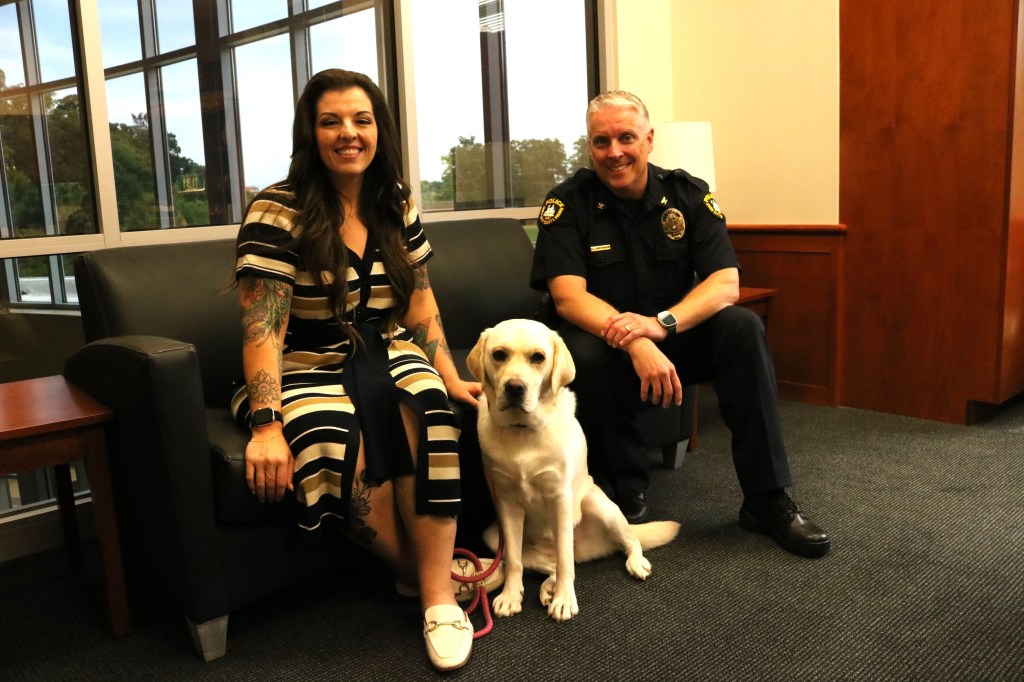
Jamison’s efforts took shape in 2024, when the county approved his request to fund a full-time wellness manager. Jesalyn Moore, a licensed clinical social worker and substance abuse treatment practitioner, came onboard last August, bringing with her more than 10 years of experience working with first responders and military members
“We were very fortunate to have the county’s support,” Jamison said. “It speaks volumes and shows they prioritize officers’ mental health.”
Moore, who works out of the county’s Law Enforcement Center on Opportunity Way, has a welcoming office, complete with a soothing water fountain, a comfortable couch and, depending on the day of the week, her therapy and service-trained dog Phoenix
Her knowledge and passion about mental health and wellness, especially as it pertains to first responders, is evident. She’s worked extensively with Navy SEALs, served in CEO positions with treatment centers and comes from a military family. Her husband is a veteran and former police officer. Phoenix, a 3-year-old English cream lab, came to Moore with the help of Veterans Moving Forward, a group that provides service, therapy and emotional support dogs to veterans
At the county police department, Moore helps create health and wellness programs and provides support to officers and civilians within the department who are dealing with everything from struggles at home to experiences with critical incidents. She often does ride-alongs where she can talk with officers casually, helping her get a better sense of day-to-day stressors
“I love it, there’s certainly a reason I’ve only worked with these folks,” she said. “For me, it’s about getting into the concerns that come with the job, understanding what the appropriate interventions are and then providing the targeted support.”
She also acts as a triage point, helping those in the department get the services they need, whether that’s financial, emotional or physical. Moore has helped people find elder care, dentists, a provider for a disabled child, and other therapists
“Cumulatively, officers are so stressed with balancing the job, balancing family life, trying to earn a living, and managing shift work, that oftentimes, it’s the personal stuff that is the tipping point,” she said
Jamison agrees
“A lot of what is going on in people’s lives is ‘life’ stuff, but, you bring that to work, and it can impact your job and how you interact with each other and in the community,” he said
In addition to mental health, physical health within the department is also getting a boost
Lt. Dave Rochard is leading a 12-week functional fitness program at the police department that offers strength training, cardio and job-related exercises twice a day, three times a week in a “judgment-free” gym setting
“I’ve been involved in my own physical fitness journey for a long time, and for me the physical fitness, the working out, and the exercising has always been therapeutic and helped with stress,” Rochard said
He said group classes have gone well, and that about 15 people took part in the first 12-week program. In addition to exercise, the program also offers tips on nutrition
“The goal is to hopefully get people who haven’t done anything interested in doing something,” Rochard said. “We sit behind desks, and we sit in cars, but the time will come when you need to exert yourself physically. If you’re not prepared for it, it will be a rude awakening.”
Prior to Rochard’s new program, there was a very minimal fitness standard within the department
“I’m proud of what we’re doing, and I’m glad to see Chief Jamison and other command level personnel who have come into the department take initiative,” Rochard said
To Jamison, “wellness” is everything incorporated
“It’s that feeling when you come to work knowing your family is safe at home with re, and knowing who to go to if you need something,” Jamison said. “We support our people here, and we want them to grow and develop, and we want them to be healthy as well
“We have re want them to know it’s OK to ask for help.”
Amy McCluskey, amccluskey79@gmail.com
