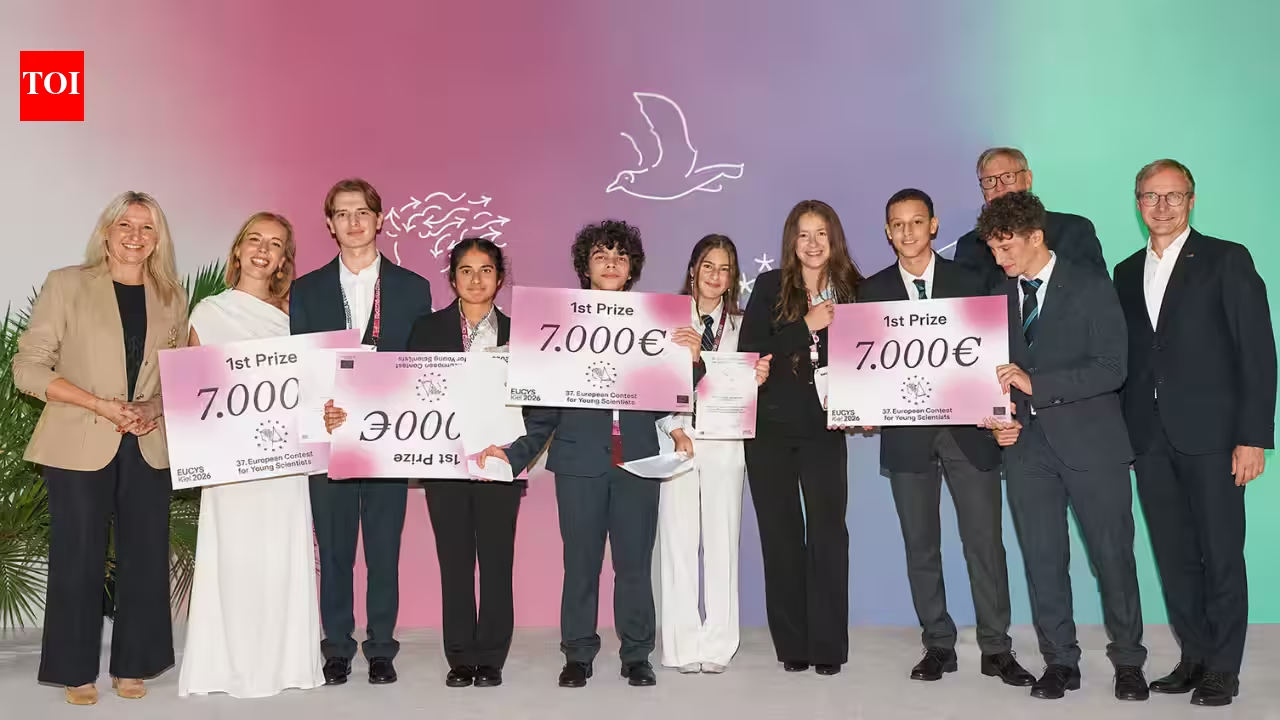
Three teenagers have developed a low-cost device designed to detect signs of stress in plants by listening to their acoustic signals. Their project, PlantLeaf, aims to make monitoring technology more accessible to farmers, with an estimated production cost of about €20 compared with existing equipment costing thousands. As reported by The European Commission, the Italian students won a first prize at the 2026 EU Contest for Young Scientists in Germany, earning €7,000 to help advance their prototype. After spending around 18 months developing the system, the team now hopes to move towards professional manufacturing and explore its potential use in agriculture.
Teenagers develop €20 plant-monitoring device to detect crop stress and disease
Abdoellah El Makkaoui, Frida Tirari and Tommaso Vaninetti, aged 16, 16 and 17 respectively, developed the project under the name PlantLeaf. Their entry combined a small electronic device with software that measures acoustic signals associated with stress in plants. The aim was to identify changes that might indicate a crop needs water or is being affected by a pest or disease.Equipment capable of recording and analysing these signals can be expensive, with some devices costing €2,000 or more. The teenagers designed their system around a much lower estimated production cost of about €20. If the approach can be developed into a reliable tool for practical use, it could make this type of monitoring more accessible to farmers who cannot justify the expense of specialised equipment.The team did not arrive at the competition after a single successful attempt. They had spent around a year and a half working on the project and had entered other competitions without winning.
How plants can reveal signs of stress
Plants do not communicate through sound in the way animals do, but they can produce acoustic emissions that sensitive equipment can detect. Changes in these signals may provide information about the conditions a plant is experiencing, including water shortage and biological threats.The challenge lies in capturing and interpreting those emissions accurately enough to distinguish useful information from background noise and other sources of variation. A listening device is only part of the process. Software must also help make sense of what it records before the results can support decisions about crop management.PlantLeaf’s system is intended to address this problem by pairing the hardware with a software component. The team presented it as a less expensive alternative to existing equipment, rather than simply a recording device. Its potential agricultural use is straightforward: earlier indications of stress could help growers investigate problems before they become obvious across a crop.The project has not, however, established that the system is ready for widespread agricultural use. Its estimated cost and competition success are encouraging early steps, but its performance in different crops and growing conditions would need to be assessed before farmers could depend on it for routine monitoring.
Four first prizes at a competition in Germany
PlantLeaf was one of four first-prize winners at the 2026 EU Contest for Young Scientists, held in Kiel from 22 to 27 September. The event brought together 141 participants aged 14 to 20 from 37 countries. Each first prize carried an award of €7,000, as reported by the European Commission.The competition was organised by Kiel University and brought together projects covering mathematics, medicine, digital technology and other scientific fields. A jury of 20 members assessed the entries, most of which had already received recognition at comparable competitions in the participants’ home countries.The other first-prize winners included Polish student Kazimierz Jakub Chomicz, whose work examined a mathematical problem involving the combinations possible when objects are sold in fixed quantities.
Teen inventors plan next steps for plant-monitoring device after €7,000 award
For the Italian teenagers, the award provides an opportunity to take the device into its next stage of development. The team plans to use the money for professional manufacturing, which could help turn their experimental system into a more developed piece of equipment.El Makkaoui said, “Our teacher also spent more than €1 000 on parts for us.”“Now we can pay him back.”Vaninetti also joked, “It will also be fun to show our award to certain teachers who complained about us missing classes.”