

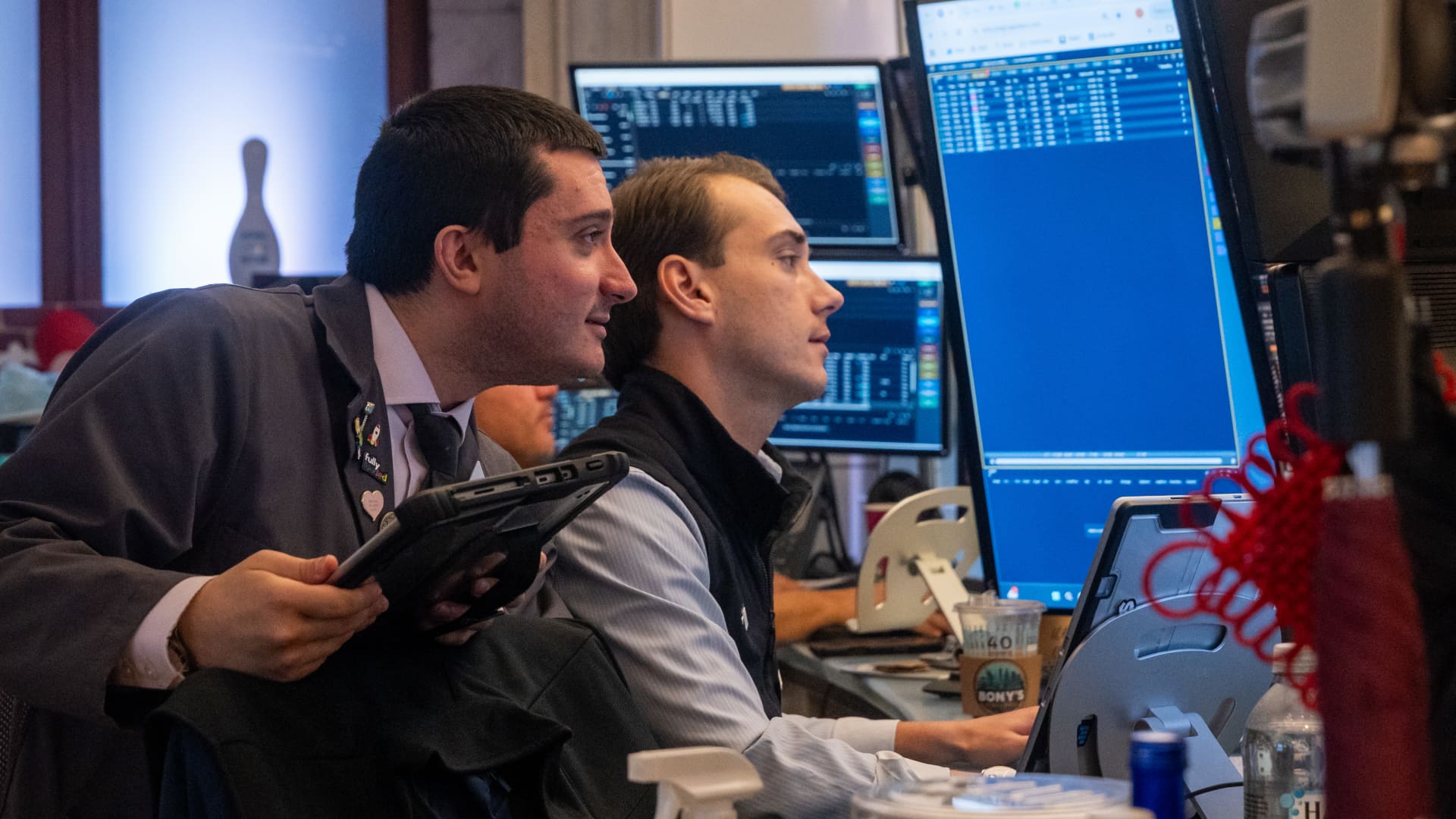
People work on the floor of the New York Stock Exchange (NYSE) on July 07, 2026 in New York City.
Spencer Platt | Getty Images
Stock futures were near flat Tuesday as investors weighed rising tensions in the Middle East and surging oil prices. They also looked ahead to minutes from the Federal Reserve’s latest policy meeting
Futures on the Dow Jones Industrial Average fell 29 points. S&P 500 futures and Nasdaq 100 futures both edged down about 0.1%
The U.S. started a “series of powerful strikes” against Iran on Tuesday evening, retaliating for attacks against three commercial vessels traveling in the Strait of Hormuz, U.S. Central Command said. Earlier, the Treasury Department revoked a license that permitted Iran to sell its oil around the world in light of the attacks in the Hormuz Strait
West Texas Intermediate futures for August delivery rose 2.1% to $71.87 per barrel in Asia trading. Futures for International benchmark Brent crude for September delivery jumped 1.9% to $75.53 per barrel
Asia-Pacific markets mostly fell Wednesday. Japan’s benchmark Nikkei 225 fell 0.55%, while the Topix declined 0.7%. South Korea’s Kospi fell 0.72%, and the small-cap Kosdaq dropped 1.94%. Hong Kong’s Hang Seng Index rose 1.2% on open Wednesday, while mainland China’s CSI 300 declined 0.47%
In the U.S. in Tuesday’s regular session, investors rotated out of artificial intelligence-linked stocks while rising oil prices weighed on sentiment. The 30-stock Dow fell more than 100 points after earlier touching a fresh intraday record. The S&P 500 slipped 0.5%, while the Nasdaq Composite dropped 1.2% as chipmakers led the declines
Investors’ attention now turns to the minutes from the Federal Open Market Committee’s June meeting, due at 2 p.m. ET Wednesday. The release is expected to provide more insight into Federal Reserve Chairman Kevin Warsh’s first policy meeting, where officials left interest rates unchanged while signaling that additional rate hikes could be warranted if inflation pressures persist
“The FOMC minutes will be [a] wildcard simply because Warsh was so opaque at the most recent press conference,” Adam Crisafulli, founder of Vital Knowledge, said in a note. “Normally, [Jerome] Powell provided fairly comprehensive accounting of the meeting discussion, but that didn’t happen with Warsh, so the minutes, which are likely to be hawkish in tone, could contain some surprises.”
— CNBC’s Garrett Downs contributed reporting
1 Hour Ago
Hanwha extends losses after losing Canadian submarine contract as Korean defense stocks fall
South Korean defense stocks were lower Wednesday
Hanwha Aerospace, Seoul’s largest defense stock, fell more than 6%. Hyundai Rotem, maker of the K2 Black Panther main battle tank, fell 9.23%, and LIG Defense & Aerospace dropped 10%. Firstec, which makes components for ground combat vehicles, declined 3.42%
Shares of South Korea’s Hanwha Ocean extended losses on Wednesday, dropping more than 6%. Shares had plunging about 23% on Tuesday, after the company lost its bid to build submarines for Canada to Germany’s Thyssenkrupp Marine Systems.
Separately, South Korean President Lee Jae Myung on Tuesday proposed at the NATO summit to upgrade his country’s current defense cooperation with the military alliance to “South Korea-NATO Defense Industry Partnership 2.0.”
2 Hours Ago
Hong Kong’s Hang Seng opens higher, mainland China’s CSI 300 falls
Hong Kong’s Hang Seng Index rose 1.2% on open Wednesday, while mainland China’s CSI 300 declined 0.47%
China’s macroeconomic backdrop remains challenging, with weak retail sales and soft consumer sentiment continuing to weigh on markets, said Tai Hui, JPMorgan’s chief Asia market strategist
Hui said on CNBC’s “Squawk Box Asia” that the underperformance of Hong Kong’s Hang Seng Index and Hang Seng Tech Index largely reflects their heavy exposure to e-commerce and internet platforms, that are getting “squeezed,” while they spend heavily to integrate artificial intelligence into their businesses
The Hang Seng has lost nearly 7% so far this year
— Lee Ying Shan
3 Hours Ago
Oil jumps as U.S. ‘powerful strikes’ against Iran risk unraveling fragile Mideast truce
Oil prices rose Wednesday after the U.S. launched fresh strikes on Iran in retaliation for Tehran attacking commercial vessels in the Strait of Hormuz
West Texas Intermediate futures for August delivery rose 2.1% to $71.87 per barrel. Futures for International benchmark Brent crude for September delivery jumped 1.9% to $75.53 per barrel
The U.S. military said it had begun a “series of powerful strikes” against Iran after three commercial vessels transiting the Strait of Hormuz came under attack on Tuesday, warning Tehran would face “heavy costs” for targeting commercial shipping
“The U.S. strikes are in response to Iranian attacks on three commercial vessels that were transiting the Strait of Hormuz. Iran’s demonstrated aggression was unwarranted, dangerous, and a clear violation of the ceasefire,” Centcom said in a post to X.
The latest exchange threatens to test a fragile ceasefire reached last month that reopened the critical Strait of Hormuz for commercial shipping after months of disruption
—Lee Ying Shan
4 Hours Ago
Asia-Pacific markets fall as U.S.-Iran tensions flare after Hormuz attacks
Asia-Pacific markets opened lower Wednesday as escalating tensions in the Middle East weighed on investor sentiment
Japan’s benchmark Nikkei 225 fell 0.55%, while the Topix declined 0.7%. South Korea’s Kospi fell 0.72%, and the small-cap Kosdaq dropped 1.94%
Australia’s benchmark S&P/ASX 200 was 1.36% lower
— Lee Ying Shan
4 Hours Ago
Z.ai says most cornerstone investors holding shares despite lock-up expiration
Hong Kong-listed AI model company Z.ai said late Tuesday that nearly 70% of its cornerstone investors will keep holding shares despite the six-month lock-up period expiring Wednesday. The Beijing-based company said backers including state-backed funds, WT Asset Management and Optimas Capital would keep holding the shares, but did not specify a time range
Also known as Knowledge Atlas, Z.ai has seen its shares skyrocket by 1,200% since listing in January. The company last month announced plans to also offer shares in mainland China’s A share market
PBOC Governor Pan Gongsheng said at a summit in Hong Kong on Tuesday that Beijing would continue to support listings of “high-quality” companies on the exchange, and expand the annual quota for mainland Chinese investment in Hong Kong and Macao-traded bonds by 300 billion to 800 billion yuan ($44 billion to $118 billion)
5 Hours Ago
Asia markets set to open mostly lower as renewed U.S. strikes on Iran weigh on sentiment
Asia-Pacific markets were set to open mostly lower Wednesday on rising tensions in the Middle East, after the U.S. launched fresh strikes on Iran in retaliation for Tehran targeting commercial vessels in the Strait of Hormuz
Japan’s benchmark Nikkei 225 is set to open lower, with the futures contract in Chicago at 67,725, against the index’s last close of 68,256.96
Australia’s benchmark S&P/ASX 200 also looked set to decline, with futures last at 8,743, compared with the index’s close of 8,803.90
Futures for Hong Kong’s Hang Seng index stood at 23,499, compared with its last close of 23,496.89
The U.S. Treasury Department on Tuesday revoked its authorization for Iranian oil sales after a series of attacks on tankers in the Strait of Hormuz this week
—Lee Ying Shan
6 Hours Ago
Gold logs first losing day in 4
Gold prices fell for a fourth straight session on Tuesday, extending a sharp retreat from record highs reached earlier this year as investors continued to unwind safe-haven trades
August gold futures settled down 0.2% at $4,157.40 an ounce, turning in the first negative day in four. The precious metal has not settled below the $4,000 level since Nov. 6, 2025
Gold has now fallen more than 20% since the Iran conflict began in late February, giving back much of the geopolitical premium that helped propel prices to an all-time intraday high of $5,626.80 and a record settlement of $5,354.80 on Jan. 29. The metal is now down 4.2% for the year
Gold futures year to date
— Yun Li, Gina Francolla
6 Hours Ago
Trivariate’s Parker: ‘You can’t be bullish on the U.S. equity market and bearish on tech’
Trivariate Research founder Adam Parker sees the story of technology stocks and the broader market connected, despite questions about if a rotation is in the works
“You can’t be bullish on the U.S. equity market and bearish on tech,” Parker said Tuesday on CNBC’s “Closing Bell.” “Those are incongruous concepts.”
Parker said in a note to clients that nearly three-fifths of S&P 500 earnings expansion over the next two years will come from tech. He called that an “incredibly high” percentage
— Alex Harring
