

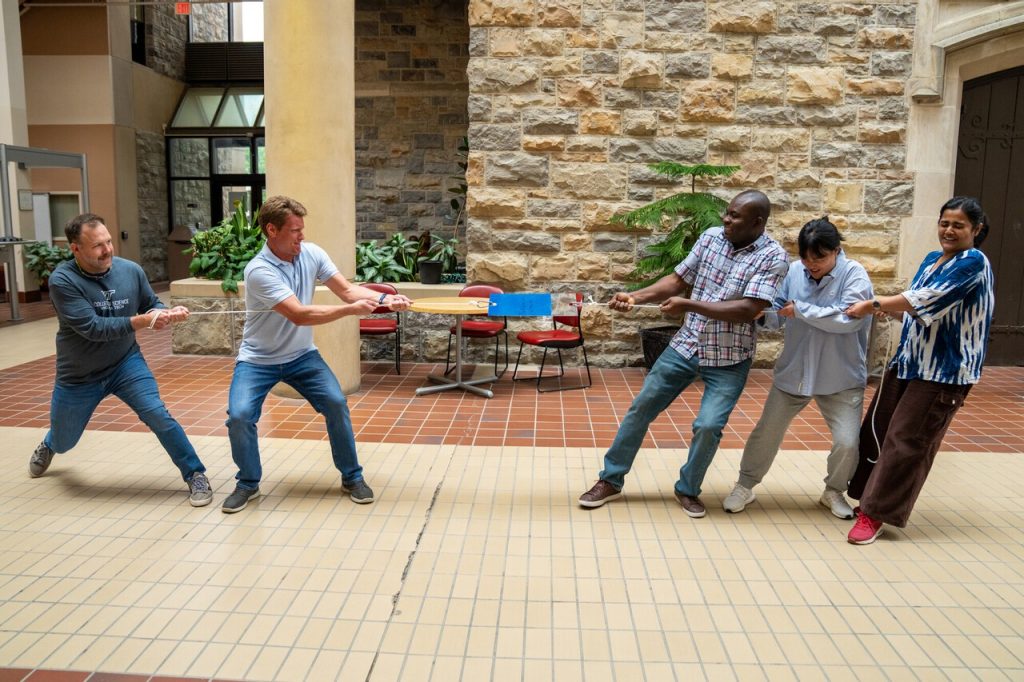
A good adhesive is unequivocally sticky. A great adhesive issticky until you don’t want it to be sticky anymore — a label on cardboard until it’s time to recycle it. Medical tape on a cut until the wound heals. A GWAR poster on a bedroom wall until your parents kick you out
Virginia Tech chemists are going for great by building degradation into the design
John Matson, Josh Worch, and their teams are developing extra-sticky adhesives that can be broken down into their original components once they are no longer needed
Polymers: Ancient Greek for ‘many parts’
A polymer is a long chain of molecules linked in a repeating pattern, like a multicolored string of Christmas lights. Like the lights, polymers can get tangled up
These entanglements give polymers a range of properties. Some entangled polymers make hard plastics, while others form materials that are rubbery, elastic, soft, conductive, resistant — and, of course, sticky
Sticky polymers are the main ingredient in many everyday adhesives, from sticky notes to tape. Useful, yes, but these products often require a nonrecyclable plastic backing and chemical additives to be effective. Any sticky residue renders cardboard boxes and related products unrecyclable
“It’s a classic friction. We want this to be useful while we’re using it, but as soon as we’re done using it, it should go away,” said Worch, assistant professor of chemistry. “We’re designing for end of life in every new material that we make.”
Worch lab: A fully recyclable tape
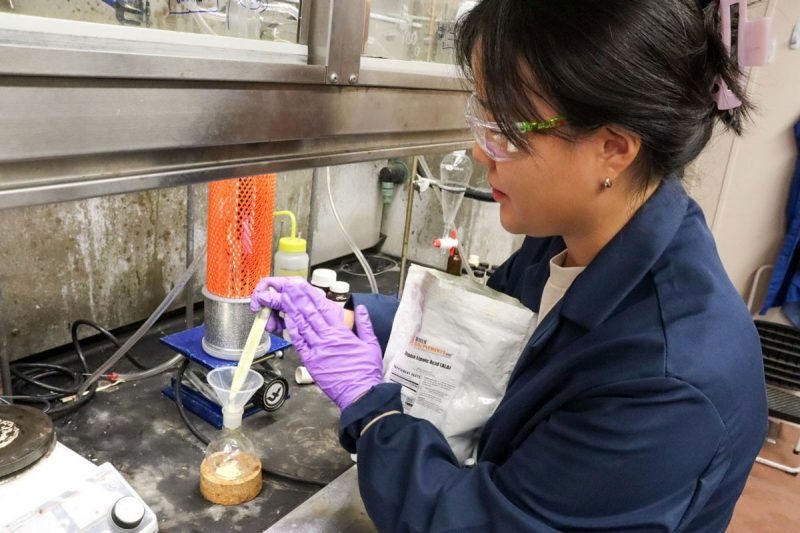
In a recent study published in Advanced Functional Materials, Worch and graduate researcher Regina Ham demonstrated a tape with adhesive and plastic backing layers that can be recycled together. The researchers describe their tape as “mono-material” design since both layers are chemically similar but perform different functions
They used lipoic acid — a naturally occurring sulfur-based compound found in foods such as broccoli and spinach — to create extremely large, inherently tacky polymers. By precisely adjusting the amount of acid, Ham found the right balance between tackiness and cohesiveness, producing an adhesive compound that outperforms heavy-duty duct tape in adhesion strength while remaining chemically recyclable
A second, mild chemical reaction takes just a few hours to break the adhesive and backing layers down into their original components. They can then be reconstructed into new adhesive tapes again and again
Matson lab: A stronger bottlebrush
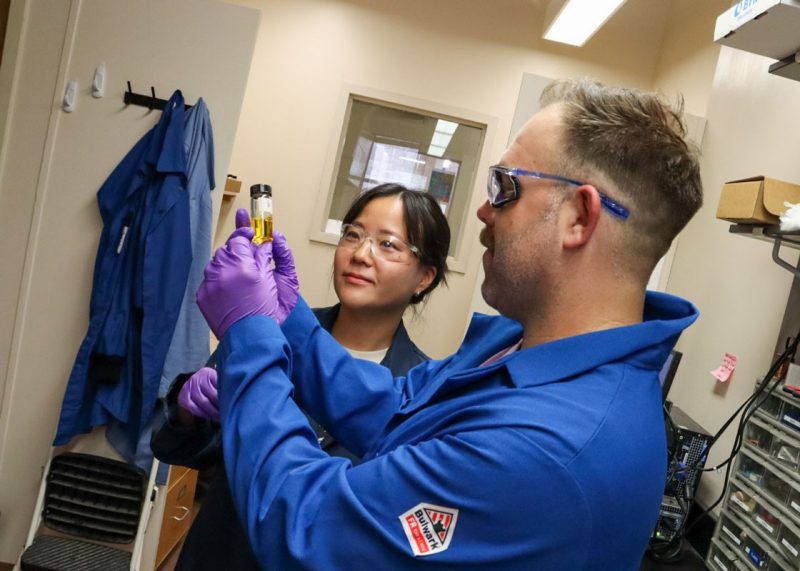
In the Matson lab, Clark Vu and Isaac Addo, former and current graduate students, respectively, developed another, even stronger degradable adhesive using a different polymer. Their work was published recently in Angewandte Chemie
This adhesive is made from a polymer with a central backbone and side chains that stick out like bristles. Under a microscope, they resemble a brush used to clean bottles — hence the name bottlebrush polymers
“When she got back to us with the results, we couldn’t believe what we were hearing,” Addo said. “It was four times stronger than the commercial adhesives used in duct tape.”
Best of all, the adhesive degrades within minutes after a quick douse with mildly alkaline water
The next step is to recapture useful starting materials
“We can get the gas back, but the remainder is not exactly the same chemical structure that we started with,” Addo said. “We’re still working on closing the loop.”
Polymer strong
The two teams are confident they can close that loop, in large part because they have each other
They’ve been discussing opportunities to combine the results of these two studies to create stronger degradable adhesives (from Matson’s lab) with fully recyclable backing (from Worch’s lab). But the collaboration goes beyond any single project
Matson’s lab is one floor below Worch’s, making conversations between the two teams easy and connecting both groups with Virginia Tech’s broader polymer research community — one that has grown steadily since the 1970s
The growth was driven in large part by the Macromolecules Innovation Institute, a universitywide research and education institute that connects polymer chemists with engineers, material scientists, sustainable biomaterials, and others who study large molecules
“We very much punch above our weight in polymers,” Matson said
That strength is what first attracted both Matson and Worch to Virginia Tech
“Scientifically it’s one of the best places I could have landed because you’re here with a bunch of other amazing folks who also work with polymers,” Worch said
The future of Virginia Tech polymer science is strong. As for recycling these degradable adhesives? Stick around and find out
Original study: DOI 10.1002/adfm.77687
Original study: DOI 10.1002/anie.7449383
Contact:
Lon Wagner
540-231-6468
