

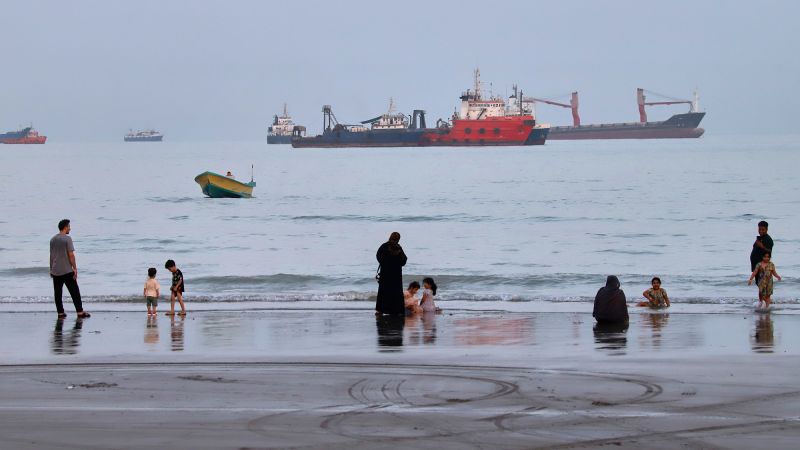
People spend time at a beach as commercial vessels are anchored in the Strait of Hormuz off Bandar Abbas, Iran, on August 5, 2026.
Iran and the United States are doubling down on competing claims of control over the Strait of Hormuz, but the reality is more nuanced than either side is willing to admit
Shipping traffic remains severely restricted, demonstrating that many shipowners are not willing to risk a possible Iranian attack and underscoring Tehran’s ongoing leverage over Hormuz
Vessel crossings amount to a tiny proportion of the 130-odd daily transits before the war, often barely reaching double digits. When it comes to crude oil-laden tankers, on average, only about two to three Very Large Crude Carriers, or VLCCs, have transited the strait every day since July 7 which tracks ships using transponders and satellite data. That compares with roughly eight VLCC transits daily before the war
Yet despite fewer transits, increasing volumes of oil are bypassing the strait altogether or relying on US protection and ship-to-ship transfers to move oil covertly out of the Persian Gulf
A leaky Hormuz blunts Tehran’s newfound energy weapon, while also allee prices, buying US President Donald Trump more time to prolong the current standoff in the hopes that Iran backs down
The United States is betting that economic pressure will achieve what military force has so far failed to accomplish: compel the Iranian regime to cave. Late Wednesday, Trump threatened “TREMENDOUS Economic Consequences” on any country that provides “any lifeline to Iran,” in a post on Truth Social declaring an “ECONOMIC D-DAY.”
Iran is showing no signs of capitulating, however, despite mounting pressure on its economy and oil sales. It continues to attack ships in the region, disrupting energy supplies to global markets
“It’s now a matter of who blinks first, if anyone,” said Jorge Leon, head of geopolitical analysis at Rystad,an energy consultancy. “There’s this dichotomy… economic pain is higher for Iran than for the US at the moment, but, importantly, political pressure on Iran is much lower,” he told CNN
Iran’s economy has already taken a major hit from the war. The International Monetary Fund expects it to shrink by more than 5% this year, which would be the worst contraction in almost four decades. Inflation is near 80% and the rial currency is at record lows to the dollar, forcing many Iranians to buy even essentials on credit
But Trump may be underestimating Iran’s pain threshold. Economic hardship is familiar territory for the country’s citizens and, so far, there have been no widespread demonstrations against the regime, which only appears emboldened by the war
“For Iran, the leadership is prepared to absorb a lot more economic pain,” said Gregory Brew, a senior analyst at Eurasia Group, a political risk consultancy. Iran has “absorbed years of US sanctions, and now a long war, and has not backed down.”
A billboard that reads in Farsi, “We must rise up” and an image of the late Iranian Supreme Leader Ayatollah Ali Khamenei towers over traffic in Tehran, on August 15, 2026.
The US is tightening the screws by choking off Iran’s oil exports through a blockade of Iranian ports. Loadings onto Iranian tankers have fallen to a fraction of the levels seen between February and April
Iran already has roughly 80 million barrels on the water outside the blockade, mostly committed to China, which will earn it roughly $1.5 billion a month at current prices, said Homayoun Falakshahi, head of crude oil analysisat Kpler. But the clock is ticking. At a discharge rate of 650,000 barrels a day, Tehran will have roughly four months’ worth of export revenues, he added. “It’s a bit like a slow death rather than falling off a cliff,” he told CNN
The US economy, on the other hand, has been comparatively insulated from the war, but rising gasoline prices, now above $4 a gallon on average, are hurting many Americans and testing Trump’s popularity ahead of midterm elections in November
Yet Trump is digging in. “The unpopular war and higher gasoline prices cost (Trump), but a chaotic Middle East retreat would be worse,” said Dan Alamariu, chief geopolitical strategist at Alpine Macro, an Oxford Economics company
“American voters don’t like presidents that lose wars,” he wrote in a note last week
The Trump administration has touted its ability to escort ships through the strait, but several analysts who spoke to CNN said Iran continues to wield significant influence over the waterway, though experts’ views differ
“Iran exerts near-full control of the Strait of Hormuz,” enforced through “the threat of attack,” said Dimitris Maniatis, the CEO of Marisks, a maritime security firm based in Greece
Notwithstanding Tehran’s influence, as many as 15 million barrels of oil are flowing out the Gulf each day on average, includingthe 20 million barrels that the region was exporting before the Iran war every day
Ship-tracking services, including Kpler, cite much lower figures, but analysts concede that sailings are becoming harder to track. Many tankers are attempting “dark” transits, switching their Automatic Identification Systems (AIS) off to avoid detection and in some cases using ship-to-ship transfers outside Hormuz to further obscure their movements
Iran is likely turning a blind eye to these transits, which in many cases involve tankers ultimately owned by Iranian, Russian, Chinese or Turkish interests
“A vessel that turns off its AIS does not go invisible… This big chunk of metal on the water has a lot of electronic transmissions over and above its AIS transponder,” he told CNN, noting that even a microwave or fridge in the ship’s galley gives off detectable signals
“If Iranians want to hit a vessel, they don’t rely on its AIS,” he added
Even Wright acknowledged that Iran, which he said had “built up a giant arsenal,” was “causing difficulties in the region” and “for the world economy.” But he argued that its ability to do so was declining
“Our ability to escort and bring products out of that region is growing,” he said in an interview with Fox News last week
Kpler’s data seems to bear that out: Falakshahi said that 72 of the 84 crude oil-laden tankers, or 86%, that have transited the strait since July 7 sailed dark and likely used theUN-authorized route through Omani waters. He cautioned, however, that it does not know this “with certainty.”
Six of the 84 vessels used the Iranian route, with the remaining six split between the Omani route and a pre-war passage between the two countries, but one likely closer to the Iranian route, he added
“It increasingly looks like Iran has at least partially lost control of the strait,” Falakshahi told CNN
For now, flows through Hormuz are providing much needed relief to the oil market. But they may perversely serve to drag the war out even longer
“Barrels getting through (Hormuz) raise the odds of a longer war, possibly deep into 2027,” said Alamariu, of Alpine Macro. “Neither side feels urgency if oil does not materially move and Iran still earns enough to sustain the regime,” he added
David Goldman contributed reporting
See all topics
