

Xinhua Headlines: U.S. record 40 trillion-dollar debts fuel global financial risks
Xinhua
20 Aug 2026, 19:45 GMT+10
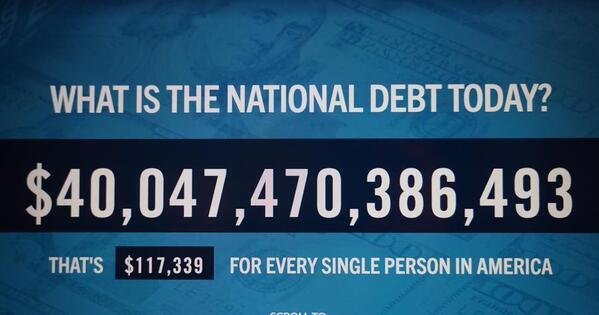
* The total debt of the U.S. federal government once again hit a historic high, surpassing 40 trillion U.S. dollars on Wednesday
* In the 21st century, the federal debt has been turned into a routine financing tool, launching a debt snowball
* The IMF’s latest Global Financial Stability Report warns that rising fragility in the U.S. Treasury market could amplify cross-market risk spillovers
BEIJING, Aug. 20 (Xinhua) — The total debt of the U.S. federal government once again hit a historic high, surpassing 40 trillion U.S. dollars on Wednesday
The latest U.S. Department of the Treasury data showed that the fresh debt record of 40.047 trillion dollars is nearly 10 trillion dollars more than last year’s gross domestic product (GDP), or approximately 116,480 dollars in federal debt per American
As the United States is the world’s largest sovereign debt market, its unchecked debt growth not only exposes deep structural fiscal problems at home, but also exports risks through the dollar-based financial system, posing a sustained threat to global financial stability and economic recovery
How did U.S. debt soar to this record high? What is the fiscal predicament? And how does this situation push up global financial risks?
“The scale of U.S. borrowing has expanded exponentially and to a level almost beyond comprehension over two and a half centuries,” said a Newsweek online article
The U.S. national debt on the Treasury Department’s records started from a modest 71 million dollars in the late 18th century, more than a decade after the nation’s independence in 1776
It reached the milestone of 1 trillion dollars in about 200 years, and 10 trillion dollars in the next about 27 years. After that, the U.S. debt swelled to 30 trillion dollars in just 14 years, and to over 40 trillion dollars in the four years since
History reveals an accelerating pace of U.S. debt growth over the past half a century
In the 20th century, national debt became a key tool of federal fiscal policy and a critical instrument for responding to major crises. And in 1981, under the administration of President Ronald Reagan, it crossed the trillion-dollar mark
In the 21st century, the federal debt has been turned into a routine financing tool, launching a debt snowball
In recent years, despite the absence of any major crisis or disruption, the annual U.S. debt increase has kept a pace of more than 2 trillion dollars, twice that of economic expansion. It shows an intensifying snowballing effect, under a fiscal framework yet without automatic brakes to slow this momentum
FISCAL WOES
“The greatest threat to our future is hidden in plain sight,” warned a recent commentary on Fox News. It pointed out that the swelling federal debt is the biggest hidden danger — with debt rising year after year, Washington has yet to offer any substantive solutions
The 40 trillion-dollar milestone is not just a number; it marks a significant deterioration in U.S. fiscal sustainability, signaling deepening structural fiscal crises and the continued accumulation of multiple risks
First, persistently high debt leverage has weakened fiscal resilience. As total debt soars, the U.S. government debt-to-GDP ratio remains elevated, reaching 123 percent by the end of the first quarter of 2026, well above the internationally recognized 60 percent warning level
The mounting debt burden continues to crowd out available fiscal relexibility to support industries, invest in public welfare, and fund infrastructure development
Kenneth Rogoff, a Harvard University professor and former chief economist of the International Monetary Fund (IMF), said in a recent interview with Japan’s Asahi Shimbun that surging debt, rising interest rates and political gridlock have eroded the resilience of the U.S. economy, all of which are typical warning signs of a country heading toward a debt crisis
Second, massive interest payments are squeezing public budgets and worsening fiscal imbalances. At current debt levels, annual interest costs have hit record highs, diverting huge amounts of public funds and gradually leaving the U.S. fiscal system focused largely on servicing its own debt
According to Fortune magazine, U.S. interest payments in the first half of fiscal 2026 totaled 529 billion dollars, or over 88 billion dollars per month, equivalent to combined spending on defense and education. This leaves the government far less room to allocate discretionary public spending
Third, prolonged and disorderly debt issuance is eroding market confidence, dimming the traditional “risk-free” aura of U.S. Treasuries. Backed by dollar hegemony, U.S. debt has long been a core global safe-haven asset. But endless borrowing has raised doubts among global investors about its long-term creditworthiness
Sovereign institutions around the world have continued to adjust their foreign exchange reserve allocations, reducing their holdings of U.S. Treasuries while increasing allocations to gold and other diversified assets. As a result, the global safe-haven premium of U.S. Treasuries has continued to narrow, significantly increasing market vulnerability
Data from the European Central Bank show that by the end of 2025, the share of U.S. Treasuries in global official reserve assets had fallen for two consecutive years, dropping 4 percentage points from the end of 2023
GLOBAL COST
As the anchor for global financial pricing and a key barometer of cross-border capital flows, the 40 trillion U.S. debt burden could transmit risks globally through channels including higher financing costs, disruptions to cross-border capital movements and reduced market liquidity, triggering prolonged and widespread negative spillover effects
Massive U.S. debt supply raises global risk-free rates, stifling the recovery. With Washington continuing to borrow heavily to cover fiscal deficits, growing concerns over the sustainability of its massive debt burden are pushing up risk premiums and driving long-term U.S. Treasury yields steadily higher
As the benchmark for global asset pricing, higher U.S. Treasury yields drive up borrowing costs for sovereign bonds, corporate dollar debt, and consumer credit worldwide. Emerging markets face heavier foreign-currency debt burdens, while global corporate investment and financing costs rise, dampening industrial expansion, cross-border investment and consumer credit demand
Rising long-term yields create a “suction effect” for dollar assets, intensifying global capital and currency volatility. High-yield U.S. Treasuries continue to attract global funds back to the United States, causing large-scale capital outflows from emerging market equity and bond markets
Data from Reuters and Bloomberg show that, as U.S. debt approaches the 40 trillion-dollar mark, long-term Treasury yields have fluctuated upward, prompting large-scale and frequent shifts in cross-border capital flows and further widening the divergence between financial markets in developed economies and emerging markets
Disorderly debt expansion also distorts bond market structures, weakens liquidity, and heightens global systemic risks. The U.S. Treasury market, once a cornerstone of global financial stability, is now experiencing supply-demand imbalances
Its ownership structure has fundamentally shifted: long-term allocators like foreign central banks and sovereign wealth funds are consistently reducing their holdings, while short-term leveraged players such as hedge funds are stepping in as major buyers
As a result, U.S. Treasuries, long regarded as a global stabilizer, are increasingly becoming aolicy or geopolitical conditions could trigger concentrated selling, leading to sharp moves in yields and sudden liquidity freezes
The IMF’s latest Global Financial Stability Report warns that rising fragility in the U.S. Treasury market could amplify cross-market risk spillovers, turning localized financial shocks into global disruptions and steadily weakening the self-correcting capacity of the international financial system
International observers broadly agree that the 40 trillion-dollar U.S. debt burden is not merely a fiscal issue for the United States alone; it has become a
The United States is using the dollar’s dominant position to externalize the costs of its fiscal imbalances, not only weighing on the global economic recovery but also continuing to undermine the existing international financial order
Over the long term, vulnerabilities in the global financial system and underlying structural imbalances will only continue to accumulate
Watch latest videos
News RELEASES
Publish news of your business, community or sports group,
personnel appointments, major event and more by submitting a
news release to India Gazette
More Information
Business
Section
OpenAI rolls out teen-focused ChatGPT with parental controls

SAN FRANCISCO, California: OpenAI launched a version of ChatGPT designed for minors on August 18, adding parental controls and stronger
Anthropic credit line could exceed $10 billion ahead of IPO

SAN FRANCISCO, California: Anthropic’s revolving credit facility is expected to surpass its roughly $10 billion target as the artificial
U.S. stocks edge higher as tech and industrials lead gains

NEW YORK, New York – U.S. stocks gained ground on Wednesday after the Treasury Department announced plans to double its buybacks of
Disney sues FCC to block early review of ABC licenses

WASHINGTON D.C.: Disney and its ABC unit have sued the Federal Communications Commission to stop an early review of licenses for eight
Meta faces landmark trial over alleged harm to young users

OAKLAND, California: Meta Platforms intentionally sought to get children hooked on Facebook and Instagram to increase their use of
Shein cuts Hong Kong IPO valuation to around $25 billion

HONG KONG: Fast-fashion retailer Shein is targeting a valuation of around US$25 billion for its planned Hong Kong IPO, sharply below
Delhi
Section
“Jinnah hidden within Congress leaders has come out”: BJP MP Dinesh Sharma slams CWC decision on Vande Mataram

New Delhi [India], August 20 (ANI): The row over Vande Mataram has escalated into a fierce political war of words between the Bharatiya
Supreme Court refuses to interfere with Delhi HC order, DUSIB land occupants required to vacate

New Delhi [India], August 20 (ANI): The Supreme Court has refused to interfere with the Delhi High Court’s order directing occupants
Delhi Crime Branch busts interstate anti-cancer drug racket, 17 arrested; medicines worth Rs 9 crore seized

New Delhi [India], August 20 (ANI): The Inter-State Cell of Delhi Police’s Crime Branch has busted an interstate syndicate allegedly
Tamil Nady CM Vijay seeks “legislative assurance” from Centre against loss of parliamentary presence in Delimitation, raises NEET issue

Chengalpattu (Tamil Nadu) [India], August 20 (ANI): Tamil Nadu Chief Minister Joseph Vijay on Thursday urged the Union Government to
India, Japan agree to deepen Maritime Security Cooperation following bilateral meeting

New Delhi [India], August 20 (ANI): Defence Minister Rajnath Singh and his Japanese counterpart Shinjiro Koizumi on Thursday affirmed
Delhi HC asks Centre to look into fresh complaints over Sai Baba content; GAC says videos may hurt religious sentiments

New Delhi [India], August 20 (ANI): The Delhi High Court on Thursday directed the appropriate Central government authority to look
