

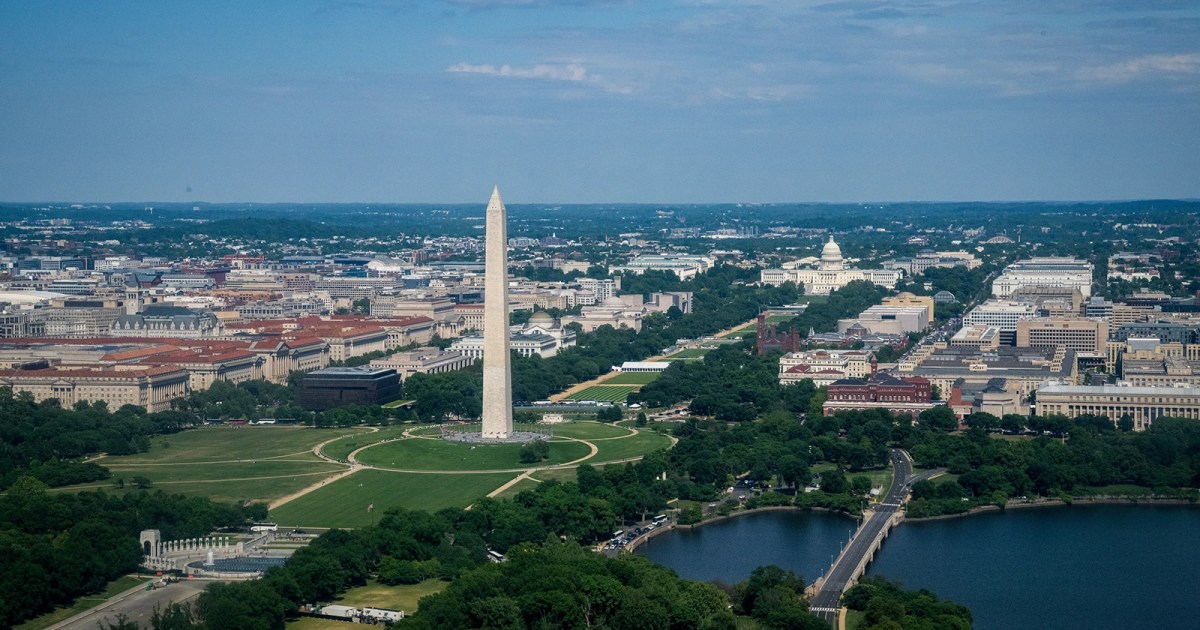
Escalating threats to President Donald Trump’s life and a thwarted alleged plot to use drones to attack a White House event this summer have put a sharp focus on the ability of U.S. air defense systems to protect the president and the nation’s capital. And former defense and FBI officials warn that existing defense infrastructure faces major vulnerabilities.
Although Iranian threats to the president’s life have existed since 2020, security has visibly increased during Trump’s second term. It wasn’t until after the Iran war had started that anti-drone systems known as Avengers were deployed to Trump’s Bedminster club and his Mar-a-Lago estate, two government officials with knowledge of the movement of the air defense systems told MS NOW.
The Pentagon first established its air defense systems around Washington, D.C., after the 2001 terrorist attacks, but the former officials who spoke with MS NOW are ringing alarm bells about the slow pace of modernization that has yet to effectively keep up with advanced drone threats and other unmanned aerial systems
“The threat is real,” said retired Gen. Glen VanHerck, who oversaw the aerial defense infrastructure as commander of U.S. Northern Command and North American Aerospace Defense Command from 2020 to 2024. “We need more of a sense of urgency to move faster to defend our critical infrastructure.”
New York Times WH Correspondent reveals Trump’s White House staff quietly question his priorities August 15, 2026 / 11:28
In June, the Department of Justice indicted eight men on murder and terrorism conspiracy charges for an alleged drone attack plot targeting the UFC fight on the White House South Lawn, which Trump and many members of his administration attended. The DOJ said one of the defendants “discussed loading explosives on the drones and how to configure and fly them for maximum destructive impact.”
The FAA also reported seizing more than 700 unauthorized drones this summer that were flying in restricted airspace near FIFA World Cup sites
VanHerck pointed to one example in particular that the nation’s capital is not equipped to handle. “What Ukraine did to Russia with Operation Spiderweb, striking their strategic bombers, that could happen right here, and we need to make sure it doesn’t happen right here.”
In 2025, Ukrainian forces executed a covert operation by sneaking 117 drones with explosive payloads attached into Russia and carried out a mass attack on Russian airfields that damaged nearly a third of the country’s strategic bomber fleet.
When asked if the U.S. is currently equipped to stop that kind of drone attack on the American homeland, VanHerck responded: “We’re not ready to stop that type of attack.”
The unmanned aircrafts repeatedly appearing over Langley Air Force Base in Virginia in 2023, as well as the flurry of drone sightings over New Jersey in 2024, were two catalysts for a swifter federal government response to potential domestic drone threats
Another former defense official told MS NOW that the type of threats that smaller unmanned aircraft systems pose to the Washington area is a challenge for the missile defense infrastructure first built around the city almost 25 years ago. Those countermeasures were designed before the outgrowth of modernized drone and short-range missile warfare
“There are absolutely capabilities in the region, but there’s no doubt that countering unmanned systems is a huge challenge that we are behind and underinvested in,” the former official said about the National Capital Region Integrated Air Defense System [NCR-IADS]
“Our ability to defend against drones, it’s pretty grim,” said former FBI agent Christopher O’Leary, who worked in counterterrorism. “D.C. has got some capability, but it’s not pervasive, and drone technology continues to expand and metastasize.”
The White House has more capabilities than the larger Washington area, said O’Leary, an MS NOW national security contributor. But “you’re limited by your imagination,” he said. “Secret Service does a great job. They’re the best in the world at it. But there’s a limit to what protective security can do. It’s reactionary.”
Trump, who frequently talks about the risk of drone attacks, argues that his massive ballroom project at the White House complex is a matter of national security because it will be both “drone-proof” and feature a “drone port” on the building’s roof.
U.S. loses 25% of its Reaper drones in Iran war: ReportAugust 14, 2026 / 10:40
In early August, a top White House aide posted a video of an Army Avenger, a short-range air defense weapon, at his Bedminster golf course earlier this month.
“I’m not worried about missiles or drones,” Trump said as he shook the hands of soldiers in front of the Avenger
One of the soldiers, pointing to the weapon, responded, “We’ve got it covered right there.”
The nation’s capital has greater technology to counter a drone attack, but drone technology and the ability for anyone to easily download an artificial intelligence program to help equip a drone with an explosive is easier now than ever before, said Niccola Milnes, a security and counterterrorism adviser who has worked in sub-Saharan Africa, Eastern Europe and South Asia
“The fear is: just overwhelming the system, or by sheer creativity coming up with drones that are able to evade it,” Milnes said. “It’s going to happen. It’s just a matter of time.”
Milnes thinks a state-sponsored drone attack is more likely to target an airport, a parade or a rally than a direct attack on the White House or U.S. Capitol. She pointed to a recent incident at Germany’s Leipzig airport, where a drone loaded with explosives bypassed the airport’s jamming and scanning countersystems, making it to a runway before being discovered and defused.
“With the exception of 9/11, the United States always had this monopoly of the sky over the United States. We controlled the air,” Milnes said. “Drones have changed that entirely.”
An Army publication in 2025 wrote that Washington’s air defense system “is not adequately modernized to keep pace with the emerging threat picture.”
