

Rival Shows the Drawback in Tesla’s Driverless Tech Strategy. Are They Right?
Daniel Miller, The Motley Fool
Sun, August 16, 2026 at 4:05 PM GMT+5:30
4 min read
- TSLA
+0.68% - GOOG
-0.12%
A while back, Morgan Stanley’s well-respected automotive analyst Adam Jonas evaluated Tesla (NASDAQ: TSLA) using a sum-of-the-parts model between artificial intelligence (AI), software, energy, and robotics rather than considering it a traditional automaker. What’s interesting is that Jonas believes autonomous driving technology and the robotaxi business drive 41% of Tesla’s valuation compared to34% from its core automotive and energy business and about 25% from Optimus robot potential. So, when robotaxi rival Waymo of Alphabet (NASDAQ: GOOG)(NASDAQ: GOOGL) points out why Tesla’s driverless technology strategy could have serious drawbacks, investors should take note.
What’s going on?
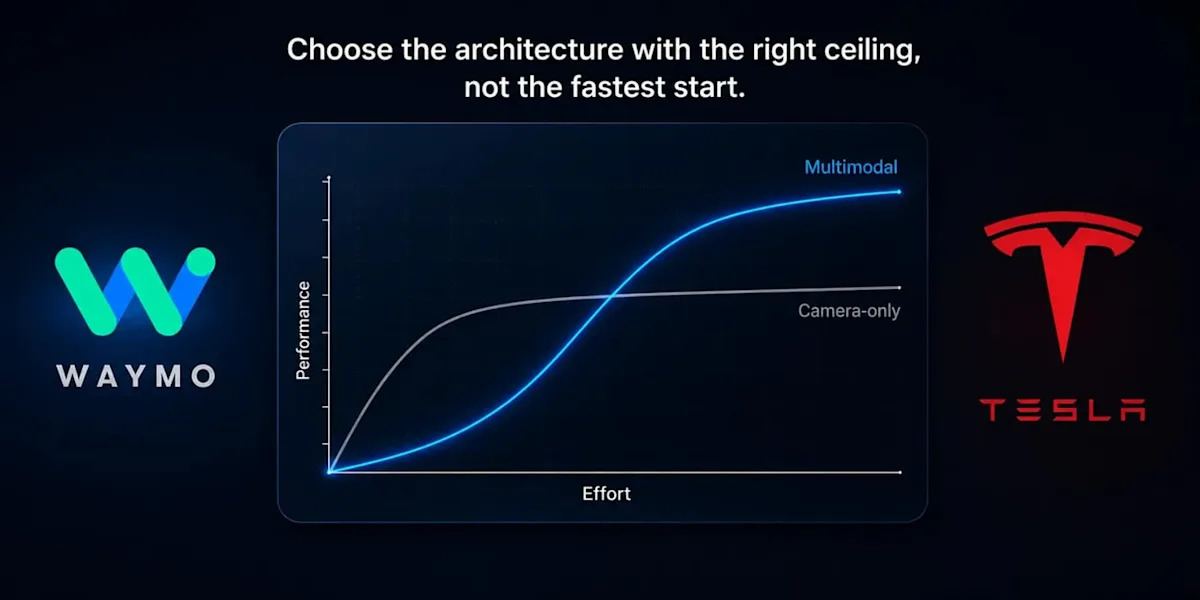
Recently, Alphabet’s Waymo co-chief executive officer, Dmitri Dolgov, seemingly took a shot at Tesla when speaking at Y Combinator’s Startup School, though he didn’t name the automnaker specifically. Dolgov essentially argued that camera-only self-driving technology could be considered “weak sensing” and that the strategy would develop quickly initially before hitting a lower ceiling of capability and performance long term
Missed Nvidia in 2009? This Rare Signal Is Flashing Again. In 2009, a “Double Down” signal flashed for a little-known chipmaker called Nvidia. For the first time in years, that same “Total Conviction” signal is flashing for a company 1/100th the size of Nvidia. Continue »
For years, the common argument for a camera-only system was that it’s cheaper and that humans rely solely on vision when driving. Therefore, a camera-only system could work adequately for driverless vehicles. Dolgov essentially agreed that a camera-only system could match human performance, but that to build a driverless technology that’s safer than humans, which is the entire goal, there needs to be more sensors
Although Tesla has opted for a camera-only driverless system strategy, which enables the automaker to lower costs, Waymo opts to use three sensor types: cameras, LiDAR, and radar. “These different sensing modalities, they’re not backups to each other,” Dolgov said during the presentation. The data fuses into a single view of the world that he noted is “vastly superior to what you get with any one sensor.”
It’s true that using three sensors is better than one unless you believe all three are redundant. In my opinion, they aren’t. Consider this simple scenario: A snow storm could cause a whiteout for camera-only systems, which would see next to nothing, while LiDAR in the same scenario would have no problem detecting a human or obstacle on the roadside. Even a fluke event such as mud covering the camera lens could completely shut down the driverless vehicle, whereas a Waymo vehicle with LiDAR and radar could safely navigate back to its home base to clean the camera.
