

Getting your Trinity Audio player ready…
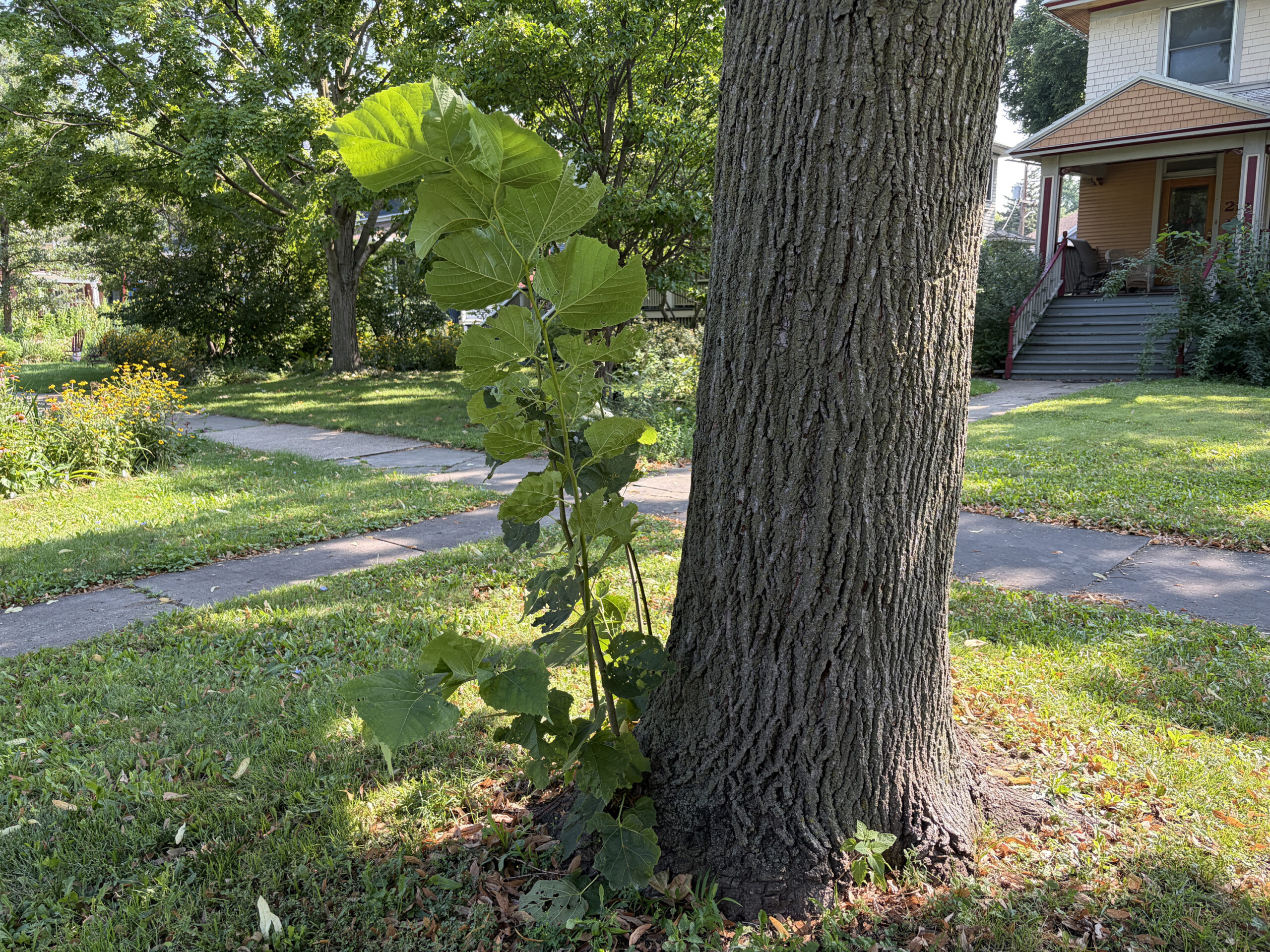
Did you plant a shrub at the base of that tree? If not, you may be looking at a mass of suckers
Stems that sprout from the base of a tree’s trunk are called suckers, on the theory that they compete with the main tree for water and nutrients manager of the Plant Clinic at The Morton Arboretum in Lisle
The real problem — apart from their untidy, bushy appearance — is that they can be a sign of trouble. “Suckers are a way for a tree to produce more leaves so it can gather more sunlight,” he said. Often, a tree grows suckers in response to stress from pests, diseases, or damage, or to difficult conditions such as inadequate root space or insufficient water
“If part of a tree’s leafy canopy is dying back or damaged, the tree may try to grow more stems from its base to compensate,” Jesiolowski said. Suckers that grow in clusters from higher up on the trunk or along branches are called water sprouts and may also be a sign of stress
Before you prune out the suckers to tidy up the tree, it’s always a good idea to figure out why the tree is producing them. “If you have a big shade tree that is growing lots of suckers, have an arborist check it out and look for problems,” he said. An arborist may tell you if there is anything you can do to help the tree
Some kinds of trees, such as honey locusts, hackberries, lindens and maples, are naturally more inclined to produce suckers. “The suckers may just be an aesthetic issue, but it’s always a good idea to have an expert confirm that,” he said
Another reason a tree might grow suckers is that it was grafted. Grafting attaches the top of one kind of tree to the roots of another kind. Usually, the two will grow together, so the bottom plant, called the rootstock, supplies water and nutrients to the top plant, called the scion, which bears the branches and leaves
The rootstock is usually hardier or more disease-resistant than the scion. Grafting makes it possible for the scion tree to grow in conditions that otherwise would be too difficult for it
Most fruit trees are grafted, including ornamental crabapples, pears and cherry trees. Many other kinds of trees sold in nurseries are also grafted to make commercial production easier
Sometimes, the rootstock of a grafted tree will send up shoots of its own from below the graft union, the bulge or change in the bark low down on the trunk where the plants are joined
“Compare the leaves of suckers growing from a tree’s base to leaves from branches overhead,” Jesiolowski said. “If they’re different, the suckers are probably growing from the rootstock of a grafted tree.”
To remove suckers, use sharp pruners to snip them off as close to the ground as you can. It’s easiest to prune them regularly, a few at a time, especially if you have a grafted tree that is probably going to keep on suckering
“If you wait until suckers have accumulated into a bushy mass, they can be a pain to tackle,” he said
For tree and plant advice, contact the Plant Clinic at The Morton Arboretum (630-719-2424, mortonarb.org/plant-clinic, or plantclinic@mortonarb.org). Beth Botts is a staff writer at the Arboretum
