

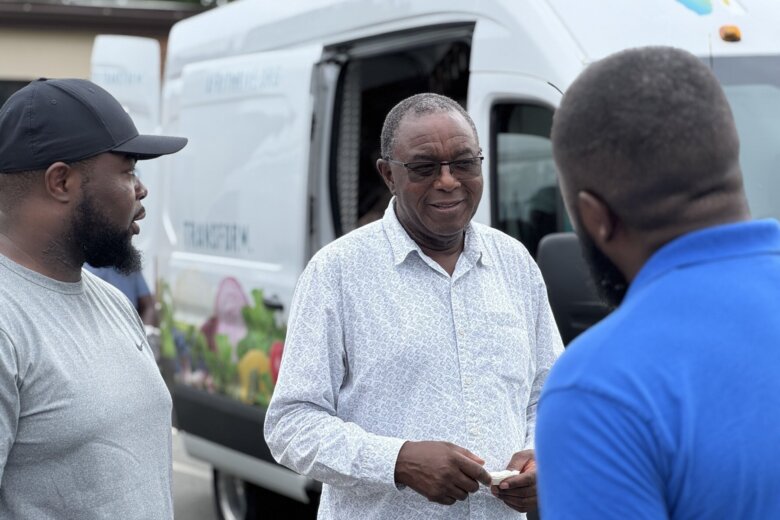
Every Friday morning, in an Aspen Hill, Maryland, parking lot, a long line forms as staff and volunteers with AfriThrive provide locally grown, fresh food to people who struggle to afford groceries
Lots of nonprofits have food distribution programs, but what sets AfriThrive apart is the priority of providing culturally-appropriate foods to the population it serves: low-income African immigrants
Charles Choti, founder and director of community engagement and partnerships at AfriThrive, said that for many of the African residents in the D.C. region, finding familiar foods can be a challenge
AfriThrive includes a food-production program, where produce is grown locally on a two-acre space in Poolesville and at community gardens in Montgomery County. The self-sustaining approach, Choti said, answered the question the founders had in creating the program: “If this food can be grown in America, why can’t we do so?”
The mobile pantry program makes it easier for recipients to access foods they’re familiar with
“We promote healthy eating, where people consume not only the food they are familiar with, but the food that really benefits their body,” Choti said
Peaches, corn, cabbage and beets are available at the weekly distributions. But some of the biggest draws are vegetables that are staples in dishes from many African countries
Stephen Omboga, food operations coordinator at AfriThrive, ticked off a few of the most popular greens on a folding table: managu, saga, and callaloo. All are leafy green vegetables gathered in bunches. Omboga called the offerings “food that is tailored for your culture.”
In June, AfriThrive began creating its Food as Medicine program
Oluwasefunmi “Seph” Obielodan coordinates the outreach effort, which will link 80 prescreened participants with clinicians and food providers to address diet-related health issues
She said many similar programs aimed at immigrant communities often see high dropout rates
“People start, but they don’t finish because a lot of those projects don’t factor in the fact that this person is from Ethiopia, this person’s from Kenya, this person’s from Nigeria,” Obielodan said, adding that foods favored by one group may be unfamiliar to another
“Because again, the food we are providing is dietician-approved,” she said
While AfriThrive’s target is serving African immigrants, Latino and Asian immigrants also participate in the food distribution program. Volunteers come from a variety of backgrounds as well
Gity Nabaiee describes herself as the “trash lady,” explaining that she helps clean up and break down the boxes and tables at the Friday morning distributions. She’s been volunteering for six years
Asked why, she didn’t hesitate: “I’m Iranian. And Iranian old culture is nothing in the world is better than serving people.”
Nabaiee said when she sees the smiles on recipients’ faces, “It makes me happy.”
Get breaking news and daily headlines delivered to your email inbox by signing up here
© 2026 WTOP. All Rights Reserved. This website is not intended for users located within the European Economic Area.
