

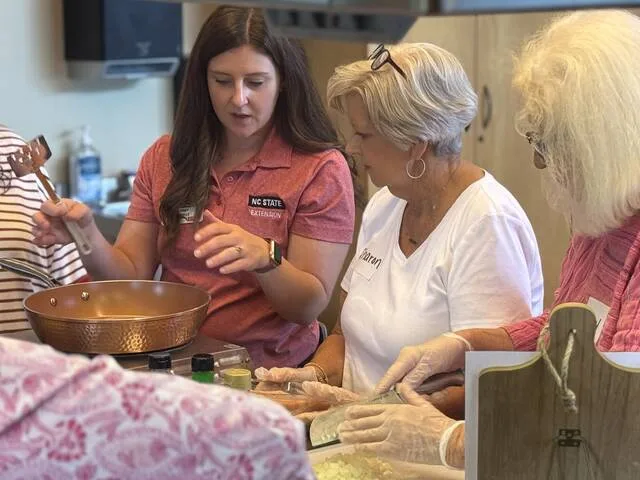
The North Carolina Cooperative Extension Service began its six-week course on Mediterranean-style nutrition and cooking at its offices on U.S. 421 this past Thursday, Aug. 6
The course is led by Sydney Knowles, an extension agent in Family and Consumer Sciences
The nutrition and cooking program was created in partnership with the Cooperative Extension, North Carolina State University, the Department of Public Health and Eat Smart-Move More. The curriculum comes directly from nutrition specialists at State
Knowles acknowledged during the first class that people may have trepidation when it comes to changing the way they eat. She said she knows that with so much information about diets online, things can feel confusing; with the rising cost of food these days, it can all seem too expensive, she pointed out
The extension agent said she understands that changing a diet can become overwhelming, but her goal is to help her students get out of their heads and into routines
“I think when we start to accept more of a lifestyle change than being focused on the diet aspect and diet mentality — this is just how we eat, or this is just the foods that we choose every day — it helps us to make that more of a long-lasting way to eat,” she said, explaining that “diet really means what you eat. It doesn’t necessarily mean, ‘to lose weight.’”
Students talked at the beginning of last week’s class about the various reasons they were attending. Some said they already had a passion for Mediterranean food and wanted to learn more; others shared that they wanted to start eating healthier, and a few students spoke about how they deal with diabetes and were hoping for a healthy diet that could best benefit them
Knowles said two-thirds of chronic disease symptoms can be treated in part by both food and lifestyle choices. The one-third that can’t be treated, she said, is when the chronic disease is hereditary
“Research consistently shows that the Mediterranean-style eating pattern is highly effective in preventing and controlling chronic disease,” she told the class
Knowles said the Mediterranean diet can help decrease the risk of Type 2 diabetes and has also been found to decrease the risk of some forms of cancer, specifically colon, breast and prostate
“Those three have the most evidence,” Knowles stated
She also added that research has found a 40 percent lower risk of developing Alzheimer’s disease among those who use the Mediterranean diet, and that initial studies are continuing to examine how that way of eating can protect brain health
The Mediterranean lifestyle can also strengthen blood vessels connected to the eyes
Those eating patterns incorporate healthy eating that was traditionally practiced in countries along the Mediterranean Sea
Lots of fruits and vegetables of different shapes and colors are “really the foundation of the Mediterranean diet,” Knowles explained. Whole grains, beans, legumes, nuts, seeds and seafood are a few of the main components of the diet
Knowles clarified after the lesson that no new students can be accepted now that the course has begun because of the structure of the class. She revealed that, in fact, there is already a waitlist for future classes
Anyone interested joining the waitlist for future nutrition and cooking classes may email Knowles at Sydney_knowles@ncsu.edu
