

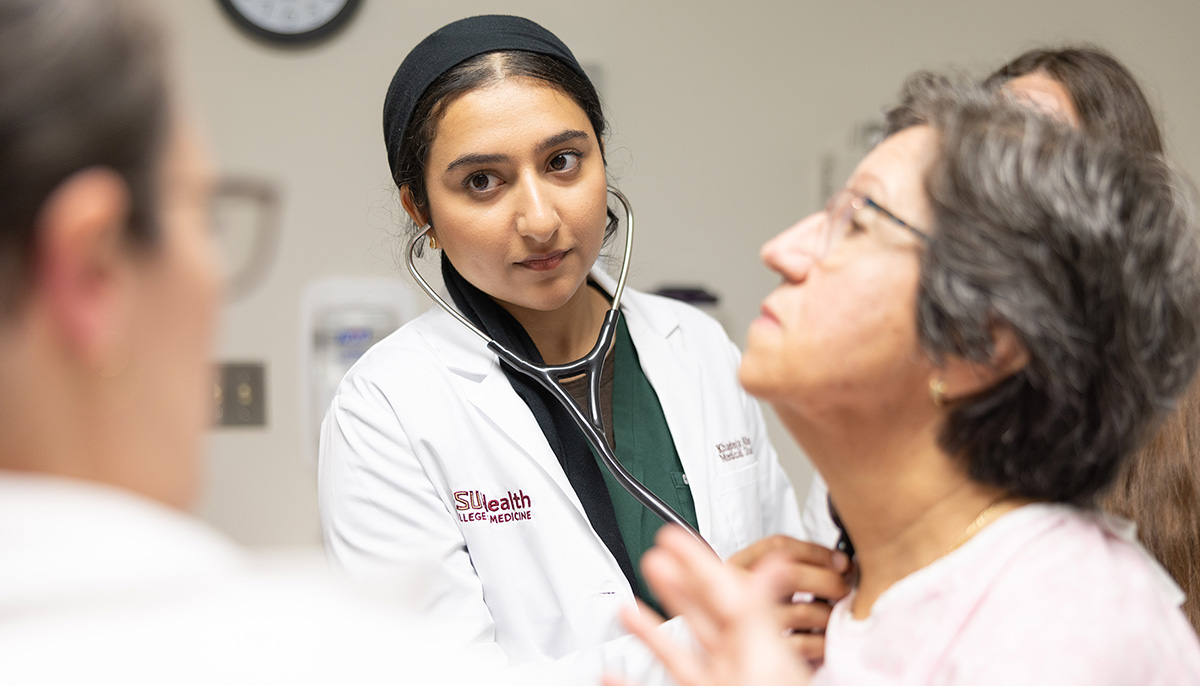
As North Florida faces a growing shortage of healthcare providers, Florida State University is helping address the challenge through FSU Health, the university’s academic health system. By bringing together education, clinical care and research, FSU Health is preparing the next generation of healthcare professionals while expanding access to care across the region
The need is expected to grow in the coming years. Florida’s population is expanding and aging, increasing demand for healthcare just as many physicians and nurses approach retirement
According to the Florida Department of Health, more than one-third of Florida’s practicing physicians are age 60 or older. At the same time, Florida’s population age 65 and older is projected to reach 6.7 million by 2036, or more than a quarter of the state’s population. A workforce analysiscommissioned by the Florida Hospital Association and the Safety Net Hospital Alliance of Florida projects the state could face a shortage of about 18,000 physicians and nearly 60,000 nurses by 2035
Those challenges are especially pronounced in rural North Florida, where many communities have limited access to primary and specialty care. The Florida Department of Health’s annual Physician Workforce Report shows many Panhandle counties have among the state’s lowest physician-to-population ratios, underscoring the need to recruit and retain more healthcare professionals
Unlike a traditional health system centered on a single hospital, FSU Health brings together the university’s colleges, research enterprise and clinical partners to educate healthcare professionals, advance research and improve patient care. Supported by investments from the Florida Legislature, the universitywide initiative spans disciplines across FSU and works with healthcare providers throughout North Florida
“The healthcare workforce shortage isn’t something any one hospital, university or health system can solve alone,” said Jeremy Slaga, vice president and chief clinical operations officer of FSU Health. “FSU Health was created to align education, research and patient care with the strengths of our clinical partners so we can prepare more healthcare professionals, expand access to care and create lasting health benefits for communities across North Florida.”
Responding to the need
Preparing the healthcare workforce Florida will need for decades to come is central to FSU Health’s mission
Since its founding in 2000, the FSU College of Medicine has focused on preparing physicians, physician assistants and other healthcare professionals to serve rural, medically underserved and aging populations
“As someone who grew up in rural Gadsden County, I understand how important it is for families to have access to quality healthcare close to home,”said Alma Littles, M.D., dean of the FSU College of Medicine and president of the Florida Medical Association. “That mission has guided our college from the beginning. We’re preparing physicians and other healthcare professionals who understand the needs of these communities and are committed to serving them.”
That approach is producing results
This year, all 120 FSU College of Medicine graduates who participated in the National Resident Matching Program matched into residency programs.Nearly half matched in Florida, while another 31% matched in neighboring Southeastern states, meaning nearly four out of five remained in the region
Many entered specialties facing some of Florida’s greatest workforce needs, including the primary care specialties of family medicine, internal medicineand pediatrics
Graduate medical education is another critical part of addressing Florida’s physician shortage. Because physicians are more likely to establish their practices near where they complete residency training, expanding residency opportunities can help Florida retain more doctors
FSU’s Graduate Medical Education (GME) programs graduated a record 116 physicians this year, with 66% completing residencies or fellowships in primary care specialties. In 2026, the College of Medicine assumed sponsorship of nine additional GME programs in Tallahassee, Sarasota, Cape Coral, Pensacola and Jacksonville. The college now sponsors 32 programs training 516 physicians statewide, with more growth planned
The university is applying the same long-term approach to nursing
The College of Nursing recently expanded enrollment, admitting students three times each year and creating a year-round pipeline of graduates entering the workforce. More than 800 students are enrolled annually across the college’s undergraduate and graduate programs
The college also is expanding its Bachelor of Science in Nursing program to FSU Panama City, supported by a $10 million gift from Bruce and Tracey Berkowitz and the Fairholme Foundation. The historic gift will strengthen Northwest Florida’s nursing workforce by providing scholarship support to students from Bay, Walton and Gulf counties who plan to practice in the region
“Florida’s nursing shortage demands innovative solutions,” said Jing Wang, dean of the FSU College of Nursing. “By expanding enrollment, creating new educational pathways and strengthening partnerships across the state, we’re preparing more nurses to provide high-quality, patient-centered care where they’re needed most. Our undergraduate expansion is just one element of our investment in the region; through pioneering efforts like our Smart Home Health Initiative, we are deepening our commitment to advance the health, well-being and future of these communities.”
Preparing the healthcare workforce requires more than educating physicians and nurses. It also depends on professionals working across disciplines to meet patients’ physical, mental and behavioral health needs
Across the university, FSU is preparing future physician assistants, psychologists, social workers, dietitians, exercise scientists, rehabilitation specialists, public health professionals, health informatics specialists and healthcare administrators. These disciplines help meet growing needs in primary care, behavioral health, rehabilitation, chronic disease prevention and community health
“Today’s healthcare challenges require teams of professionals with different expertise working together to improve the health of Florida’s communities,” said Damon Andrew, dean of the Anne Spencer Daves College of Education, Health, and Human Sciences. “Across FSU, we’re preparing graduates who understand how nutrition, exercise, behavioral health, human development, education and other factors intersect to shape lifelong health and well-being. Whether in schools, clinics, or community settings, our graduates play essential roles in improving health and quality of life for individuals and families.”
Together, these programs reflect FSU Health’s team-based approach to healthcare, recognizing that improving health outcomes depends on professionals across disciplines working together to care for patients and communities
FSU also is expanding its work directly in rural communities. The College of Medicine recently was awarded more than $19 million through the federal Rural Health Transformation Program to launch six projects addressing rural health challenges including workforce development, behavioral health, preventive care, food insecurity, telehealth and at-home care. Two projects will focus on Northwest Florida, a central hub for FSU Health, while four will serve Southwest Florida
Building the future of FSU Health
Preparing the healthcare workforce of the future is supported by major investments in clinical partnerships, research and patient care
The FSU Health Research and Collaboration Building under construction on the Tallahassee Memorial HealthCare campus will provide space for clinical research, laboratories and a family medicine residency clinic, creating new opportunities for education, patient care and scientific discovery
FSU also is expanding its partnership with Tallahassee Memorial while continuing development of FSU Health Panama City Beach, where an outpatient medical office building is already serving patients and construction is underway on a new hospital
“At the end of the day, success is about people,” Slaga said. “If more Floridians can receive the care they need closer to home because we educated the physicians, nurses and other healthcare professionals who chose to build their careers here, then we’ve accomplished what FSU Health was created to do.”
