

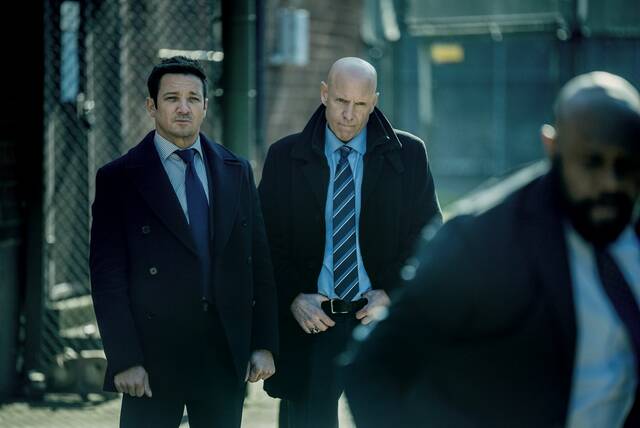
Jeremy Renner stars as Mike McLusky and Hugh Dillon plays Ian in “Mayor of Kingstown,” which wrapped filming its final season in Pittsburgh earlier this summer. (Courtesy Jeremy Parsons/Paramount+ )
“American Rust” was filmed in Southwestern Pennsylvania during the region’s post-covid-19 film/TV production boom. (Rob Owen | For TribLive)
<img src="https://todaytrendnews7.com/wp-content/uploads/2026/08/9799232_web1_ptr-ViewingTip-08082026-AmericanRust-set-150×150-1.jpg” alt=””>
While viewers await the final season of Pittsburgh-filmed “Mayor of Kingstown,” likely to stream on Paramount+ sometime this fall, and the debut of locally filmed “Nocturne” (Oct. 30, Apple TV), local crews and film and TV production observers are left to wonder: What’s next?
In the event of success, it’s likely that “Nocturne” will be back to film a second season. But beyond that? Things are pretty quiet
“The Pitt” will parachute in for a few days this fall to film scenes for its third season around Allegheny General Hospital, but that brief production schedule doesn’t amount to much work for local crews
The current dearth of long-term local film/TV productions in the region mirrors a nationwide trend
In the immediate aftermath of 2020’s covid-19 pandemic, the region had its biggest year ever as the Peak TV phenomenon saw more than 600 original scripted series per year produced for U.S. broadcasters, cable networks and streaming platforms
“We had 11 shows with over $300 million in economic impact, and everyone got used to that for a minute,” said Dawn Keezer, director of the Pittsburgh Film Office
Even before the 2023 dual writers’ and actors’ strikes, it seemed clear Peak TV was unsustainable. When Netflix reported its first subscriber loss in a decade in early 2022, Wall Street suddenly got cold feet about its focus on subscriber-at-all-costs streaming growth, reorienting to a focus on profits
Bloomberg’s Screentime newsletter reported last month that Hollywood produced 100 fewer TV shows in the first half of 2026 than it did a year earlier, the fourth year in a row of decline and a drop of almost 50% since 2022, according to industry data tracker Luminate
“The industry has been contracting; not as many things are being made right this second,” Keezer said. “It’s cyclical. Everybody expects it to change. New York said last week in an article I read that they’re starting to see a little bit more business, but what we’re seeing across the country is it’s slow everywhere.”
It probably doesn’t help that Pennsylvania’s film tax credit program has been stuck at a $100 million cap since 2022
Keezer points to New York, which has an $800 million cap, and Georgia, whose program is uncapped, as Pennsylvania’s competition for winning film and TV projects
“We’d like to be at $300 million,” Keezer said. “We’re not trying to go crazy, but we have two production centers in the Commonwealth of Pennsylvania, and that should be celebrated.”
Without getting into back-and-forth economic policy arguments for and against tax incentives for filmmakers, the reality is that without these tax breaks, film and TV projects look elsewhere
How do we know tax breaks are key to luring productions? Film producers and TV showrunners have been saying so for the last two decades
In 2015, Cinemax’s “Banshee” relocated to film its final season in Western Pennsylvania after North Carolina, where it shot previous seasons, gutted its film tax incentive program
“We chose Pittsburgh for the look of the surrounding area and for the Pennsylvania tax incentive,” “Banshee” producer Robert Phillips told me at the time
TV writer/showrunner Greg Garcia said he wanted to film 2022’s “Sprung” in Frostburg, Md., where he went to college, but he needed a production center. He pointed to the Pennsylvania film tax credit as a reason Pittsburgh wound up playing the fictional Kimberton, Md
ABC’s 2017 critically acclaimed comedy “Downward Dog” almost went elsewhere due to a state budget impasse in 2015 that threatened the show’s ability to apply for the film tax credit
“There was a sketchy two- or three-week period where it looked like the show might go to Canada or Atlanta,” said “Downward Dog” executive producer Michael Killen at the time. “Thank goodness for people like [agent/producer] Jimmy [Miller] and [studio executive] Thomas Tull who were able to keep this a Pittsburgh product.”
Lee Daniels, who directed the 2024 Netflix film “The Deliverance” locally, said of Keezer and the film tax credit, “She made me an offer where I couldn’t refuse, and I was able to make the dollar stretch in a way that I couldn’t do it anywhere [else].”
But with a $100 million cap in Pennsylvania, there’s not always enough film tax credit incentives to go around. August Wilson’s “Fences” and “Ma Rainey’s Black Bottom” filmed in Pittsburgh, but Netflix’s 2024 version of Wilson’s Hill District-set “The Piano Lesson” decamped for Canton, Ga., an hour by car north of Atlanta, likely because the Pennsylvania film tax credit for that fiscal year was all spoken for at the time “Piano Lesson” needed to begin production
Occasionally film/TV projects do come to Western Pa. without a tax credit as an incentive. “The Pitt” doesn’t spend enough of its budget locally to qualify, nor did Showtime’s “Escape at Dannemora,” which filmed locally for two weeks in October 2017
“They’ve got to spend a minimum of 60% of their budget to qualify to receive a 25% tax credit,” Keezer said. “We want everybody here spending money, so we’re not gonna shut the door to anybody that wants to come. But our goal was television series, and I think we’ve had 32 of them now. We like the projects that come employ Southwestern Pennsylvania crew and pay family-sustaining wages and contribute positively to economic development in the region.”
Like “Kingstown,” “Dannemora” came to use the shuttered SCI Pittsburgh prison as a location. Now Keezer is also pitching producers on using the shuttered landside terminal at Pittsburgh International Airport as a studio space, calling it Terminal P
“I always say the number one reason anyone comes is our crew because we have highly trained, highly talented, very experienced individuals that number over 5,000 in the region that live here,” Keezer said. “[Productions] get to use qualified, quality people to work on their shows, and they keep that money here at home.”
The second reason Keezer gives is the diversity of locations
“We can look like anything in the world as long as you don’t need a beach or a desert,” Keezer said
The third reason she offers is the local economy
“We’re far cheaper than most of our competition for most things that you’re paying for, be it hotels, car rentals, whatever. It’s just cheaper to do business in Southwestern Pennsylvania,” Keezer said, before emphasizing, “but without the tax credit, none of those things I listed matter.”
The whole reason Pittsburgh evolved into a frequent filming location was the creation of the film tax credit program in the early 2000s around the same time producers began to find their projects getting priced out of California. Many decamped to Canada. Domestically, the Pennsylvania film tax credit helped lure them to Western Pennsylvania, as did similar programs in other states
California began to lose so many projects in recent years that, despite being home to Hollywood, the state had to boost its own film tax credit program from a $330 million cap to a $750 million cap in 2025 to try to lure back runaway productions. (Perhaps the last straw was when even many of Fox’s less expensive reality competitions decamped for other countries, with “Name That Tune,”“The Floor” and “Next Level Chef” finding it more economical to fly American contestants to film in Ireland rather than Los Angeles. Fox’s “The Quiz with Balls” shoots in Belgium.)
Locally, Keezer points to the benefits of the PFO’s creation of a workforce training program, Create PA, that partners local union crews with people who want to learn skills useful in the film industry
“Now we want to put them to work,” Keezer said of program graduates. “We need to increase the tax credit. We need to get some more work.”
To that end, Keezer sees some reason for hope
“We’re starting to get a few more calls,” she said. “I don’t have anything booked, but we’ve gotten a few more inquiries.”
About the Writer
You can reach TV writer Rob Owen at rowen@triblive.com or 412-380-8559. Follow @RobOwenTV on Threads, X, Bluesky and Facebook. Ask TV questions by email or phone. Please include your first name and location
News Spotlight
- Westmoreland County Housing Authority sued over water damage at Greensburg businessesTribLive
- What Is Selling a House As-Is With Aged Mechanicals?Buys Houses
Partner News
- Dodgers leave Freddie Freeman in Los Angeles to rest a sore right ankle ahead of the playoffsKDKA
- Simple Ways to Move On From a Property You No Longer WantBuys Houses – We Buys Houses in Pittsburgh
Partner News
- What Is Selling a Home With Needed Repairs?Buys Houses – We Buys Houses in Pittsburgh
Partner News - Latrobe junior pitcher Gaskey picks Penn State as next stopTribLive
- How to Sell a House With a Leaky Roof and Aged MechanicsBuys Houses
Partner News - Westmoreland happenings: Yellow Tie Gala, recovery meeting, reunion news, moreTribLive
- St. Margaret Mary Parish Festival to continue Saturday in Lower BurrellTribLive
- What Is Selling a Home With Foundation Issues?Buys Houses
Partner News
Push Notifications
Get news alerts first, right in your browser
Enable Notifications
