

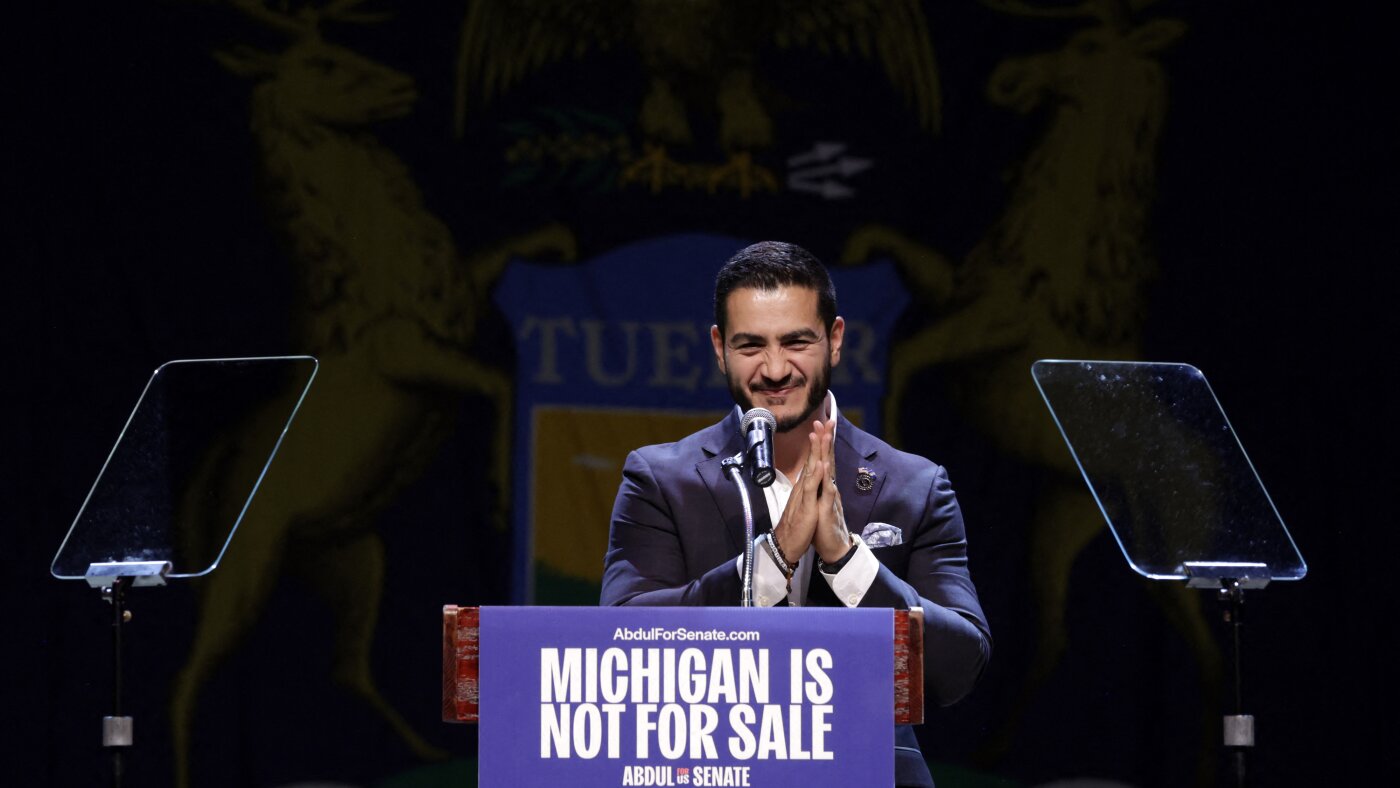
<El-Sayed wins Michigan’s primary. And, Fauci faces contempt of Congress vote
August 6, 20267:30 AM ET
Hormuz Negotiations, Michigan Senate Race, Trump Talks Economy
Listen·13:2813:28
Transcript
- Download
- Embed
<iframe src="https://www.npr.org/player/embed/g-s1-137574/nx-s1-mx-5922766-1" width="100%" height="290" frameborder="0" scrolling="no" title="NPR embedded audio player"> - Transcript
Transcript
MICHEL MARTIN, HOST:
President Trump has claimed several times that a deal to reopen the Strait of Hormuz is close
LEILA FADEL, HOST:
Now Iran is saying it, too, but in a deal that is being negotiated directly with Oman
MARTIN: I’m Michel Martin. That’s Leila Fadel, and this is UP FIRST from NPR News
(SOUNDBITE OF MUSIC)
MARTIN: Progressive Abdul El-Sayed eked out a primary victory for a Michigan Senate seat. He now faces former GOP Congressman Mike Rogers in November. What does El-Sayed need to do to win an estate that voted for President Trump two years ago?
FADEL: And President Trump traveled to Las Vegas, where he claimed the economy was fine and blamed Democrats for high prices
(SOUNDBITE OF ARCHIVED RECORDING)
PRESIDENT DONALD TRUMP: The economy is the greatest economy we’ve ever had by far
(SOUNDBITE OF MUSIC)
FADEL: What do voters say? Stay with us. We’ll give you the news you need to start your day
(SOUNDBITE OF MUSIC)
FADEL: Iran’s deputy foreign minister says his country is close to a deal to allow ships to pass through the Strait of Hormuz
MARTIN: The deal may not even involve the U.S. Instead, it’s being hammered out between Iran and Oman, which is located on the southern edge of the strait, one of the most important waterways for oil and gas exports
FADEL: To discuss what the deal might entail, we’re joined now by Reporter Sameer Hashmi in Dubai. Good morning, Sameer
SAMEER HASHMI: Good morning
FADEL: So what do we know about this potential agreement?
HASHMI: Well, Iran says that the deal with Oman is in its final stages but hasn’t shared the precise details. What the country’s deputy foreign minister, Kazem Gharibabadi, said is that the talks with Oman have covered technical arrangements, the security details and a proposed joint coordination center between the two countries to manage maritime traffic. Now, he was also speaking to Iran’s state media and in an interview, he said that under the proposed arrangement, temporary routes would allow ships to pass through Iran’s waters and exit through Oman’s waters.
Now, Iranian officials have also stated that this would not be the complete reopening of the strait. And Esmail Baghaei, when he was speaking to the press, he said that the deal with Oman would not guarantee safe navigation due to, quote, a “U.S. blockade of Iran’s ports.” Now, these negotiations have been on for the last three weeks, and they’re hoping to – they’re on the verge of finalizing it, is what these officials are saying
FADEL: Is the U.S. involved at all in these talks?
HASHMI: Well, Iran denies it. Iran says it’s directly negotiating with Oman and it’s not talking to the United States. However, we heard from President Trump earlier this week saying that the U.S. was in talks with Iran, and they were also discussing the reopening of the Strait of Hormuz. And he also threatened that this was Tehran’s last chance for a deal. Otherwise, the U.S. would strike them again. And he also said yesterday that he expects the reopening of the Strait of Hormuz to be announced soon, in the next few days, and the talks have made progress.
FADEL: Yeah. And we should point out this was all open to shipping before the U.S. and Israel attacked Iran more than five months ago. Will the deal give Iran de facto control of the strait?
HASHMI: It’s tough to say at this stage because we don’t know the exact details of this deal that has been hammered between Iran and Oman. But if you see the statements that have come out from Iran over the past few months since the war started, and even during the ceasefire, which was announced in June, Iranian officials have insisted that they need to have some sort of control over the strait, whether it’s taking permission from Iranian officials, ships taking permission from them or paying a toll. So they have made those statements consistently.
FADEL: So there are talks to open the Strait of Hormuz again, but that hasn’t stopped the attacks. There were attacks on another key shipping route on the Red Sea. What can you tell us about that?
HASHMI: Yeah. On Wednesday, the Houthis, which is the Yemeni group backed by Iran – Iran-backed militia. They said that they had struck two Saudi oil tankers on Wednesday on the Red Sea, and they also threatened to intensify these attacks in an effort to close all access routes to Saudi oil shipments. Now, this is a critical route to export oil for the Saudis, especially since the Strait of Hormuz was shut. So the Saudis are relying on this route to send shipments carrying oil since the war started. So if this is also blocked, it would add more uncertainty for oil supplies coming out from this region and add to the oil volatility that we have been seeing.
FADEL: That’s reporter Sameer Hashmi in Dubai. Thank you so much for your reporting
HASHMI: Thank you very much
(SOUNDBITE OF MUSIC)
FADEL: The general election contest for Michigan’s open U.S. Senate seat is underway
MARTIN: Former local health official, Dr. Abdul El-Sayed, won Tuesday’s Democratic primary. He now faces former Republican Congressman Mike Rogers in what is sure to be an expensive and hard-fought battle
FADEL: Colin Jackson of the Michigan Public Radio Network joins us to discuss what’s next now that the primary election is over. Good morning, Colin
COLIN JACKSON, BYLINE: Good morning
FADEL: So let’s start with why this race is so competitive. Michigan is a swing state. What does that mean for the Senate race?
JACKSON: You know, well, President Trump won Michigan in 2024, but a Republican hasn’t won a U.S. Senate race here since the ’90s. You have Democratic strongholds in southeast Michigan – you know, think Detroit or Ann Arbor and pockets around college towns and population centers like Grand Rapids and Lansing. But west Michigan, northern Michigan, you know, minus a few places here and there, are generally redder. And to borrow a term, El-Sayed will have to lose by less in those rural areas to win the state.
FADEL: Tell us how El-Sayed will try to go about doing that
JACKSON: During the primary, El-Sayed pushed a populist platform that he often boiled down to, you know, three slogans – money out of politics, Medicare for All and money in your pocket. He built a younger coalition campaigning alongside Bernie Sanders, Alexandria Ocasio-Cortez and other progressive voices. And he beat Congresswoman Haley Stevens, a moderate in the primary. And, you know, she relied on a traditional coalition of Black, working-class and Jewish voters. Now El-Sayed’s going to have to appeal to those voters. You know, he’s already calling for Democrats to unite behind him to defeat Mike Rogers. He said that on Morning Edition on Tuesday.
(SOUNDBITE OF ARCHIVED NPR CONTENT)
ABDUL EL-SAYED: We also know that what unites us is way bigger than what divides us. We know that Trumpism has been just a colossal failure. We know that to defeat Trumpism, we’re going to have to defeat Trump’s hand-picked candidate for U.S. Senate
FADEL: What messaging are we hearing from Mike Rogers, the Republican?
JACKSON: Mike Rogers is an establishment Republican with a long track record in office, but he can also appeal to the MAGA base. And Rogers is already trying to paint El-Sayed, who is Muslim, as a communist and an extremist. You know, Rogers’ reaction statement to the win included some dog whistles, referencing terrorism and baselessly linking El-Sayed to the Muslim Brotherhood. You know, El-Sayed, who is the son of Egyptian immigrants – you know, he said he’s dealt with this his whole life, and he considers it baseless fear-mongering.
(SOUNDBITE OF ARCHIVED RECORDING)
MIKE ROGERS: We need a senator to fight for these jobs, to fight for these defense-industrial-based jobs. I’m the only guy in the race that actually worked on a car assembly line – Chrysler LeBaron convertible – who doesn’t want one of those. I will tell you that we’re feeling pretty good about where we’re going
JACKSON: El-Sayed does have the UAW endorsement, but blue-collar workers are still pretty much a big factor here
FADEL: OK. So a lot of fear-mongering around El-Sayed’s faith. What are some of the main challenges for each campaign to win in November?
JACKSON: Rogers will have to balance appealing to MAGA Republicans while also not turning off the independents, who are largely against Trump here. Meanwhile, El-Sayed is going to need to bring in people that he may have turned off back to his side. You know, think some Oakland County Jewish voters in Metro Detroit, who have issues with his criticism of Israel. There’s establishment voters and moderate Dems who do think he’s too extreme
And he’ll also need to contend with the big fundraising gap. In the primary race, AIPAC and other outside groups spent over $60 million against him. Republican groups are pledging a lot of money against him, too, and AIPAC says it’s committed to keeping El-Sayed out of office
FADEL: That’s Michigan Public Radio Network’s Colin Jackson in Detroit. Thank you, Colin
JACKSON: Thank you
(SOUNDBITE OF MUSIC)
FADEL: President Trump traveled back to Las Vegas to try and pitch voters that his economic agenda is working
(SOUNDBITE OF ARCHIVED RECORDING)
TRUMP: I saw polls today on television that say Donald’s Trump polls on the economy aren’t good. The economy’s the greatest economy we’ve ever had by far
MARTIN: In a city that relies heavily on tourism, though, tipped workers say Trump’s policies are not helping
FADEL: NPR White House correspondent Deepa Shivaram is in Las Vegas and joins us now. Good morning, Deepa
DEEPA SHIVARAM, BYLINE: Good morning
FADEL: So polling does show Trump’s approval rating on the economy is dipping, even among his own supporters. What was his message yesterday in Las Vegas?
SHIVARAM: Yeah. Trump is really struggling when it comes to trying to sell his economic agenda as prices of goods have gotten higher since the U.S. and Israel started war with Iran. A new Reuters/Ipsos poll shows that for the first time in almost 10 years, more Americans prefer Democrats to Republicans on handling the economy, and that’s bad news for Republicans in the upcoming midterm elections. But in the last few months, I will say Trump’s message hasn’t really changed much. He continues to insist that the economy is great. He says any high prices are there because he inherited it from Democrats. And he says people are making money thanks to his policies, including no taxes on tips.
FADEL: Now, you spoke with some workers in Vegas. Are policies like no-tax-on-tips popular?
SHIVARAM: Yeah. I chatted with several workers in Vegas, some of whom said they did see higher tax refunds this year. But I also spoke to workers who said there are economic factors – other ones that are making things difficult. Mario Sandoval is one of those workers. He’s been a server at Binion’s Steakhouse in downtown Las Vegas for 40 years. And he referred to himself as a tipped worker, but he put the tipped part in air quotes. And I asked him why
MARIO SANDOVAL: I’ve experienced 9/11, 2008, the pandemic. And I have to tell you that our income right now is at the level of 9/11. It’s bad
SHIVARAM: He says people aren’t eating out and tipping the way they used to, so he’s getting tips, but not as much. Now, any worker in Vegas will point out that June, July and August are the slower months for tourist season here. But Sandoval says his restaurant started seeing a decline last year. According to the Las Vegas Convention and Visitors Authority, tourism did decline more than 7% in 2025. And there was a noticeable drop in visitors from Canada, which is a nationwide trend after Trump’s soured relations with Canada over tariffs and, you know, saying that he wants to make them the 51st state.
So Trump is here plugging no-tax-on-tips as a way to put money back in people’s pockets. But there are a lot of folks in Vegas I spoke with who say that with declining tourism and higher prices, it’s not enough
FADEL: How are Republican candidates there trying to message around Trump’s policies?
SHIVARAM: Yeah. The interesting thing I noticed while spending time here is that while Trump is on stage, saying his economy is a success and at times mocking the idea of affordability, Republicans like Marty O’Donnell, who’s running for Congress in this area, are taking a little bit of a different approach. He’s trying to argue that life should be more affordable, that one job should be enough to get by. It’s actually kind of a similar argument to what Democratic candidates are saying here, too. So I found that really striking – that someone like O’Donnell, who supports President Trump, is making a pitch on stage that sounds really different than how the president talks about the economy.
FADEL: Did Trump talk at all about some of the latest primary results?
SHIVARAM: Yeah. For a speech that was billed as talking about his economic agenda, Trump spent a lot of time talking about a lot of other things, including some of the races from Tuesday night. He specifically railed against Dr Abdul El-Sayed, a progressive candidate who won the Democratic Senate primary in Michigan. And he criticized Wisconsin’s Francesca Hong, who’s running for governor
And Trump brought up some he’s been talking about more recently, which is how the direction of the Democratic Party, he says, is trending toward communism, which Trump says is a threat. But in his remarks, he also implied that Republicans would face off better against more left-wing Democratic candidates. And he said he thinks he’s, quote, “happy” that El-Sayed won
FADEL: That’s NPR’s Deepa Shivaram. Thank you, Deepa
SHIVARAM: Thank you
(SOUNDBITE OF MUSIC)
FADEL: And that’s UP FIRST for Thursday, August 6. I’m Leila Fadel
MARTIN: And I’m Michel Martin. Today’s episode of UP FIRST was edited by Padma Rama, Tina Kraja, Rebekah Metzler, HJ Mai and Alice Woelfle. It was produced by Ziad Buchh and Nia Dumas. Our director is Christopher Thomas. We get engineering support from Neisha Heinis and Patrick Murray. Our technical director is Carleigh Strange, and our deputy executive producer is Kelley Dickens. We hope you’ll join us again tomorrow
(SOUNDBITE OF MUSIC)
Copyright © 2026 NPR. All rights reserved. Visit our website terms of use and permissions pages at www.npr.org for further information.
Accuracy and availability of NPR transcripts may vary. Transcript text may be revised to correct errors or match updates to audio. Audio on npr.org may be edited after its original broadcast or publication. The authoritative record of NPR’s programming is the audio record
