

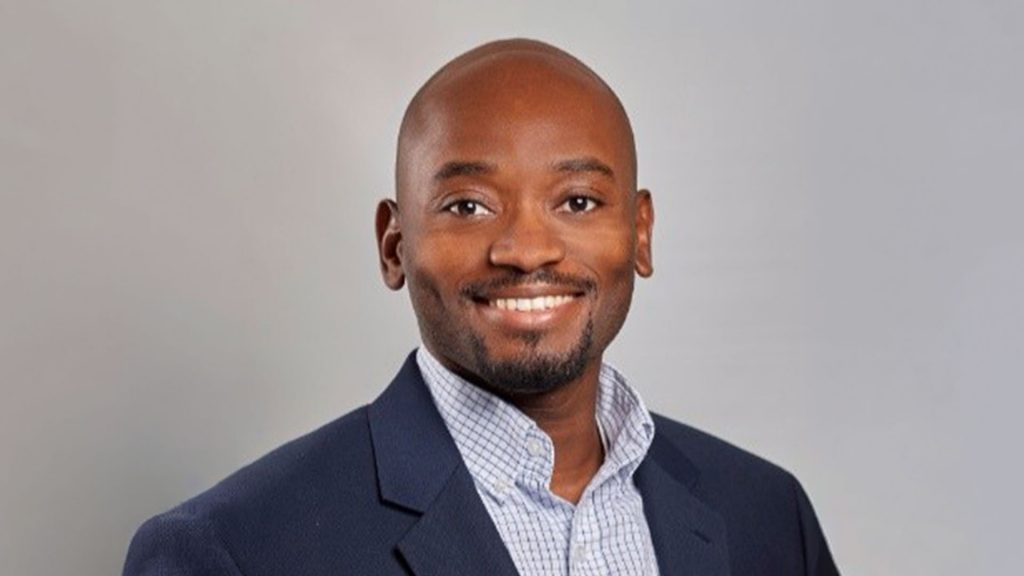
As he pursued two degrees in mechanical engineering at Virginia Tech, Azize Traore ’09, Ph.D ’14 took a winding path, studying topics that seem unrelated: English, automotive engineering, biology
But those disparate interests led him to build models of the human body for drug testing, sit in boardrooms where he advised Fortune 500 companies as a consultant, and most recently work at biopharmaceutical company AstraZeneca — a bio-inspired career path that’s a model for other mechanical engineers
Taking apart radios and English
As a young child, Traore took things apart. Growing up in the Ivory Coast, he often disassembled old radios with his grandfather, learning the function of each part, and then put them back together. Eventually, he learned to make repairs
“I would take apart anything I could get my hands on, including toys,” Traore said. “I would find a screwdriver, take it apart, and try to understand what was going on. I still enjoy doing that.”
His first language was French. When Traore came from the Ivory Coast to Blacksburg “by pure luck,” he began his studies with English immersion at Virginia Tech’s Language and Culture Institute. Sifting through grammar and verb tenses, he was now taking apart language instead of radios. When he was able to speak and understand the language well, he enrolled in the College of Engineering, eventually choosing mechanical engineering as his major
Steering into a team
The next thing he deconstructed was a car. Though Traore wasn’t a “car guy,” he knew he wanted hands-on experience, and he ended up joining one of the student automotive teams, Virginia Tech Formula SAE, his junior year
“I wanted that to be my capstone senior design project,” he said. “I was on the suspension subteam and worked on the steering system.”
In addition to learning his way around a car, he benefited from the mentoring Formula SAE offered, as well as the team atmosphere, which helped him continue to adapt culturally just two years after finishing his English studies
A bio-inspired pivot
As he reached the end of his undergraduate studies, Traore decided that his next step would be a master’s degree. But what to study? Should he continue to build steering systems for cars?
As he had when he came into the unfamiliar territory of cars, he took another hard left turn and found a mechanical engineering lab conducting bio-inspired research that piqued his interest: Professor Bahareh Behkam’s
“Dr. Behkam’s research bridged mechanical engineering fundamentals and biology,” Traore said. “Similar to what I was doing on the car team, we used vectors and force equations to analyze the forces exerted on a given body. Understanding the impact of those forces in their environment is similar whether you’re applying it in an automotive setting or looking at the movement of bacteria. The questions you’re answering change, but the fundamentals are the same.”
Traore found that he liked the work so much, he changed his academic plan. Instead of pursuing a two-year master’s degree, he changed his goal to a Ph.D. and spent five years working in Behkam’s lab
As Behkam’s first doctoral student at Virginia Tech, Traore’s adaptable skill set helped Behkam expand her lab’s work to cancer research, a topic she continues to pursue today. Her expertise in the field has been recognized globally
“Prior to starting my lab, I had worked on developing microrobotic systems but had not explored applications yet,” Behkam said. “The area was very new. In fact, my own thesis was a seminal work in this area. As we began expanding the capabilities of our lab, autonomous systems for cancer drug delivery was one of the first areas we explored. Aziz’s willingness to challenge himself and learn new science and experimental techniques was critical in moving forward quickly in this area.”
Leaving the lab
As a senior manager at biopharmaceutical company AstraZeneca, Traore draws from his wide range of learning experiences at Virginia Tech, his history of research, and his ability to take problems apart to succeed.
In the world of pharmaceuticals, the challenges are no longer just technical; they are also human. In his work, he applies data and healthcare goals to inform biomedical decisions, using the tools and flexibility he’s acquired over years to deconstruct new problems every day
Three pieces of advice from Traore
- Be open to new experiences. “My path took me from Formula SAE to Dr. Behkam’s lab — two very different worlds. Yet I found something to enjoy at every stage and walked away with something new each time. The more open you are, the more you stand to gain.”
- Understand the problem. “Working as a consultant taught me the importance of being clear about what I’m trying to accomplish — though that’s not always straightforward. Sometimes the problem isn’t immediately obvious. You have to dig a little.”
- Remember what keeps you going. “Find the things that get you going and lean into them. Not every role will be perfect, and your path may not look exactly as you planned — and that’s OK. Step back, look at the bigger picture, and keep your focus on what truly matters.”
Contact:
540-231-2108
