

Native Hawaiian entrepreneurs move toward economic sovereignty | Honolulu Star-Advertiser
Hawaii News
Native Hawaiian entrepreneurs move toward economic sovereignty
Today
•
Updated
7:04 a.m
GEORGE F. LEE / GLEE@STARADVERTISER.COM
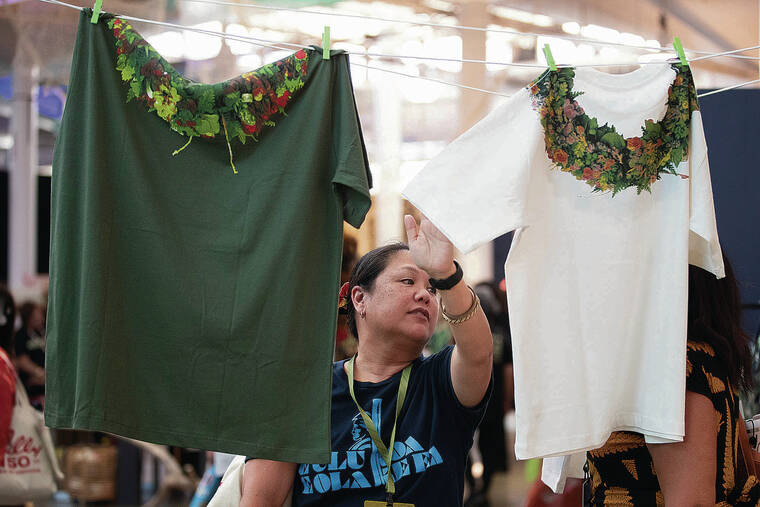
Hawaii businesses are getting help from local entrepreneurs to build brands that create long-term economic stability. Lei shirts were on sale at the Na Mea Hawai‘i Marketplace during last week’s Native Hawaiian Convention at the Neal S. Blaisdell Center

Select an option below to continue reading this premium story
Already a Honolulu Star-Advertiser subscriber? Log in now to continue reading
Get unlimited access
From as low as $12.95 /mo
Starting with just $70 worth of fabric and a home sewing machine, Max Mukai and his family built Kahui Palaka into a thriving apparel brand that now purchases roughly $70,000 in textiles
annually
Once worn by plantation workers and paniolo, palaka has long symbolized Hawaii’s working-class heritage. For Mukai, reviving the fabric is also an exercise in “economic sovereignty,” building local wealth and ownership through a business grounded in Hawaiian culture
Mukai now manages the Hawaiian Council’s KuHana Business Accelerator Program for Native Hawaiian and local entrepreneurs. To date, 16 cohorts have graduated from the multiweek program with business plans they can present to banks or investors
“We lean on one another and provide each other opportunities,” Mukai said after leading the “Let’s Make a Deal!” workshop at the Native Hawaiian Convention, held July 20-22 at Honolulu’s Neal S. Blaisdell Center. “Capitalism is only bad when bad people do it.”
His journey from sewing palaka apparel at home to mentoring aspiring business owners reflects a broader movement taking shape across the state. As federal support for Native Hawaiian programs faces increased uncertainty and initiatives for diversity, equity and inclusion come under attack, Native Hawaiian leaders like Mukai are advancing economic sovereignty as a path toward greater self-reliance
With more than half of Native Hawaiians living outside the islands, leaders are working to create opportunities that can help Hawaiians stay in Hawaii or return home
Don’t miss out on what’s happening!
Stay in touch with breaking news, as it happens, conveniently in your email inbox. It’s FREE!
By clicking to sign up, you agree to Star-Advertiser’s and Google’s Terms of Service and Privacy Policy. This form is protected by reCAPTCHA.
The theme surfaced repeatedly throughout the
convention, from entrepreneurship and workforce development to housing, agriculture, renewable energy and cultural industries. It also framed discussions over emerging opportunities such as legalized gambling, where some Native Hawaiian leaders argue that if gaming comes to Hawaii, Hawaiians should help shape how the industry develops and who benefits from its economic returns
Kuhio Lewis, president and CEO of the Hawaiian Council, sees economic sovereignty as an expression of self-determination and as key to building a brighter future
“If we truly want our communities to thrive, we must also build,” Lewis said while opening last week’s convention with a call to action
“We must build businesses, build homes, careers, opportunities,” he said. “We must build wealth that stays in Hawaii. We must create pathways where our young people don’t have to leave home to pursue their dreams.”
That vision was echoed across convention sessions, where speakers warned that economic dependence leaves Native Hawaiians
vulnerable to political and funding shifts while local ownership creates long-term stability
With more than 1,000 members from nonprofit and for-profit organizations, the Hawaiian Council has built a network of business, lending and workforce initiatives aimed at turning those ideas into action
BE.kakou, a mobile cafe approaching two years in operation, is one of the KuHana Program’s success stories. Founded by Kaitie and Cody Miyashiro-Carvalho, their mission grew from experiencing the power of community at protect Mauna Kea protests and growing “disheartened” at seeing so many Hawaiians and local families leaving the islands “in tandem with many continental chain businesses becoming more prevalent” on Oahu, they said on their website
The business has expanded to nine employees and is on track to reach $500,000 in sales this year while creating gathering spaces for their community
In addition to its business accelerator program, the Hawaiian Council’s $10 million loan fund, including the Koa Credit Builder Loan and Ama Loan programs, helps Hawaiians launch their businesses, improve their credit history and learn how to manage and grow their portfolios
The Hawaiian Trades Academy also has developed marketable trade skills for nearly 1,000 graduates — including fire and police exam prep, carpentry and solar energy
WHILE MANY convention discussions focused on strengthening existing industries, others explored how Native Hawaiians might participate in emerging sectors
Brandon Maka‘awa‘awa, vice president of the Nation of Hawai’i, is on the state Tourism and Gaming Working Group and helped establish the Nation of Hawai‘i Film Commission to diversify its economic portfolio
The small village of Pu‘uhonua O Waimanalo, the sovereignty group’s headquarters, is a self-
sufficient socioeconomic and ecological community stewarding 45 acres of land.
Restoring the ahupua‘a system, members have built their own housing and a community-managed broadband network and established the Central Bank of Nation of Hawai’i in 2021
Maka‘awa‘awa said he was initially opposed recent state legislation relating to sports wagering and gaming on cruise ships after watching members of his own family struggle with gambling addiction. But his approach has evolved to ensure Hawaiians have seats at the table
“The guys are within the walls now,” he said during a “Betting on Economic Sovereignty” panel on the first day of the convention. “They’re here, they’re around the politicians, the developers … . I don’t want this thing to run us over.”
Tyler Iokepa Gomes, chief administrator for the Hawaiian Council, is also on the Tourism and Gaming Working Group. During the gaming panel, he said Hawaiians having control over the gaming narrative and rules would allow the entire state to thrive from new jobs in security systems, construction, spas, gift shops, retail and food outlets and more
The Hawaiian Council also has been expanding its own portfolio of businesses and financial programs designed to generate revenue and opportunity within the community, especially in the absence of federal support
Last year, the council
purchased Na Mea Hawai’i, a marketplace for Hawaii artists and crafters founded 30 years ago by Maile Meyer, owner of Native Books, a bookstore and publisher in Chinatown’s Historic Arts District
“Why look further when everything you have and need is here at home,” said Ashlee Affonso, manager of retail operations and events at Na Mea Hawai’i
Affonso said Na Mea is a manifestation of Hawaiians coming together and practicing sustainable commerce that invests not only in culture and people, but also in a different way of life
The council’s partnership with Ko Olina resort also offers a vision of Hawaiian-led tourism. A multi-million dollar investment in the Kaula Lu‘au at Ocean’s Edge by the Hawaiian Council and the production of “The Epic Tale of Hi‘iaka” musical has created more than 140 local jobs in the Leeward Coast according to Ko Olina’s website
“This isn’t about choosing between culture and economics,” Lewis said. “It’s about recognizing that one strengthens the other … . It means creating a Hawaii where our people are not only participants in the economy, but the owners, the builders, the innovators, the entrepreneurs, the decision-makers.”
