

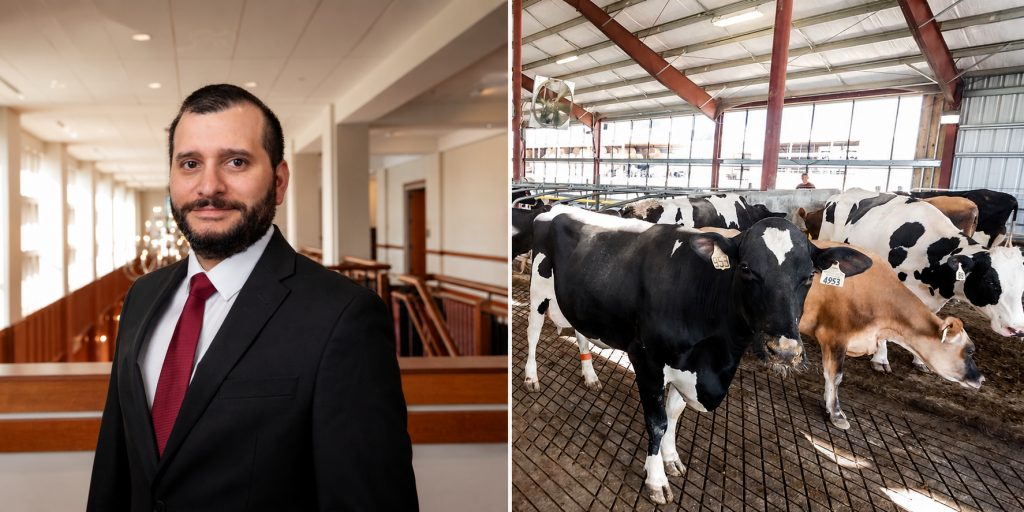
In Virginia Tech’s College of Agriculture and Life Sciences, researchers are exploring whether nutrition can serve not just to sustain cows but also help protect them.
Johan Osorio, assistant professor in the School of Animal Sciences, and his team are studying bioactives — naturally occurring compounds already used to support human health — to determine whether they can strengthen immune function in dairy cows. The idea is to reduce chronic inflammation and oxidative stress, allowing animals to better withstand disease and environmental pressures.
This is important because dairy products help fuel both American diets and rural economies
From school cafeteria milk to finely curated cheese boards, dairy products play an outsized role in the American diet, providing roughly half of the calcium and vitamin D consumed nationwide. And economically, the dairy industry supports rural economies across the country, employing millions, and generating nearly a trillion dollars in economic impact each year.
But as milk production has expanded in recent decades, so have concerns about animal health. Since the mid-1990s, diseases such as mastitis and lameness have become more common in dairy cattle. Mastitis alone costs Virginia farmers an estimated $12.5 million each year, underscoring the economic toll of declining herd health.
Osorio’s research looks at how cows absorb bioactives and how these comp influence both health and milk production. His work, supported by a grant from the U.S. Department of Agriculture’s National Institute of Food and Agriculture, centers on the period around birthing, when cows face intense metabolic demands and often consume less feed
“During calving, cows are particularly vulnerable to illness,” Osorio said.
Osorio’s team tracks how animals fed bioactive-rich diets perform in terms of milk yield and quality. Team members also measured and tracked multiple biological indicators of inflammation
Glutathione, a powerful antioxidant linked to improved milk production, may play an important role in supporting lactation, according to Osorio’s findings. Beyond its antioxidant activity, glutathione may act as a reservoir for amino acids, the building blocks of proteins.
Cows with sufficient liver glutathione stores before calving appear better able to withstand periods of reduced feed intake and stress, which allows them to produce more milk.
Still, most animals fall short. Only about 32 percent of cows reach what researchers consider adequate glutathione levels at calving, leaving the majority with room for improvement.
“The fact that only about a third of cows reach adequate levels at calving tells us there’s real opportunity to strengthen how we manage cows around calving,” Osorio said. “Our goal now is to translate these findings into practical nutrition and management strategies that Virginia dairy producers can actually use, whether that’s through targeted supplementation or adjustments during the late gestation, to help cows enter lactation better prepared.”
Osorio’s research also is expanding beyond dairy. Studies supported by the Virginia Cattle Industry Board are examining whether glutathione can help beef cattle cope with stress caused by grazing on fungus-infected fescue, particularly during periods of summer heat. Ongoing trials are evaluating both dietary supplements and intravenous delivery methods.
For dairy farmers navigating shifting milk prices, rising feed costs and persistent health challenges, these advances could offer a measure of stability, particularly with much of Virginia experiencing a historic drought. Extension reerative Extension, continue to provide guidance on dairy farm biosecurity, calving caremanagement strategies and health risks of consuming raw milk
Dairy production sits squarely in the center of the land-grant mission that drives Virginia Tech’s research focus, and it’s the job of Extension to translate that research into practical solutions for producers. Osorio hopes his research will help dairy farmers see improved profits during an economically turbulent time and give a boost to the industry so much of America relies on.
“Many Virginia dairy farms are family-run and tied to local supply chains,” Osorio said. “Using nutrition to support the immune system protects not just profitability, but it supports animal welfare across dairy farms, protecting longevity and industry resilience.”
Contact:
540-232-2501
