

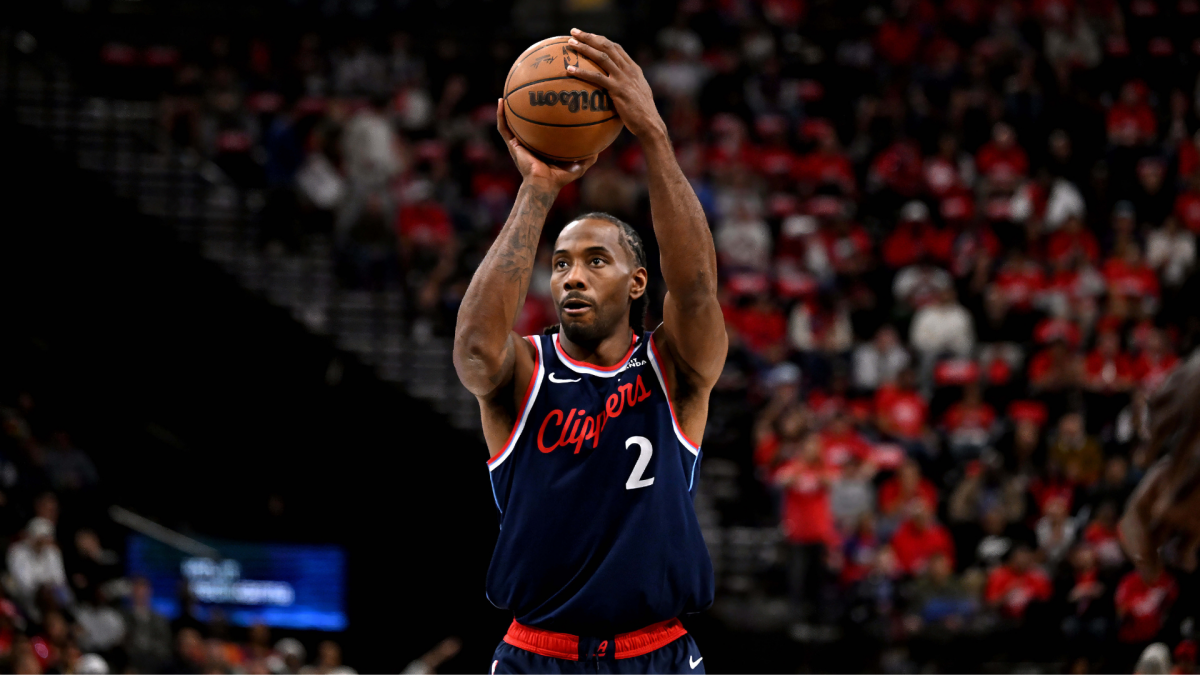
Monday will mark the 11-month anniversary of Pablo Torre’s first podcast about Kawhi Leonard, Aspiration and the possibility that the Los Angeles Clipperscircumvented the salary cap in order to pay Leonard more than was legally allowable. You’d think that would mean we’re nearing a resolution. NBA commissioner Adam Silver has even said that the league’s investigation into the matter “needs to be wrapped up before the beginning of next season.”
And yet, at least from the outside, a resolution doesn’t seem imminent. After all, Torre released yet another podcast this week detailing Leonard’s secret ownership stake in a soccer team in Rhode Island. Additionally, ESPN reported that this saga could drag into 2027 if the parties don’t agree on the investigation’s findings, and the Clippers, after all, are no longer the only team with a stake in the NBA’s determination.
The Toronto Raptorsagreed to trade for Leonard in June. They would later decide to put the trade on hold until the situation was resolved. Completing the trade would have meant absorbing the risk of any punishment for Leonard, though the reporting has largely been consistent in stating that both sides do eventually intend to consummate the deal. That is, until Thursday, when ESPN’s Ramona Shelburne planted the first true seeds of public doubt
“I can see a world in which Kawhi Leonard is back on the Clippers if this trade doesn’t go through,” Shelburne said on “NBA Today.” “And the Clippers, quite frankly, are fine with that.”
NBA training camps start in less than two months. The regular season starts in less than three. In a perfect world, this situation will be fully resolved in the coming weeks. But the longer this drags on, the less likely that will be the case. And if we do approach the season without answers, the Raptors will eventually have to make a decision here. At this point, there appears to be a real chance they will elect not to move forward with this deal
So what’s going on here? What is the holdup? What will inform Toronto’s eventual choice? And is there anything the Clippers could do to grease the wheels here?
Why is this taking so long?
As far as we know, the NBA is still in the investigation stage. As long as this investigation has taken, it is only the beginning. The league cannot simply make a unilateral decision based on what the law firm of Wachtell, Lipton, Rosen & Katz finds.
If any of the parties involved here dispute their findings, the next step would be arbitration. The arbitrator would be jointly appointed by the NBA and the NBA Players Association, and would have the power to compel document production, witness testimony and order discovery. After that hearing, the arbitrator’s ruling could be appealed to a three-person panel jointly appointed by the NBA and the NBPA. That appeal panel would finally have the power to make a binding decision
We are still in the investigation phase here. The disciplinary phase, should the investigation’s findings prove it necessary, has yet to begin and could take a fair bit of time. That process could theoretically be hastened through a settlement, but the immediate complication with any settlement is that three parties are involved
NBA Power Rankings: LeBron James vaults 76ers into top five; Spurs have early edge over Knicks
Brad Botkin
The NBA is obviously one of them. The Clippers are another. But don’t overlook the third notable party here: the NBPA. This is not simply a matter of protecting Leonard. The last thing the union wants is the NBA policing every sponsorship agreement that its players sign. Should the NBA decide that Leonard deserves to be punished, the NBPA would likely object.
This raises some pretty delicate points of conflict. The NBA has maintained 15 years of relative labor peace, but the NBPA has raised some very vocal concerns about the second apron and its roster-building restrictions recently. The current collective bargaining agreement can expire as soon as 2029. In a perfect world, the NBA would prefer to avoid a messy fight with the union before those CBA negotiations even begin
It is possible that the NBA negotiates separately with Leonard and the Clippers, perhaps settling with one party and taking the other to arbitration. It’s also possible that, through the investigation process, the NBA finds no wrongdoing it wants to act on
The length of this investigation suggests that the NBA is attempting to be as thorough as possible, and that’s probably the right decision. The details of the Leonard case are extremely public, and the evidence is, at the very least, compelling. There is a big difference between “compelling” and “actionable,” but it’s hard to imagine a team circumventing the salary cap in 2026 and leaving behind more breadcrumbs than Torre and his podcast team have dug up. If this investigation comes up empty, it essentially suggests that the bar for proving cap circumvention is so high that it is effectively impossible to punish, provided it is done with even a shred of discretion. In other words, it would be open season on cap circumvention.
That creates yet another purpose for this investigation. It’s not just about Leonard or the Clippers. It has to be a deterrent, a signal to any other parties that might consider circumventing the cap that, if they do so, the league will leave no stone unturned in pursuit of punishment. Put all of this together and you have one of the most complicated investigations the league has ever undertaken. As impatient as the basketball world has been about this, the protracted nature of this investigation feels almost inevitable.
How does this affect the Raptors? What can they do?
The Leonard trade was put on hold because formally executing it would have forced the Raptors to assume the risk of any punishments for Leonard. To be clear, only the punishments for Leonard matter for their purposes. The NBA is not going to strip Toronto of any draft picks for violations committed by the Clippers.
However, if the Raptors traded for Leonard and his contract were voided, they would still lose him and presumably the draft picks they traded for him (unprotected first-round picks in 2031 and 2033, a pick swap in 2027 and second-rounders in 2030 and 2033). Therefore, they decided to wait this thing out
If Leonard’s contract is indeed voided, the Clippers obviously cannot trade it. A relatively short suspension probably wouldn’t be a problem either. But a longer suspension or a protracted arbitration and appeals process would greatly complicate matters
Leonard is 35, enormously injury-prone and in need of a contract extension. The odds suggest that his best chance at being a high-level contributor to a championship team again is here and now. The Raptors are trading for him, first and foremost, for the 2026-27 season. They presumably plan for him to be on the roster beyond that, but his value could precipitously decline in the somewhat near future. You get him to maximize your chance of winning the championship this upcoming season
NBA offseason grades 2.0: 76ers get LeBron James and only A+, nobody is having a worse summer than the Cavs
Sam Quinn
And maximizing your chance of winning the championship this season relies on having Leonard at training camp and available to play for most of the season. If he’s suspended for half of the year, or if there isn’t certainty when camp begins, the Raptors just cannot justify paying the price they were willing to pay for Leonard in June
That leaves them with three choices. They could take the plunge and trade for him anyway, but that would be enormously irresponsible. They could call off the trade altogether and simply move forward with Brandon Ingram, Gradey Dick and their draft picks, potentially with the plan to re-engage the Clippers when and if this gets resolved during the season. Or they could bring the Clippers back to the table during the offseason and demand concessions. Maybe there’s a price — probably a substantially reduced price — at which the Raptors would be willing to absorb the risks associated with the Leonard investigation.
We don’t know where the Raptors currently stand on any of this other than their unwillingness to complete the trade with the investigation-related risk attached to it. But the longer this drags on, the likelier the trade falls apart.
Toronto’s pursuit of the 2027 championship relies on having Leonard in the fold as quickly as possible. They need the regular season to develop continuity and determine if any follow-up moves are needed. They can’t wait this thing out forever. Eventually, they will have basketball games to play
How can the Clippers seal the deal?
It may not seem like it relative to some of the other crazy trade packages the NBA has given us over the past decade or so… but the Clippers got a lot for Leonard. Two unprotected first-round picks deep in the future, plus a first-round swap on a pick that could be No. 29 or No. 30 for a player with all of the risks associated with Leonard, is substantial, especially since Leonard was reportedly only willing to sign an extension with the Raptors or San Antonio Spurs
No matter what message the Clippers are sending, they should not be “fine” with bringing back Leonard, as Shelburne indicated. They do not have a roster capable of contending. They have nothing to gain by keeping him, and Leonard’s trade value, given all of these risk factors, could plummet at any time. Getting this trade across the finish line should be a priority for them. One way to do that would be to accept less from the Raptors in exchange for them absorbing the Leonard-related risk, though we don’t know if there is any price Toronto would willingly pay to do so.
But there’s another way the Clippers could speed up this process: by settling. You could argue that they’re incentivized to do so. When the dust settled on the infamous Joe Smith case, the Minnesota Timberwolves were docked three first-round picks (initially five, but two were reinstated). If the Leonard trade doesn’t go through before any other punishments are applied, that’s two picks and a swap lost, just a hair below what was taken from Minnesota. Losing the trade would arguably be tantamount almost to the Smith penalty, whether or not they’re guilty, and then, of course, down the line, they could actually be stripped of more picks as a direct punishment.
Do the Clippers really want to risk a scenario in which they lose six or seven first-round draft assets when they might be able to settle for one or two? The logical answer in that scenario would probably be to settle if the NBA is open to it. Of course, a settlement would essentially be an admission of guilt. The Clippers, at every turn, have denied any wrongdoing. Even if attempting to settle would be the logical approach, this isn’t a fully logical decision. No team is ever going to be eager to admit to breaking the rules, whether or not it actually did so.
The other alternative, should the Raptors be unwilling to make a deal by the time training camp arrives, would be for the Clippers to explore other trade partners. Leonard’s reluctance to sign an extension with a wider pool of teams would complicate matters, but given his age and the potential price discount if Toronto did back out, maybe someone would take the risk on a rental. Remember, renting Leonard would secure his Bird Rights and with them the ability to pay him as a 2027 free agent. With limited cap space on the market, those Bird Rights are his easiest path to a hefty extension, though the presence of the California-based Golden State Warriors as a cap-space team does pose a bit of a threat to potential renters.
We’re in fairly uncharted waters here, so establishing any sort of firm timetable feels almost impossible. If there isn’t clarity within a month or two, someone, whether it’s the Clippers or the Raptors, is going to have to make a difficult choice. There are several possible compromises and alternatives on the table, and the longer we go without answers to the many questions about this investigation, the more likely it becomes that the parties involved will have to start exploring them
