

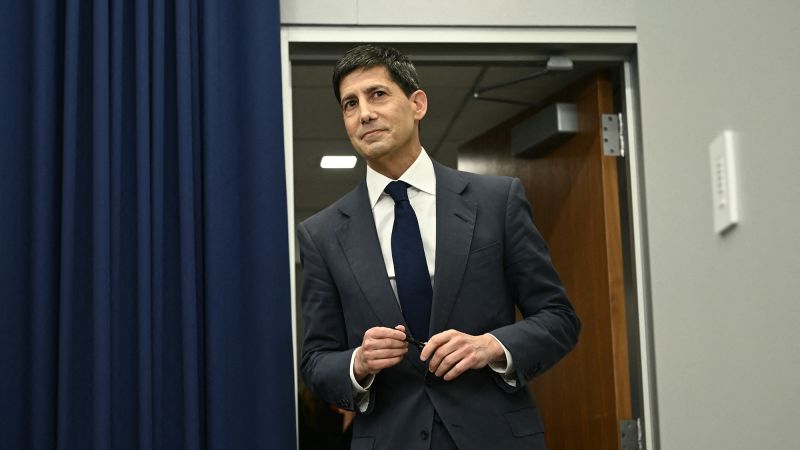
US Federal Reserve chairman Kevin Warsh arrives for a press conference in Washington, DC, on June 17, 2026.
See all topics
Washington —
The Federal Reserve has been unusually silent about the future path of interest rates, with Chairman Kevin Warsh offering few signals as policymakers grapple with renewed inflation concerns and a murkier economic outlook
Fed officials will have a chance to clarify their thinking when they announce their latest rate decision at 2 p.m. ET Wednesday, followed by Warsh’s post-meeting news conference at 2:30 p.m. ET
Inflation slowed sharply in June, according to the latest Consumer Price Index, largely due to lower energy prices that month as tensions briefly eased in the war with Iran. The encouraging inflation report prompted investors to scale back expectations that the Fed would need to raise interest rates for the first time since July 2023 in order to keep price pressures in check
But the conflict in the Middle East escalated earlier this month, triggering a spike in global energy prices last week. Tensions have eased in recent days, prompting energy prices to decline accordingly. However, shipping through two key waterways — the Bab al-Mandeb Strait and the Strait of Hormuz — remains subdued. Nearly a quarter of the world’s oil flows through the region. Meanwhile, Fed officials are debating how the rapid adoption of AI could impact inflation
The economic crosscurrents have made it difficult to understand where inflation is headed. Compounding that uncertainty, Warsh has declined to offer clear guidance on interest rates. Ahead of this week’s policy meeting, markets are spliton whether the Fed will hold its benchmark lending rate steady for the fifth consecutive time or deliver a rate hike
It’s a lack of clarity not seen in years
“The Fed is looking at all these inflationary impulses and determining if they will be there over the longer term,” Narayana Kocherlakota, an economics professor at the University of Rochester and former president of the Federal Reserve Bank of Minneapolis, told CNN
“But it’s becoming very difficult to know what the Fed is going to do in the next few months, because Chair Warsh has been studiously uncommunicative about how the Fed is going to react to these changes in economic conditions,” Kocherlakota said
Warsh has long signaled that he intended to ditch a long-held practice known as “forward guidance.”
Since 2000, Fed officials have generally used forward guidance to give investors a clearer sense of where interest rates were headed, arguing that greater transparency makes monetary policy more effective. But in his confirmation hearing in April, Warsh said he wouldn’t speculate on the economy’s path as chairman
With the Fed’s next move still an open question, it’s unclear whether Warsh’s break from decades of Fed communication has reduced — or amplified — uncertainty
The eagle statue sits on the Marriner S. Eccles building of the Federal Reserve Board on August 6, 2025 in Washington, DC.
“It’s going to lead to market volatility,” said Kocherlakota. “It makes businesses more reluctant to invest, meaning they’ll be less likely to demand workers to build the kinds of goods and services … because they’re uncertain about what the Fed is going to be doing.”
“That kind of uncertainty, in my view, is a complete unforced error on the part of the Fed,” he added
On the other hand, some argue that Fed officials have in recent years spoken too frequently about the economy
“We got to a point where the dissection of the Fed’s forward guidance was so acutely broken down into parts that I’m not sure it helped in the way it was meant to help either,” said Kezia Samuel, chief market strategist at wealth management firm AssetMark
Fed officials largely agree that the central bank shouldn’t respond to higher energy prices with interest rate hikes because those costs are expected to come down on their own
“Conventional wisdom among central bankers is to look through one-time price increases, such as those associated with higher tariffs and a jump in oil prices,” Fed Governor Christopher Waller said this month
However, if price pressures persist, there’s a far greater the risk that inflation broadens well beyond the energy market. That could begin to erode Americans’ faith that inflation will eventually slow toward the Fed’s 2% annual target
To get a sense of inflation’s direction, central bankers focus on so-called core measures of inflation that strip out volatile food and energy prices. Core inflation gives economists and policymakers a good sense of how persistent price pressures may be, and to gauge Americans’ view of prices, officials look at market- and survey-based measures of inflation expectations
Neither of those measures warrantimminent rate hikes, but that could change if the Iran war spirals out of control or persists for an extended period
Meanwhile, Fed officials are closely watching Big Tech’s massive spending on AI data centers, which was discussed at the Fed’s June policy meeting
“Many participants noted that ongoing strong demand for AI infrastructure would likely sustain upward pressure on prices for technology products and electricity,” the meeting’s minutes read. “Most participants remarked that growth in economic activity that exceeded that of potential output, owing in part to strong AI business investment, could contribute to more persistent inflationary pressures.”
See all topics
