

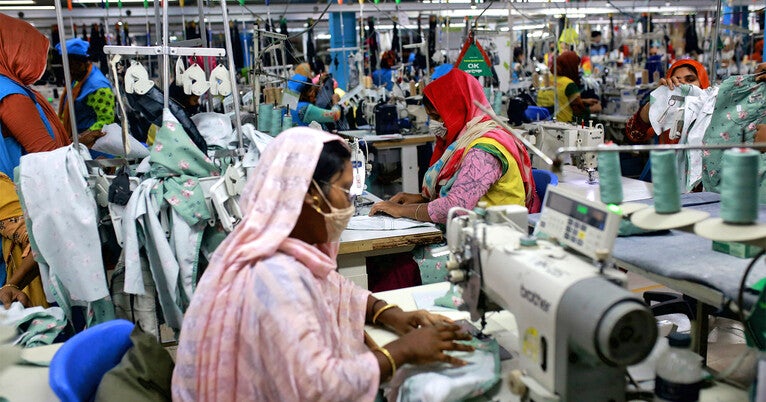
On April 24, 2013, more than 1,100 people died when Rana Plaza — a factory building outside Dhaka, Bangladesh, where garment workers were forced to toil despite evidence of acute structural flaws — collapsed to the ground.
The disaster highlighted profound and systemic failures in the fashion industry, including a widespread disregard for workplace safety and labor protections. It also drew attention to the industry’s status as a major polluter — the sector is responsible for at least 8% of global greenhouse gas emissions.
In response to the Rana Plaza collapse, lawmakers worldwide enacted a wave of regulations that sought to address social and environmental concerns related to the fashion industry, an economic behemoth with supply chains that stretch across borders and oceans. In a recent study, Meital Peleg Mizrachi, a postdoctoral fellow in Yale’s Department of Economics, analyzes this regulatory landscape
The study, published in the UC Business Law Journal and coauthored by Rachel Chambers, an assistant professor of business law of the University of Connecticut, identifies key trends shaping regulation, including a growing emphasis on environmental issues over labor protections and persistent gaps between regulatory ambitions and the structural realities of fashion.

Mizrachi recently spoke to Yale News about the study, laying out the flaws in regulation, the role of fast fashion in driving exploitation and environmental degradation, and a path toward a more effective regulatory approach. The conversation has been edited and condensed
In the article, you make the case that the global fashion industry is one of the world’s most polluting and exploitative sectors. Can you give a sense of how the industry is harming the environment and the people who make our clothes?
Meital Peleg Mizrachi: The fashion industry generates more greenhouse gas emissions than airlines and maritime shipping combined. It causes 20% of global wastewater production and consumes enough water annually to meet the basic needs of over 2 billion people — more than the combined population of China, the United States, and the European Union. It releases an estimated 500,000 tons of microfibers into the ocean each year through the laundering of synthetic textiles, accounting for about 35% of the microplastics polluting the seas. There are many such metrics, but altogether, it’s very clear that this is one of the most polluting industries. And it should be noted that these environmental harms disproportionately affect low-income and marginalized communities
But it’s not just about the environment. Fashion is also one of the most exploitative industries, well-characterized by forced labor, child labor, and gender-based violence. More than 90% of fashion brands don’t pay living wages to the people manufacturing the clothes they sell. Of course, fashion brands outsource labor to third-party companies, so they’re not the formal employers of those workers, but it remains a fact that the vast majority of workers are underpaid and forced to work in unsafe conditions. There are reports that more than 60% of females working in textile factories suffer daily physical and verbal abuse. It’s easy to see that this is a very problematic industry.
Keep in mind that the industry’s environmental degradation and labor exploitation are deeply connected. Many of the factories where underpaid workers toil in unsafe conditions also pollute local ecosystems by discharging untreated wastewater into rivers. They operate under unsafe air quality conditions and expose workers to hazardous chemicals.
The fast-fashion business model is widely condemned as a driver of exploitation and environmental degradation. What is “fast fashion”?
Mizrachi: When we’re talking about fast fashion, we’re talking about fashion that is globally uniform and produced and sold by global corporations at relatively cheap prices. This business model emerged in the late 1980s, and the brand Zara was pioneer of it. Since then, many fast fashion brands, such as H&M, Primark, and Gap, adopted a business model centered on “translating” runway trends and haute couture into relatively cheap clothes. Fast fashion companies can release between 50 to 55 collections annually, which is wild given that we only have four seasons each year.
Today, we’re talking about ultra-fast fashion, which is the third generation of fast fashion. The second generation occurred when the first digital marketplaces, such as Asos, grew popular. But now we’ve moved to ultra-fast fashion. Chinese brands, such as Shein and Temu, post between 3,000 and 11,000 new items every day on their websites. It’s becoming much faster and much more polluting and exploitative
How does China’s growing influence affect regulation?
Mizrachi: An important difference between this generation of fast fashion and the preceding two is that, while those were by U.S. and European brands, this new one is mainly controlled by Chinese brands. China holds the dominant position in global apparel manufacturing, but North America and Europe continue to drive consumer demand
Much of the regulation we analyze in our article is shaped by geopolitical tensions and concerns about a growing China. We show that many regulations are presented as environmental and human rights law but really are more about political economy and targeting the Chinese economy than about protecting human rights and the environment
What is the current state of regulation?
Mizrachi: There is a notion that we don’t have enough regulation of the fashion industry. That’s not accurate. There is a lot of regulation, much of it enacted over the last 15 years. But the regulation is extremely fragmented because the fashion supply chain, even for a single item, is very long and includes many countries. A garment might start with cotton grown in India, textile manufacturing in South Korea, and garment assembly in Cambodia before being distributed in retail markets in Europe, the United States, and, increasingly, Asia. Regulations that only operate in one country don’t address problems occurring in other countries. We don’t have many good examples of international regulation that accounts for the entire supply chain.
So, despite this growing wave of regulations, we continue seeing both environmental and social hazards happening across the supply chain. The truth is that regulations tend to be shaped more by political and economic realities than by genuine concern for the environment or labor rights. So, yes, we have a lot of regulation, but not nearly enough effective regulation
You argue in the article that regulation increasingly focuses on environmental protections to the detriment of concerns about social sustainability. How so?
Mizrachi: We show that policymakers are using the environmental components of sustainability almost as a shield to ignore labor protections or they are imposing environmental protections without considering effects they have on workers. We see this in the landmark fashion-specific legislation passed in France in 2024 and in the proposed New York Fashion Act in New York State.
France’s legislation imposed a range of penalties on fast fashion products, including a tax that is intended to penalize environmentally damaging imports, but it didn’t account for how the taxes might affect workers in exporting countries, whose livelihoods are at stake. Measures like this can cause factory closures and job losses. They should have labor protections integrated into them to mitigate effects on workers.
The New York Fashion Act was introduced in 2021 as comprehensive legislation that incorporated both the social and environmental aspects of the fashion industry. Then, for political reasons, the components intended to address labor protections and workers’ rights were stripped from the legislation. Maybe it was useful politically to remove the social aspects of the legislation, and it goes without saying that environmental sustainability is of great importance, I’m not dismissing that. But when it comes to addressing issues concerning workers’ rights in the fashion industry, it was a bad decision.
How do we get to effective regulations?
Mizrachi: The first step towards better regulation is understanding how much of the current and proposed regulation is affected by political realities and geopolitical relations. That starts with recognizing that fashion is not an outlier to the political economy. This is a $2.3 trillion industry. For context, that’s larger than the economies of Canada and Italy. So, the economic perspective is not something we can dismiss.
Second, we want to see fashion-specific regulation. There are a lot of regulations, especially in Europe, that include the fashion industry but do not specifically target it. We need regulations tailored to address the specific problems plaguing fashion.
Third, we want to see international collaboration around fashion regulation that supports the countries where clothes are manufactured. Regulations enacted by wealthy countries often impose mandates on the poorer countries where clothes are made. One of the best examples is the European Union’s “digital product passport,” which purports to provide a comprehensive digital record documenting products as they move through the supply chain. This sounds great but in practice, it requires the non-European countries where clothes are produced to use technology that they don’t have and aren’t equipped to support.
Now, EU officials might argue that they want to support European manufacturing. Okay, fine. But what does that mean for people in Bangladesh, Vietnam, and Cambodia whose livelihoods depend on the production of clothing? And again, I would emphasize that effective regulation must consider both the environmental and the social aspects of sustainability. You cannot address one without the other.

Discoveries
Study uncovers lost ‘golden age’ of languages
Jul 23, 2026
Teaching and learning
Training child psychiatrists at Yale: A team-based approach to care
Economics
Top economists come to Yale for Cowles Summer Conferences
Jul 15, 2026

High in the canopy
Meet ‘Likweli’: A new monkey species discovered in the Congo Basin
Jul 15, 2026
