

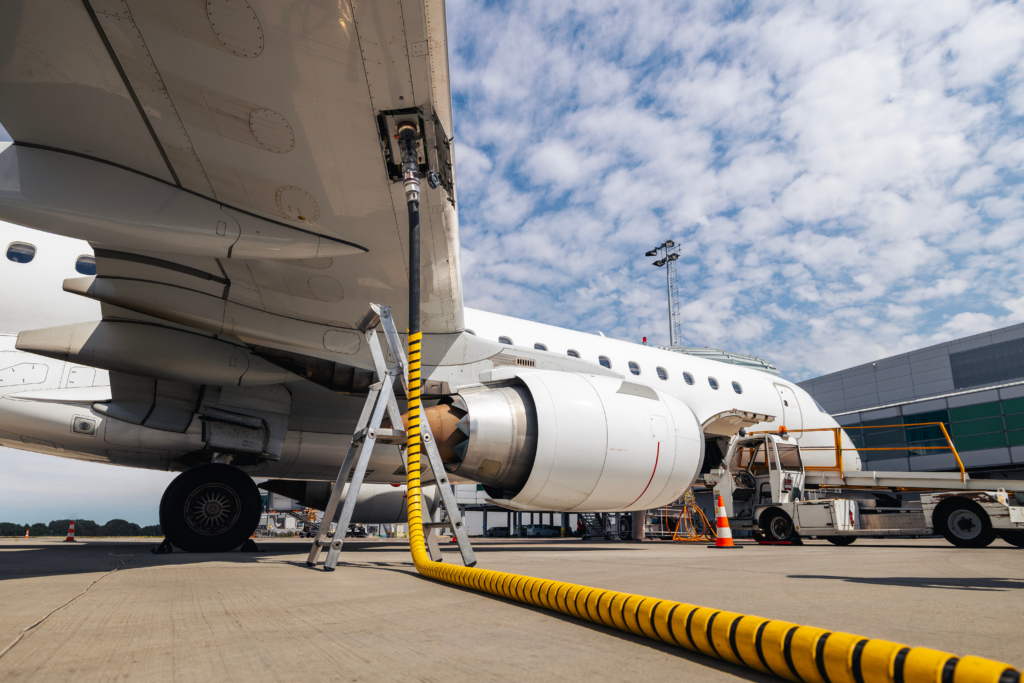
Fuel is one of the highest operating costs for airlines. Yet many carriers may be missing significant savings hidden in how individual aircraft are flown, according to a
The company argues that the biggest opportunities for fuel savings are no longer found through new aircraft or engines alone, but by using data from each aircraft to optimise every stage of flight
Its AI-powered OptiFlight platform can reduce fuel consumption by up to 3% per flight, with savings adding up to around $50,000 per aircraft annually and lower carbon emissions.
Digital twins for every aircraft
Traditional flight planning tools rely on generic aircraft performance models for the type. SITA’s OptiFlight creates a digital twin of each aircraft. The system combines Quick Access Recorder (QAR) data, machine learning and high-resolution 4D weather forecasts to model how each airframe performs in real-world conditions
This allows the software to recommend the most fuel-efficient climb speeds, cruise profiles, descent paths and routing for each specific aircraft rather than relying on standard fleet-wide assumptions.
According to SITA, the technology has already been deployed on more than 2,500 aircraft worldwide
Small improvements add up
Fuel savings often come from incremental operational improvements rather than dramatic changes
SITA says its optimisation tools can deliver:
- Up to 5% reduction in climb fuel burn
- Around 3% cruise fuel savings
- Up to 3% average fuel savings across an entire flight
- Flight-by-flight verification of actual savings rather than theoretical estimates.
Because fuel is one of an airline’s largest operating expenses, even a one- or two per cent reduction can translate into millions of dollars across a fleet
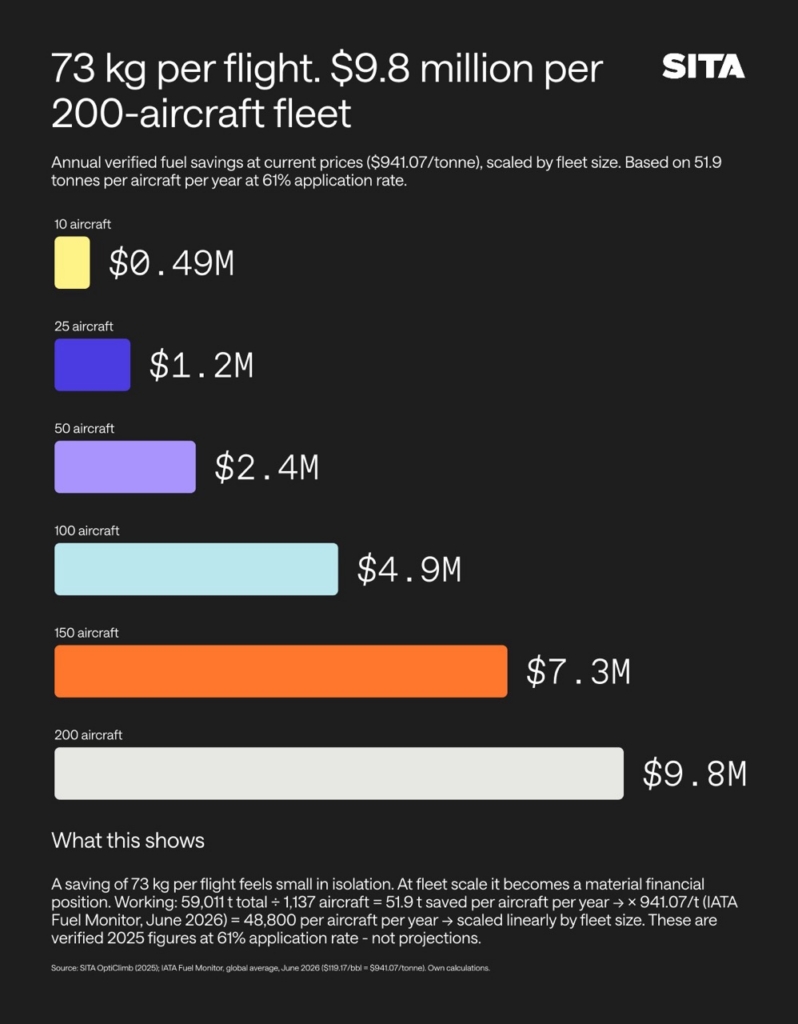
Using SITA’s estimates, a 200-aircraft fleet could achieve around $9.8 million in annual net savings, equivalent to nearly $50,000 per aircraft.
No cockpit modifications required
Importantly, the platform does not require airlines to install new cockpit hardware
Recommendations are delivered directly to pilots through ACARS communications or the OptiFlight Electronic Flight Bag (EFB) interface. Post-flight analysis compares predicted and actual fuel consumption to refine the aircraft’s performance model continually.
The system analyzes 40 flight parameters to provide aircraft-specific recommendations while integrating with existing airline workflows.
Auditable results back sustainability claims
With regulations like the EU Green Claims Directive requiring verified data and penalising “greenwashing” claims, airlines need to prove that they are truly reducing their fuel burn and emissions
The OptiFlight digital tool can help airlines substantiate real-world fuel savings. It generates a fuel consumption prediction before the aircraft departs, operates the flight, and compares the fuel-savings data with auditable results.
Real-world airline adoption
Airlines have already adopted the technology as part of wider fuel-efficiency programmes
Earlier this year, ITA Airways announced it was rolling out SITA OptiFlight across its fleet to optimise climb performance using AI and aircraft-specific data. The airline expects to save more than 7,100 tonnes of fuel and reduce CO₂ emissions by over 22,100 tonnes across 2025 and 2026.
Airbus focuses on descent
SITA is not the only company seeking ways to optimise airline fuel consumption. Delta Air Lines selected Airbus’ Descent Profile Optimisation (DPO) tool to reduce fuel burn on descent and approach—one of the most fuel-intensive phases of flight.
Airbus installed DPO on 270 Delta aircraft, including narrowbody A319, A320, A321 and widebody A330s.
Why optimising flights matters
Airlines operate on narrow margins, with IATA predicting the industry will see a global profit of only 3.9% in 2026. Fuel accounts for up to 30% of airline operating costs. Airlines need to ensure fuel efficiency to stay in the black.
The airline industry has committed to NetZero 2050 targets, but lowering the environmental footprint requires higher supply levels of sustainable ahnologies that could take decades to deliver.
Operational improvements resulting from AI-powered technologies like SITA’s OptiFlight and Airbus’ DPO can help airlines reduce fuel costs and emissions immediately
News
Air TransportSustainabilityfuel burnOptiFlightSITASustainability
Sign up for our newsletter and get our latest content in your
inbox.
1
What is UPRT pilot training? What is UPRT pilot training?
Airshows
July 26, 2026
2
Who is Saadia Zahidi? Meet the woman trading the World Economic Forum for the global airline stage Who is Saadia Zahidi? Meet the woman trading the World…
Air Transport
July 26, 2026
3
Merlin and IAI partner to bring AI-assisted autonomy to commercial cargo aircraft Merlin and IAI partner to bring AI-assisted autonomy to commercial…
autonomous aircraft
July 24, 2026
4
Farnborough International Airshow final day: Pioneers of Tomorrow Farnborough International Airshow final day: Pioneers of Tomorrow
Farnborough Internation…
July 24, 2026
Related Topics
More from
What is UPRT pilot training?What is UPRT pilot training?
July 26, 2026
Who is Saadia Zahidi? Meet the woman trading the World Economic Forum for the global airline stageWho is Saadia Zahidi? Meet the woman trading the World Economic Forum for the global airline stage
July 26, 2026
Merlin and IAI partner to bring AI-assisted autonomy to commercial cargo aircraftMerlin and IAI partner to bring AI-assisted autonomy to commercial cargo aircraft
July 24, 2026
Farnborough International Airshow final day: Pioneers of TomorrowFarnborough International Airshow final day: Pioneers of Tomorrow
July 24, 2026
Ukraine’s Fire Point aims to double Russia’s Geran drone production with 100,000 FP-1/2s Ukraine’s Fire Point aims to double Russia’s Geran drone production with 100,000 FP-1/2s
July 24, 2026
Merlin and IAI partner to bring AI-assisted autonomy to commercial cargo aircraftMerlin and IAI partner to bring AI-assisted autonomy to commercial cargo aircraft
July 24, 2026
Farnborough International Airshow final day: Pioneers of TomorrowFarnborough International Airshow final day: Pioneers of Tomorrow
July 24, 2026
World’s largest electric aircraft cleared for first flight as Heart Aerospace secures FAA approval World’s largest electric aircraft cleared for first flight as Heart Aerospace secures FAA approval
July 24, 2026
Ukraine’s Fire Point aims to double Russia’s Geran drone production with 100,000 FP-1/2sUkraine’s Fire Point aims to double Russia’s Geran drone production with 100,000 FP-1/2s
July 24, 2026
Farnborough International Airshow final day: Pioneers of TomorrowFarnborough International Airshow final day: Pioneers of Tomorrow
July 24, 2026
Air Cambodia orders 20 COMAC C909 regional jets in landmark China deal Air Cambodia orders 20 COMAC C909 regional jets in landmark China deal
July 22, 2026
Sora Aviation partners with Toray for 30-seat S-1 eVTOL development Sora Aviation partners with Toray for 30-seat S-1 eVTOL development
July 22, 2026
World’s largest electric aircraft cleared for first flight as Heart Aerospace secures FAA approvalWorld’s largest electric aircraft cleared for first flight as Heart Aerospace secures FAA approval
July 24, 2026
Farnborough International Airshow 2026: The day four wrap Farnborough International Airshow 2026: The day four wrap
July 23, 2026
Gulf Air becomes JetZero’s first Middle East airline customer for blended-wing-body Z4 aircraft Gulf Air becomes JetZero’s first Middle East airline customer for blended-wing-body Z4 aircraft
July 22, 2026
Europe’s first all-electric cargo airline targets 2027 launch from Schiphol Europe’s first all-electric cargo airline targets 2027 launch from Schiphol
July 22, 2026
