

Iran Update Special Report, July 25, 2026
The Institute for the Study of War (ISW) and The Critical Threats Project (CTP) at the American Enterprise Instituteare publishing daily updates to provide analysis on the war with Iran. The updates cover events from the past 24-hour period.
Note: ISW-CTP will publish abbreict and Axis of Resistance developments directly related to the conflict starting on July 18, 2026.
Note: ISW-CTP has revised its update structure due to the resumption of war between the United States and Iran. Iran is currently engaged in an information effort to frame its attacks on US bases and regional states as retaliatory and defensive. Iran is not merely responding to US strikes on Iran, however, but is engaged in proactive military operations to achieve discrete objectives. The revised update structure reflects some of these key objectives
Key Takeaways
- The Saudi-led coalition struck several Houthi targets across Yemen in order to degrade the Houthis’ capabilities to threaten Saudi-linked shipping in the Red Sea and strike Saudi critical infrastructure.
- The Houthis responded by attacking Saudi vessels and Red Sea ports. Houthi attacks on oil infrastructure in major Red Sea port cities compound the tactical effects of the group’s blockade on Saudi Arabia, which raises the cost for Saudi Arabia to continue air operations in Houthi-controlled territory.
- The United States did not conduct a wave of overnight strikes in Iran for the first time in 13 days. An Iranian health ministry spokesperson confirmed that the United States had not conducted any attacks in Iran since July 24. US President Donald Trump reportedly ordered the US military to hold strikes on Iran several hours after an Omani delegation arrived in Tehran to discuss efforts to re-open the Strait of Hormuz with the Iranians.
- Iran has fired advanced variants of the Kheybar Shekan medium-range ballistic missiles (MRBM) at regional US bases during the current conflict that have evaded US defenses, according to US officials speaking to the Wall Street Journal. One US official stated that some of these missiles have successfully evaded US defenses.
Toplines
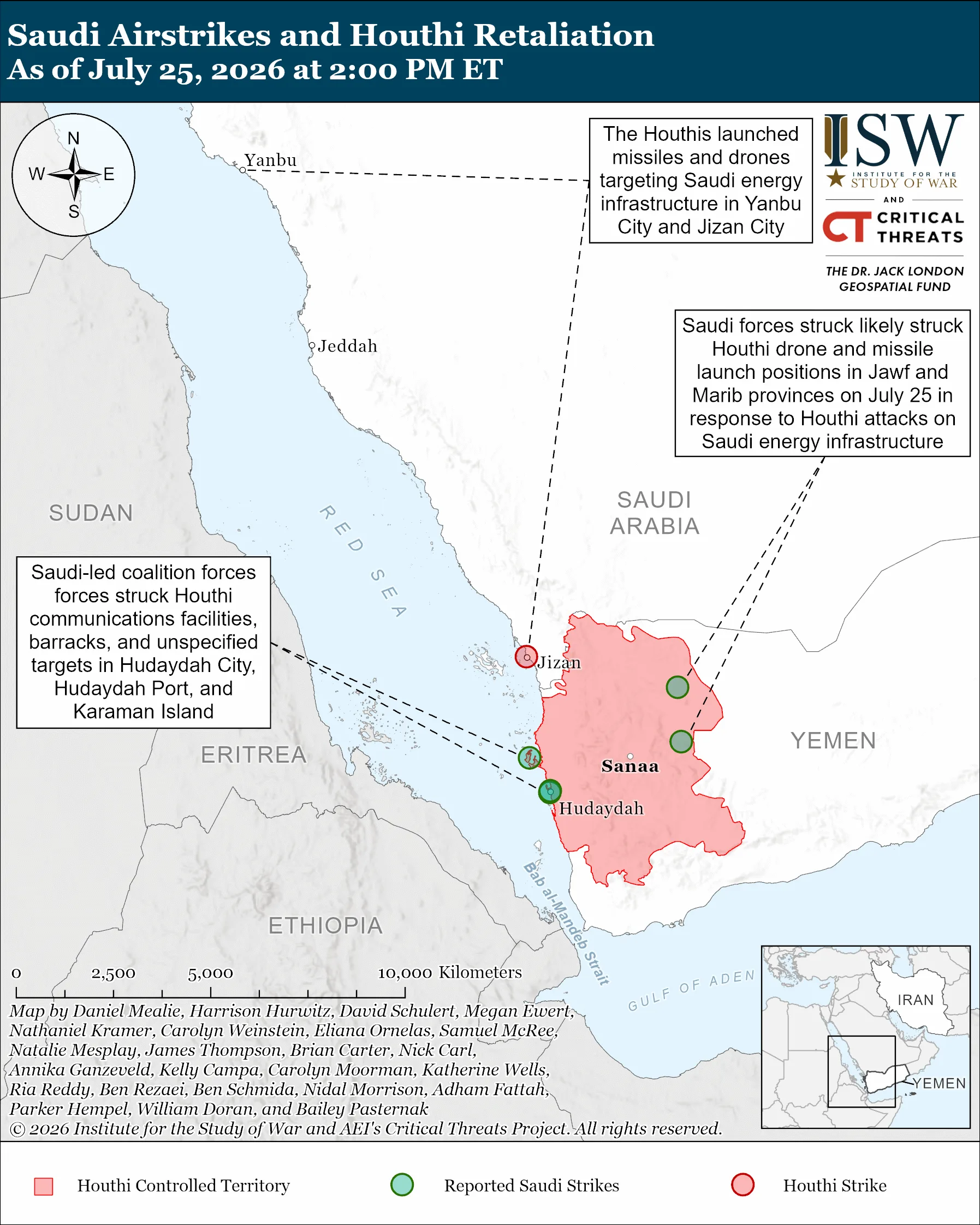
The Saudi-led coalition struck several Houthi targets across Yemen on July 24 and 25 in order to degrade the Houthis’ capabilities to threaten Saudi-linked shipping in the Red Sea and strike Saudi critical infrastructure.[1] The Houthis and Houthi-affiliated media claimed that Saudi-led forces struck Hudaydah Port, a telecommunications building in Hudaydah City, and an unspecified target on Karaman Island near Salif Port, northwestern Yemen, on July 24.[2] Anti-Houthi Yemeni media claimed that the strikes targeted Houthi barracks near Hudaydah Port.[3] Geolocated imagery showed a fire burning at Hudaydah Port on July 24 after the alleged Saudi strikes.[4] A spokesperson for the Saudi-led coalition denied that the coalition conducted any strikes targeting the port.[5] Saudi forces later struck likely Houthi drone and missile launch sites in Jawf and Marib provinces on July 25 in response to Houthi attacks on Saudi critical infrastructure in Yanbu and Jizan on July 24.[6]
The Houthis attacked Saudi vessels and Red Sea ports on July 24 to coerce Saudi Arabia into abandoning its air campaign against Houthi ports and infrastructure.[7] The Houthis fired missiles and drones targeting Saudi state-owned oil infrastructure in Yanbu and Jizan on the Red Sea coast.[8] An open-source intelligence account on X confirmed that Houthi munitions impacted in Jizan, and Reuters reported that Greek-operated Saudi air defenses intercepted two Houthi ballistic missiles targeting Yanbu.[9] The Houthis claimed that their forces conducted the attacks in response to Saudi airstrikes on Houthi sites several hours earlier.[10] International media reported that Houthi forces also attacked a Saudi vessel, the NCC Masa, in the Red Sea on July 24.[11] Houthi military spokesperson Yahya Sarea warned on July 25 that the Houthis will continue to enforce their blockade on Saudi ports and vessels and will “not hesitate” to escalate or expand the group’s targeting in response to Saudi attacks.[12] A US-based Yemen analyst reported on July 25 that the Houthis may expand their targeting of Saudi infrastructure, including energy and maritime assets.[13] Houthi attacks on oil infrastructure in major Red Sea port cities compound the tactical effects of the group’s blockade on Saudi Arabia, which raises the cost for Saudi Arabia to continue air operations in Houthi-controlled territory.[14] Saudi Arabia heavily depends on Yanbu as an oil export hub in light of Iranian attacks on vessels and oil infrastructure in the Persian Gulf and Strait of Hormuz.[15] Houthi attacks on Yanbu and other Saudi Red Sea ports also advance Iranian interests by eliminating Saudi alternatives to accepting Iran’s demand for recognized control over the Strait of Hormuz.[16]
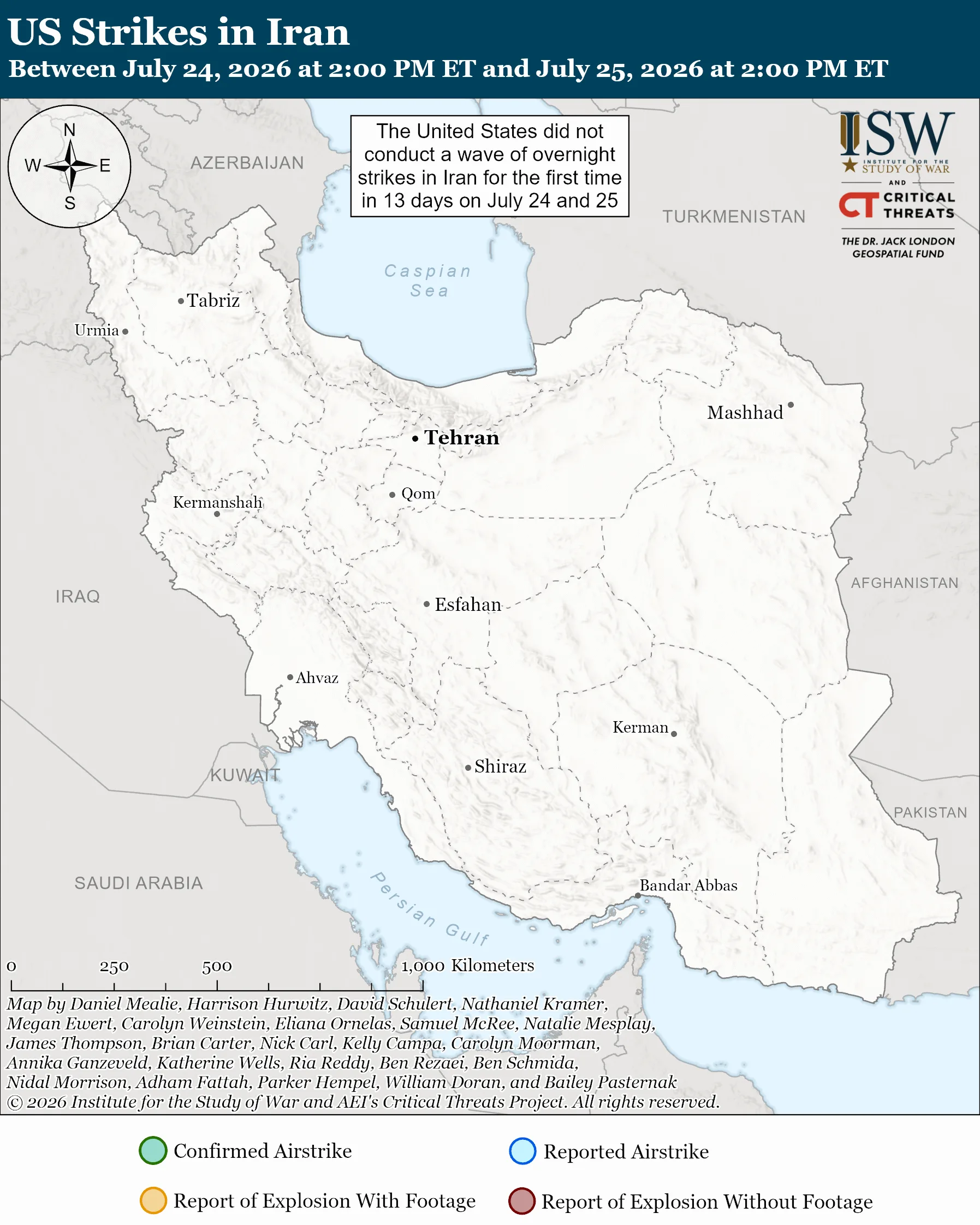
The United States did not conduct a wave of overnight strikes in Iran for the first time in 13 days. An Iranian health ministry spokesperson confirmed that the United States had not conducted any attacks in Iran since July 24.[17] US President Donald Trump met with senior advisers at the White House on July 24 to discuss US options for operations in Iran, including reportedly the possibility of expanding US military operations.[18] Trump reportedly ordered the US military to hold strikes on Iran several hours after an Omani delegation arrived in Tehran to discuss efforts to re-open the Strait of Hormuz with the Iranians.[19] Trump told reporters that the United States “is talking” with the Iranians.[20]
The United States has conducted nightly waves of strikes in Iran since July 12 targeting Iranian military command centers, drone storage facilities, communications networks, coastal surveillance sites, maritime capabilities, and military logistics infrastructure.[21]US military officials said that US forces have struck over 1,000 targets.[22] The United States struck 13,000 targets in 38 days during the previous phase of the war.[23]
Iran has only conducted one attack targeting a US base in Bahrain since CTP-ISW’s last data cut-off on July 24, which suggests that Iran is calibrating attacks on US positions in response to US activity.[24]A likely Iranian attack triggered alarms in Bahrain on July 24.[25] Iran has conducted daily attacks on states hosting US bases—particularly Bahrain, Kuwait, and Jordan—since the US resumed daily strikes on Iran on July 12.[26] The sharp reduction in Iranian attacks on US bases overnight between July 24 and 25 may reflect the absence of US strikes in Iran during the same period. Iran is using its attacks on US bases to inflict a steady number of US casualties at US regional bases in order to impose US domestic pressure that would force the US government to halt its airstrike campaign on Iran.[27] Iran also aims to raise the cost for US regional allies of hosting US forces and pressure US allies to urge the United States to end its strike campaign on terms favorable to Tehran.
A “credible” Iranian-linked threat prompted US President Donald Trump to switch to a more secure plane for his return flight from the NATO summit in Ankara on July 8.[28]Multiple people briefed on the matter told the New York Times on July 24 that US officials determined that “Iranian proxy forces” posed a “credible threat” to Trump and Air Force One.[29] Sources briefed on the matter said that the threat that prompted Trump to change planes was ”separate” from a recent Iranian threat attributed to Israeli intelligence.[30] Israel recently shared intelligence with the United States that Israel said indicated that an Iranian plan to kill Trump, according to the Wall Street Journal on July 9.[31]
US and Partner Military Operations
US forces disabled a vessel that violated the US blockade in the Gulf of Oman on July 24.[32] A CENTCOM spokesperson said that US forces fired into the engine room of the Lavineafter the crew did not comply with US warnings after at least four previous attempts to run the blockade.[33]The Lavinewas attempting to transport Iranian liquefied petroleum gas, according to Iranian media.[34] Iranian media reported that the attack killed two sailors.[35] CENTCOM acknowledged the reports of casualties.[36] The Lavineis the second ship that US forces have disabled since the United States re-imposed the blockade on July 14.[37]
Iranian Strike Campaign
Assessed Iranian War Aims:
- Secure international recognition of Iranian control over the Strait of Hormuz
- Degrade the US ability and willingness to continue the war
- Restore deterrence vis-à -vis the United States and its regional partners
- Divide the United States and Israel from the Arab states
Iran has fired advanced variants of the Kheybar Shekan medium-range ballistic missiles (MRBM) at regional US bases during the current conflict that have evaded US defenses, according to US officials speaking to the Wall Street Journal.[38]The US officials stated that Iran has launched Kheybar Shekan missiles along different flight paths and at varying speeds and maneuvers in attempts to circumvent US air defenses.[39]One US official stated that some of these missiles have successfully evaded US defenses. Unspecified analysts and officials told the Wall Street Journal that some Kheybar Shekan variants have a detachable warhead-bearing nosecone that can adjust its trajectory during the terminal phase at speeds of up to 6,000 miles per hour.[40] A military analyst added that Iran can rapidly fuel and load these missiles onto mobile launchers, which allows Iran to reduce its vulnerability to strikes targeting fixed Iranian launch sites. The United States and Israel estimated that Iran possessed approximately 2,500 Kheybar Shekan MRBMs before the US-Iran war began in February 2026. A missile expert told the Wall Street Journalthat Iran may be currently assembling more Kheybar Shekan missiles using components stored in underground facilities.[41] The expert added that previous US-Israeli strikes have destroyed Iranian facilities used to assemble the missile’s engine, however.
US-Iran Negotiations
See topline section
Iranian Domestic Affairs
Nuclear expert David Albright assessed on July 24 that the degraded state of Iran’s nuclear program following the June 2025 Israel-Iran war will continue to pose significant barriers to Iran’s development of a post-fission nuclear weapon.[42] The New York Times reported on July 24 that US intelligence agencies assess that Iranian Supreme Leader Mojtaba Khamenei has more interest in developing a nuclear weapon than former Supreme Leader Ali Khamenei, according to officials briefed on the assessments.[43] The officials said that this assessment relies primarily upon Mojtaba’s public statements and intercepted communications before US and Israeli strikes in Iran in February and April 2026. US officials told the New York Timesthat Mojtaba supports the development of a thermonuclear warhead that Iran could miniaturize for deployment on a long-range ballistic missile.[44] Albright suggested that Mojtaba is unlikely to pursue developing thermonuclear weapons at this time, given the current status of Iran’s targeted nuclear weaponization-related sites.[45] US and Israeli airstrikes in 2026 targeted Iranian nuclear weaponization sites, following June 2025 strikes that disabled Iran’s uranium enrichment infrastructure and buried at least a majority of Iran’s highly enriched uranium stockpile.[46] Albright stated that the June 2025 war significantly reduced Iran’s capacity to produce a nuclear weapon while increasing both the likelihood of detection and the risk of technological failure.[47]
Lebanon
Nothing significant to report
Nothing significant to report
Arabian Peninsula
See topline section

[1] https://t.me/army21ye/3594 ; https://x.com/CJFCSpox/status/2080784707357180324/photo/1; https://x.com/Alsakaniali/status/2080956969649615001 ; https://x.com/BashaReport/status/2080980011226366077?s=20
[2] https://t.me/army21ye/3594 ; https://x.com/TvAlmasirah/status/2080987012048318691 ; https://x.com/FaytuksNetwork/status/2080756968403480618
[3] https://x.com/defenseliney/status/2080753037992202259?s=20
[4] https://x.com/LayBay_ish/status/2080752164159312180?s=20
[5] https://x.com/CJFCSpox/status/2080784707357180324/photo/1
[6] https://x.com/Alsakaniali/status/2080956969649615001 ; https://x.com/BashaReport/status/2080980011226366077?s=20
[7] https://x.com/BashaReport/status/2080948398375453128?s=20 ; https://apnews.com/article/iran-us-hormuz-strait-war-25-july-2026-df3790320c595f3e599fb1dd69423e77 ; https://www.reuters.com/world/middle-east/saudi-vessel-sustains-minor-hull-damage-after-red-sea-attack-state-news-agency-2026-07-24/
[8] https://x.com/BashaReport/status/2080948398375453128?s=20 ; https://apnews.com/article/iran-us-hormuz-strait-war-25-july-2026-df3790320c595f3e599fb1dd69423e77
[9] https://www.reuters.com/world/middle-east/saudi-strikes-target-yemens-hodeidah-says-houthi-run-al-masirah-tv-2026-07-24/ ; https://x.com/john_marquee/status/2080890037558984957?s=20
[10] https://x.com/MMY1444/status/2080986931974787307?s=20
[11] https://www.reuters.com/world/middle-east/saudi-vessel-sustains-minor-hull-damage-after-red-sea-attack-state-news-agency-2026-07-24/
[12] https://x.com/MMY1444/status/2080986931974787307?s=20
[13] https://x.com/BashaReport/status/2080988205520711799?s=20 ; https://x.com/MMY1444/status/2080986931974787307?s=20
[14] https://understandingwar.org/research/middle-east/iran-update-special-report-july-24-2026/ ; https://www.nytimes.com/2026/07/20/world/middleeast/yemen-houthis-saudi-arabia-red-sea-blockade.html
[15] https://www.reuters.com/business/energy/crude-exports-saudis-yanbu-port-surged-near-4-mln-bpd-last-week-data-shows-2026-03-24/ ; https://www.reuters.com/business/energy/saudi-arabia-considers-expansion-oil-pipeline-red-sea-5296203-crude-shipments-saudi-arabias-yanbu-port-near-maximum-levels ; https://www.newarab.com/news/us-iran-strikes-escalate-iranian-attack-hits-kuwait-oil-site
[16] https://www.reuters.com/world/middle-east/iran-insists-keeping-control-over-hormuz-senior-iranian-
[17] https://x.com/HKermanpour/status/2080922983468515726
[18] https://abcnews.com/International/live-updates/iran-live-updates-kuwait-attacked-bahrain-sounds-sirens/?id=134907987&entryId=135068807
[19] https://www.axios.com/2026/07/25/trump-iran-war-military-directive-strikes
[20] https://abcnews.com/International/live-updates/iran-live-updates-kuwait-attacked-bahrain-sounds-sirens/?id=134907987&entryId=135068807
[21] https://www.nytimes.com/2026/07/24/us/politics/trump-escalation-iran.html?smid=url-share; https://x.com/CENTCOM/status/2076495252454584794; https://x.com/CENTCOM/status/2080463031289380910; https://x.com/CENTCOM/status/2077932932400865598?s=20[22] https://www.nytimes.com/2026/07/24/us/politics/trump-escalation-iran.html?smid=url-share; https://x.com/CENTCOM/status/2076495252454584794
[23] https://www.nytimes.com/2026/07/24/us/politics/trump-escalation-iran.html?smid=url-share
[24] https://x.com/moi_bahrain/status/2080761417469178086
[25] https://www.nytimes.com/live/2026/07/25/world/iran-war-us-strikes-trump-oil/heres-the-latest?smid=url-share; https://x.com/moi_bahrain/status/2080761417469178086
[26] https://understandingwar.org/research/middle-east/iran-update-special-report-july-24-2026; https://understandingwar.org/research/middle-east/iran-update-special-report-july-23-2026; https://understandingwar.org/research/middle-east/iran-update-special-report-july-17-2026; https://understandingwar.org/research/middle-east/iran-update-special-report-july-14-2026; https://understandingwar.org/research/middle-east/iran-update-special-report-july-12-2026/
[27] https://www.criticalthreats.org/analysis/iran-update-evening-special-report-july-24-2026
[28] https://www.nytimes.com/2026/07/24/us/politics/trump-plane-iran-threat.html?smid=url-share; https://www.nytimes.com/2026/07/08/us/politics/trump-air-force-one-security.html
[29] https://www.nytimes.com/2026/07/24/us/politics/trump-plane-iran-threat.html?smid=url-share
[30] https://www.nytimes.com/2026/07/24/us/politics/trump-plane-iran-threat.html
[31] https://www.wsj.com/world/middle-east/iran-hatched-fresh-plot-to-kill-trump-israel-told-u-s-1511d9d2
[32] https://www.nytimes.com/live/2026/07/25/world/iran-war-us-strikes-trump-oil/d26a82f5-a16b-5f71-b482-4bd0ba03774e?smid=url-share
[33] https://www.nytimes.com/live/2026/07/25/world/iran-war-us-strikes-trump-oil/d26a82f5-a16b-5f71-b482-4bd0ba03774e?smid=url-share
[34] https://t.me/Nournews_ir/378425
[35] https://t.me/Nournews_ir/378425
[36] https://www.nytimes.com/live/2026/07/25/world/iran-war-us-strikes-trump-oil/ad857484-b5a4-5f71-bbaf-bdadd1477844?smid=url-share
[37] https://www.pbs.org/newshour/world/u-s-military-says-it-fired-on-another-vessel-trying-to-breach-its-blockade-of-iranian-ports; https://www.centcom.mil/MEDIA/PUBLIC-RELEASES/Article/4542098/us-forces-to-resume-naval-blockade-against-iran/
[38] https://www.wsj.com/world/middle-east/iran-kheibar-shekan-missile-5776a6e4
[39] https://www.wsj.com/world/middle-east/iran-kheibar-shekan-missile-5776a6e4
[40] https://www.wsj.com/world/middle-east/iran-kheibar-shekan-missile-5776a6e4
[41] https://www.wsj.com/world/middle-east/iran-kheibar-shekan-missile-5776a6e4
[42] https://x.com/DAVIDHALBRIGHT1/status/2080781711634210995?s=20
[43] https://www.nytimes.com/2026/07/24/us/politics/iran-nuclear-weapon.html
[44] https://www.nytimes.com/2026/07/24/us/politics/iran-nuclear-weapon.html
[45] https://x.com/DAVIDHALBRIGHT1/status/2080781711634210995?s=20
[46] https://isis-online.org/isis-reports/comprehensive-analysis-of-nuclear-facilities-targeted-during-the-second-phase-of-the-iran-war
[47] https://x.com/DAVIDHALBRIGHT1/status/2080781711634210995?s=20
