

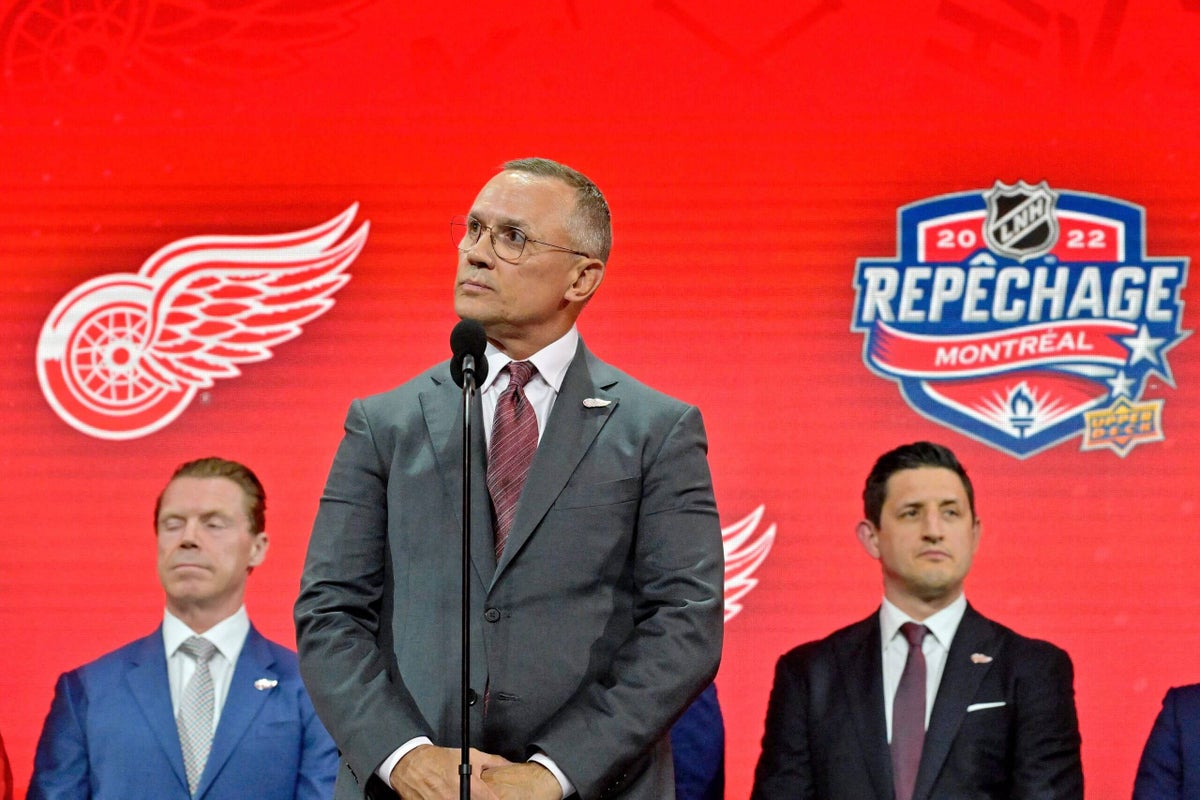
Seven years ago, the Detroit Red Wings pulled off the near-impossible: They made a move that absolutely everyone loved
Their own fans, who were thrilled. Other fan bases, who were grudgingly jealous. The media. The experts. The insiders. The nerds. All 200 hockey men
Everyone agreed: Hiring Steve Yzerman as general manager was a slam dunk
The news landed one Friday morning, somehow both coming out of nowhere while also feeling like we’d known it all along. Of course the captain was coming home. After an apprenticeship in Tampa Bay that saw him build the Lightning into a powerhouse, Yzerman was returning to Detroit to do the same for the team he’d led to three Stanley Cup titles on the ice. The news received glowing reviews everywhere, with the possible exception of Tampa Bay, where a team already reeling from a historic playoff collapse in their first year without Yzerman worried about what might come next.
Is Zach Werenski really committed to the Blue Jackets?
Aaron Portzline and Sean McIndoe
After all, this wasn’t just the typical NHL homecoming, where a struggling team trots out a former player to buy some time with a skeptical public. In 2019, Yzerman was considered one of the very best GMs in the league. He’d worked magic in Tampa, he’d led Team Canada to gold, he’d won GM of the Year. Now he was home, taking over a team ready to make the next step toward contention and beyond
It was a new hope because it couldn’t fail. And then it did
There’s really no arguing it. We can quibble over which adverbs to apply — did he fail spectacularly or just dramatically? — but the failure part isn’t up for debate. And among the many pieces of the fallout we’re still sorting through sits Yzerman’s reputation as a front-office genius, once pristine, now in shambles
If you’ve been a hockey fan long enough, all of this might sound oddly familiar
Stop me if you’ve heard it before. A GM establishes himself with one team, building a reputation that morphs from competent to smart to borderline infallible. They win plenty, maybe even a championship or two. Eventually they hit the open market, where other teams line up to meet them with open arms and blank checks. When one finally hires them, we all but get to work on the Cup engraving
And then it just doesn’t work. And we’re all left wondering: Wait, was that guy really as smart as we all thought?
It happens time and again. Here are a half-dozen of the most notable
Glen Sather
Maybe the most famous example of all, Glen Sather won five Cup titles in Edmonton, including one nobody saw coming after he’d been forced to sell off Wayne Gretzky. And even as the sport’s emerging economics hammered the small-market Oilers into submission, Sather kept them competitive. At one point, while lamenting the financial constraints he was working under, Sather infamously said, “If I had the Rangers payroll, I’d never lose a game.”
Then the Rangers hired him in 2000, and he got his wish, including several years of pre-cap freedom where he could basically throw unlimited money at any player he wanted. The result: A massive payroll, a bunch of broken-down former stars clogging up the roster and zero playoff appearances. Sather eventually found some success in his later years in New York, but never won another Cup title
Ken Holland
A familiar name for Wings fans, Ken Holland was GM in Detroit for over 20 years before Yzerman arrived, winning three Cup titles as GM and another as an assistant. In 2009, Sports Illustrated’s list of the top 10 executives of the decade had Holland in second place across all of pro sports, trailing only the New England Patriots’ Scott Pioli and ahead of names such as Theo Epstein and Billy Beane; they wrote that he “assiduously has kept this well-oiled machine purring with artful final-pieces-of-the-puzzle deals and signings.”
When he became available in 2019, the Oilers snapped him up almost immediately in what seemed like a perfect fit. Five extremely uneven years later, he was out, with his reputation so diminished that the Kings hiring him was met with headlines such as this
Peter Chiarelli
After winning the Cup in Boston, Peter Chiarelli was riding so high that the Bruins proudly posted his trade deliberations online. He was hired in Edmonton in 2015 in the aftermath of the Connor McDavid lottery win, heralded as the culture change the team needed. These days his four-year stint is remembered for “the trade is one for one” and not much else, and he hasn’t held a GM job since
Dale Tallon
Before Bowman pushed the Hawks over the finish line, it was Dale Tallon who built them into a quasi-dynasty. His four years in Chicago ended weirdly, but he was the one who took a floundering team and added Jonathan Toews, Patrick Kane and Marian Hossa, not to mention hiring Joel Quenneville. The Panthers put him in charge for most of the next decade, and achieved just about nothing over that time beyond introducing the “computer boys” punchline to the hockey world. Once Tallon was out, Bill Zito arrived and quickly transformed the Panthers into the league’s model success story.
Brian Burke
Brian Burke was already an experienced GM by the time he arrived in Anaheim, having held the role in Hartford and Vancouver. But with the Ducks he hit home run after home run, landing Scott Niedermayer and Chris Pronger and bringing back Teemu Selanne before rolling to a 2007 Cup win with a team built in his old-school image. Then he left for Toronto, to great fanfare and (initially) fan and media adoration. A few years, several blockbusters, multiple soundbites and no big wins later, he was fired and we were wondering how it all went wrong. A further stint in Calgary failed to salvage what was left of his reputation.
Neil Smith
Maybe the most extreme example we’ll ever find, Smith spent over a decade as GM of the Rangers, and was the one who finally ended their record drought. He inherited a team that wasn’t all that good and built them into a Presidents’ Trophy and eventually Stanley Cup-winning powerhouse through a masterclass of aggressive moves. He waited for the right opportunity for a second act, then lasted a few weeks with the Islanders before being replaced by a backup goalie. He was never a prominent figure in the NHL again.
To be clear, this isn’t a universal phenomenon, and there absolutely have been established GMs who’ve succeeded elsewhere. Jim Rutherford won a Cup in Pittsburgh after winning in Carolina, the only modern GM to pull off that feat. Cliff Fletcher rebuilt the Leafs after a decade and a Cup in Calgary. Bryan Murray barely missed a beat going from Anaheim to Ottawa, David Poile won a ton of games in Washington and then Nashville, and Lou Lamoriello exceeded all expectations with the Islanders
But it’s also hard not to notice that many of the GMs who rank high on any list of all-time greats — a list that would begin with the immortal Sam Pollock and also include legends such as Harry Sinden, Serge Savard and Bill Torrey plus more modern names such as Pierre Lacroix and Doug Wilson — never took a second job anywhere
Maybe that was a good thing, because man, a lot of these so-called geniuses sure seem to fall flat on their face when they’re asked for a repeat performance
It’s weird, right?
Every situation is different, and the fact that somebody succeeded in one market doesn’t guarantee that they’ll do it again somewhere else. But it doesn’t feel like it should be possible for a guy to go from being in the conversation as the very best in the world at their job to the very worst. That would be like McDavid signing in New York in a few years and immediately struggling to hit 40 points, or Quinn Hughes getting to Minnesota and slotting in as a third-pair guy, or Patrick Roy being dealt to Colorado and immediately turning into André “Red Light” Racicot. Aging curves and injuries aside, that just doesn’t happen to players.
And with a handful of exceptions, it really doesn’t happen with coaches either. Maybe you point to examples such as Don Cherry in Colorado, or Marc Crawford anywhere but Colorado. But teams love their recycled coaching retreads for a reason: They almost always work, at least for a while
Just not with GMs. There was a time when NHL teams seemed to be learning the lesson, with a noticeable trend emerging away from hiring second-time GMs. That was probably an overcorrection, and these days we’re back to seeing retreads such as Jason Botterill, John Chayka and Jarmo Kekäläinen get second chances despite so-so results in their first stops
But even given that, it’s hard to ignore just how many of the consensus picks for the best GMs in the league are first-timers. You can start with recent Cup winners such as Eric Tulsky, Bill Zito, Kelly McCrimmon and Julien BriseBois. Mix in recent GM of the Year honorees such as Bill Guerin, Don Sweeney and three-time winner Jim Nill, plus widely praised names such as Mike Grier. That’s a wide array of backgrounds — former players, front-office assistants and an agent, with approaches both old school and new — but none had ever been GMs for another NHL team.
By contrast, who’s the most successful GM on a second stint? With Doug Armstrong done in St. Louis and Chris MacFarland only just starting in Nashville, we’re left with … who, maybe Kyle Dubas? Unless you think Don Waddell has been knocking it out of the park in Columbus, that’s pretty much your only option.
This has to mean something. I’m just not sure what. But let’s throw a couple of possibilities out there
Lesson 1: We’re just really bad at evaluating GMs. If the hockey world keeps anointing guys as geniuses who then immediately fail in their next stop, it seems like the most obvious lesson is that we’re bad at this. Maybe the reason Yzerman went from mastermind to chump is that he was never a mastermind in the first place — and maybe he’s not a chump now. His team won, and we all gave him the credit. Then his new team lost, and we blamed him. Maybe it’s all a lot more complicated than that.
More specifically …
Lesson 2: A front office isn’t just a GM. There was a time when it largely was, when guys such as Pollock and Sinden and Fletcher were wheeling and dealing based largely on their own gut instincts. These days, almost every team has ranks of assistants and analytics and consultants, not to mention an army of scouts. The GM might hire a lot of those people, and ultimately the buck stops with the boss. But that doesn’t mean you can airlift a guy out of one job into the next and expect anywhere near the same results.
Lesson 3: We’re too quick to ignore what’s already been built. You may have noticed a pattern with some of these high-profile GM success stories that don’t hold up: A lot of them sure seem to involve teams where key pieces were already in place. Sather already had Gretzky. Holland had Yzerman himself, plus Nicklas Lidstrom and others. Bowman had Jonathan Toews and Patrick Kane. We tend to hand-wave that stuff away under the guise that everybody inherits something, and that’s largely true. But maybe we need to pump the brakes on crowning the next great GM based on what somebody else built.
Lesson 4: The NHL evolves faster than we want to think. This is a different way of looking at the problem. Maybe it’s not that the smart GMs get dumb. Maybe the Sathers and Hollands and Burkes and Yzermans of the hockey world really were as smart as we all wanted to think, and maybe they stayed that way. The problem wasn’t that they changed, but that the league did
In other words, maybe expecting Yzerman to be as good a GM in 2026 as he was in 2016 is no more unrealistic than expecting him to lace up the skates and go be the player he was in 1996. What works today won’t work tomorrow, and everyone gets left behind eventually. Tulsky is making this all look easy now, but maybe in a decade he’ll be the old and out-of-touch guy struggling to keep up with these new-fangled ideas as he guides the Houston Scarlet Aeros to another last-place finish
Lesson 5: Maybe nobody is good at this and it’s mostly luck. You knew this was coming if you’ve read my thoughts on the role of luck in the NHL over the years. And sure, it obviously can’t all be luck, and it would be depressing if it was. Besides, while it’s not always easy to figure out who the great GMs are, it sure seems like there are legitimately bad ones, which means there’s at least some skill in play here somewhere
But maybe a lot of this all comes back to our desperate need as fans to feel like the right result always plays out in the end. If a team wins, their GM must be smarter than everyone else because the idea that everyone is basically rolling the same dice and flipping the same coins and some guys are just getting luckier on the results is kind of a bummer. It’s at least possible that being a successful GM is a little bit of skill mixed in with a lot of luck, and even if the first part of that equation is a long-term trait, that doesn’t mean the latter half will be.
I’m not sure. But I do know one thing: The next time a team breaks the bank to hire a sure-thing GM prodigy based on their success at their last stop, I’m going to be one of the skeptics. There’s something weird going on with these guys, and it should make us rethink how we feel about the job they’re being hired to do
