

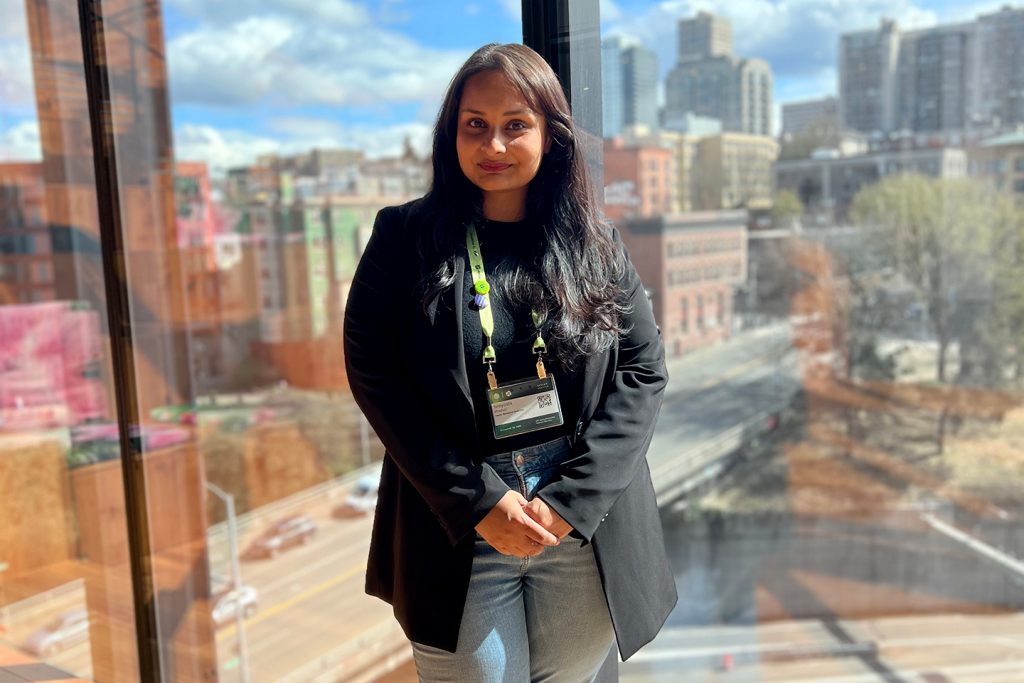
More than a decade ago, Sreyoshi Bhaduri M.S. ’13, M.S. ’17, Ph.D. ’18 had an epiphany while on a trip to Europe with 12 other Virginia Tech graduate students
Working on her master’s degree in mechanical engineering at the time, Bhaduri had been selected for the Global Perspectives Program Fellowship organized by Karen DePauw, then the vice president and dean for graduate education. The fellowship allowed select graduate students to experience higher education administration by meeting with students and provosts at universities throughout Europe
On a train ride back to Riva San Vitale, Switzerland, home of the Steger Center for International Scholarship, Bhaduri expressed fascination with the global challenges facing engineering along with wanting to research what it took to be an engineer and a wish to pursue a Ph.D. on that topic
“You do know that we have a Department of Engineering Education?” DePauw asked her. “You could always apply.”
That conversation prompted immediate action
“As soon as I got back to the U.S., I applied and got accepted,” Bhaduri said. “I just really enjoyed how the department supported what, at that time, was a very nontraditional approach to researching some of the things that I was interested in.”
Bhaduri ultimately earned a Ph.D. in engineering education to go along with master’s degrees in mechanical engineering and applied statistics. In a testament to her drive, she completed her statistics coursework at the same time she finished her dissertation
Bhaduri now works for Amazon, with the title manager, applied science within Amazon Creators and Social. She leads a team of scientists, economists, and engineers, building algorithms that personalize social advertising and developing tools that help content creators produce and monetize their work
Bhaduri represents a broader shift for doctoral students in the engineering education program. Doctoral programs in this field feature employment opportunities in a range of academic careers, but Virginia Tech’s program quietly is building a track record of students branching into industry, applying their interdisciplinary training to complex, real-world systems
Count Bhaduri as one of the trailblazers
A different kind of engineering mindset
Bhaduri’s Global Perspectives Program Fellowship in Europe shifted her thinking beyond technical problem-solving to broader questions about systems, learning, and human development
It introduced her to a field that felt like a natural fit. Bhaduri’s parents both hold Ph.D.’s, and she always knew she wanted to pursue one herself. She sought flexibility to explore unconventional research questions, and Virginia Tech’s engineering education program offered that
The program plays a dual role within the College of Engineering. It teaches first-year general engineering students the basics of engineering and shows them the different majors within the college. It also houses a nationally recognized Ph.D. program that enrolls approximately 50 students at any time
The program features a core philosophy: Engineers design and build things that empower individuals and society, so engineering education should integrate human, systems, and societal perspectives
“I got a second master’s in applied statistics because I was interested in how we conduct research and how we select from all our methodological approaches that are available as a researcher or a scientist,” Bhaduri said. “The Virginia Tech Department of Engineering Education enabled that for me in a way that wasn’t very rigid or static in terms of all the courses you need to take. They actively encouraged us to take courses from across the university, which was something that I wanted to do and enjoyed.”
Bhaduri grew interested in the applications of natural language processing – a branch of artificial intelligence (AI) and an atypical topic for engineering education research at that time. She wasn’t steered back toward traditional qualitative research methods, but instead, given room to take the coursework that would let her answer what she wanted to know
That openness proved transformative associate dean of graduate and professional studies in the Department of Engineering Education and Bhaduri’s Ph.D. advisor
“Sreyoshi is truly a trailblazer,” Matusovich said. “She had an idea for her dissertation research that was very different than other work in engineering education at the time. She was interested in machine learning and natural language processing long before its current popularity. She has created a unique career pathway and is thriving.”
Using data to drive decisions
After graduating, Bhaduri joined McGraw Hill, a global education company with roughly 4,500 employees, at a time when the company was building a new data-driven initiative aimed at better understanding its workforce. The position allowed Bhaduri to use her doctoral training in mixed methods approaches to help answer questions critical to organizational success
Bhaduri learned to contextualize the data within the complex human and organizational dynamics that shaped outcomes. It also enabled her to look at how people interact with and shape systems
Instead of studying classroom dynamics, she was now studying corporate ecosystems
“I really thought that opportunity was a great fit for some of the skills that I had built in the Department of Engineering Education,” Bhaduri said
Flexibility and versatility becoming desired traits
After three years at McGraw Hill, Bhaduri’s career shifted when a recruiter from Amazon reached out. She ultimately moved from New York City to Arlington joining a company known for its sprawling structure
Over the past five years, she has achieved incredible success. In 2024, she won the Society of Women Engineers Distinguished New Engineer award, which recognizes outstanding professionals within their first 10 years of engineering practice
Bhaduri has worked across three different teams while at Amazon, illustrating her adaptability and the versatility of her training. Her current role blends machine learning, product development, and generative AI strategy, bringing technical depth together with an eye for how people interact with emerging technologies
“It’s a very interesting space to be in – social media and the whole influencer creator space, learning about the creator economy and learning about performance marketing and advertisement,” Bhaduri said. “A lot of folks tell me that it’s pivot from ed tech or people analytics to creating our economy and thinking about marketing and advertisements. But I feel like a lot of my scientific and engineering skillset transferred directly to these challenges.”
Looking ahead
Bhaduri’s career reflects a larger trend within the Department of Engineering Education, which recently celebrated its 20th anniversary. While many graduates still pursue academic paths, an increasing number are finding opportunities in industry, government, and nonprofit sectors
Ed Berger, department head, agreed that Bhaduri serves as one example of a graduate with the skills to thrive in any career
“Our students bring a unique skillset to the workplace,” Berger said. “They have a broad set of technical skills, but they also have a great sensitivity to all the sociocultural elements of how to make a system work and how to satisfy a client need
“She’s an outstanding representative of the many strengths and successes within our Ph.D. program.”
Bhaduri remains closely tied to Virginia Tech. She serves on the engineering education advisory board and Ph.D. dissertation committees for graduate students. Her career continues to be guided by a foundation formed at Virginia Tech: stay curious and learn as she builds
“I want to continue having fun building products and learning,” she agreed. “We live in interesting times, and I want to keep leading teams, building products that make sense, working on hard problems, and always learning through it all.”
Contact:
540-231-2108
