A patient has been diagnosed with diabetes. Another is managing high blood pressure.
A parent is worried about childhood obesity. An older adult is struggling to maintain
strength and independence.
In each case, food is one part of the story. For physicians and other health providers,
knowing that nutrition matters is not enough. To make a difference, they must be able
to translate evolving nutrition science into practical guidance that reflects a patient’s
unique circumstances
That challenge is why a decade ago, the USF Health Morsani College of Medicine became
one of the first universities in the nation to create a dedicated forum for students
to explore nutrition research as part of their medical school training
Now celebrating its 10th anniversary, the Nutrition Research and Health scholarly concentration has become a staple of student-led inquiry at the college
and an example of USF Health’s early leadership in a field increasingly aware of the
critical role nutrition plays in preventing disease and achieving positive health
outcomes.
Food is one of the most ordinary parts of daily life, but what a person chooses to
eat can have a profound impact on their overall health and well-being. Poor nutrition
is connected to a host of chronic conditions such as heart disease and diabetes, as
well as decreased athletic performance and behavioral health. Yet because dietary
patterns are often tied to family history, income, access to healthy foods and the
realities of daily life, recommendations that sound simple in the clinic may be difficult
to follow at home.
To help physicians better understand this complexity, the Morsani College of Medicine
launched the Nutrition Research and Health scholarly concentration in 2016, allowing
students to engage more deeply with the subject through a combination of research,
learning and practical application.
One of 11 tracks in the Scholarly Concentration Programcreated to supplement the medical school’s core curriculum, the concentration highlights
the science of nutrition, its role in preventing and managing disease and the ways
food can be used to improve patient care.
Participating students attend monthly sessions featuring faculty experts, guest speakers,
student presentations and work-in-progress discussions. They also pursue specialized
research projects on related topics such as obesity, metabolic disease, sports nutrition
and endocrinology. Designed to be flexible, the concentration can be tailored to students’
interests under the guidance of faculty leaders, who provide individualized mentorship
and support their scholarly development.
The concentration was popular from its earliest days. When it launched 10 years ago,
nutrition was woven into portions of the medical school curriculum, but the concentration
created a space for students who wanted to go further.
“What began as a way to broaden nutrition education has become a meaningful part of
how we help students think about the full range of factors that shape health,” said
Susan Pross, PhD, professor in the Morsani College of Medicine and a co-captain of
the Scholarly Concentrations Program. “The medical school curriculum at the time provided
students with a basic understanding of nutrition and its place in health care, but
the students wanted more. The scholarly concentration allows them to take a deeper
look at nutrition and understand how it can be used alongside other aspects of modern
health care.”
In the years since, the program has grown to approximately 70 students who learn from
faculty mentors, researchers, clinicians and health professions across multiple disciplines.
The concentration also complements broader nutrition education within the MD program,
which has continued to expand its emphasis on preparing physicians to address diet-related
disease
Heewon Gray, PhD
Heewon Gray, PhD, lead faculty mentor for the Nutrition Scholarly Concentration and associate professor
in the USF College of Public Health, said the program’s strength lies in its multidisciplinary
approach.
A nationally recognized leader and researcher in nutrition education, childhood obesity
and lifestyle medicine, Dr. Gray works closely with students to help them understand
nutrition as both a scientific field and a practical part of patient care. A key part
of that effort is training learners to translate credible research into specific applications
for patients and communities
“Nutrition is a very broad topic. The research and practice in this field can’t be
done in a silo,” Dr. Gray said. “It’s important for students to understand nutrition
from a multidisciplinary perspective, so that when they go on to build care plans
for their own patients, they stay up to date with and incorporate the latest diet
and nutrition research.”
That approach brings together expertise from medicine, public health, dietetics, athletic
training, behavioral health and community health — reinforcing the lesson that nutrition
is one part of a larger approach to managing and preventing chronic disease
Such an interdisciplinary approach has been well-received by students, whose enthusiasm
for the concentration has been central to its continued growth and longevity.
Rosemaria Thomas, a second-year medical student and newly elected co-leader of the
nutrition scholarly concentration, was drawn to the program through her background
as a multisport athlete in high school and a broader interest in the relationship
between nutrition and athletic performance.
During her first year in medical school, she said she began to see nutrition’s role
beyond athletics and through the broader perspective of a future physician.
“The more I learned about this field, the more I realized how important nutrition
is to community and global health,” Thomas said. “I’m especially interested in learning
more about how nutrition is shaped by culture and economics, and how that affects
the way people make decisions about their health.”
As a student leader of the scholarly concentration, Thomas hopes to sponsor educational
experiences that build on the interests of her classmates, include guest lectures
from nutrition experts, cooking classes with culinary medicine specialists and sessions
focused on how physicians can have more meaningful conversations with patients about
food and health
“I’m very excited to help guide my classmates in this concentration and learn what
they want to hear about the most,” Thomas said. “Nutrition has sometimes been overlooked
in medicine, but knowing more about the underlying science can make a difference for
our future patients.”
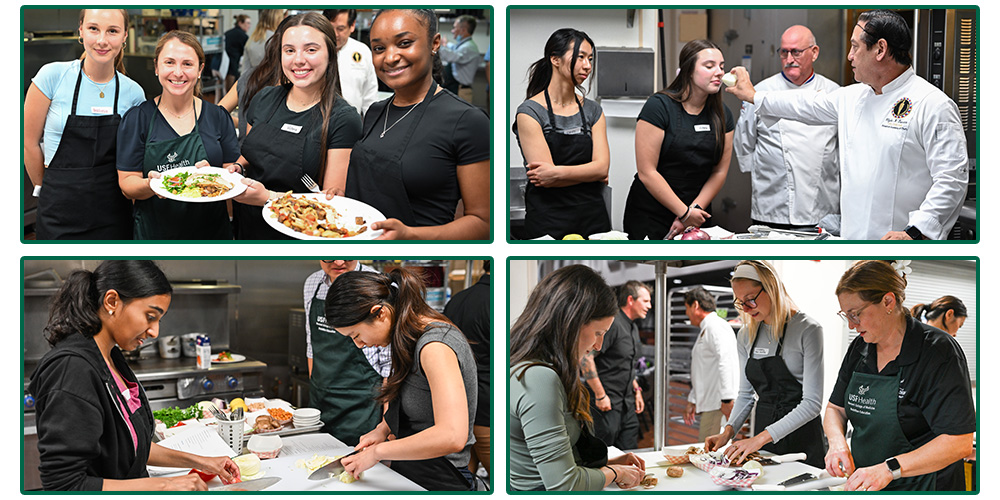
Photos from the Culinary Medicine Lab, April 2026